
Hair Relaxer Settlement Amounts: What Is Confirmed and What Is Not
MDL 3060 is one of the largest active product liability dockets in the country, with 12,381 cases pending before Judge Mary M. Rowland in the Northern District of Illinois. It has produced no settlement, no verdict and no published payout figure of any kind. Every hair relaxer settlement amount you have seen quoted is an estimate someone constructed.
Where the Hair Relaxer Litigation Actually Stands
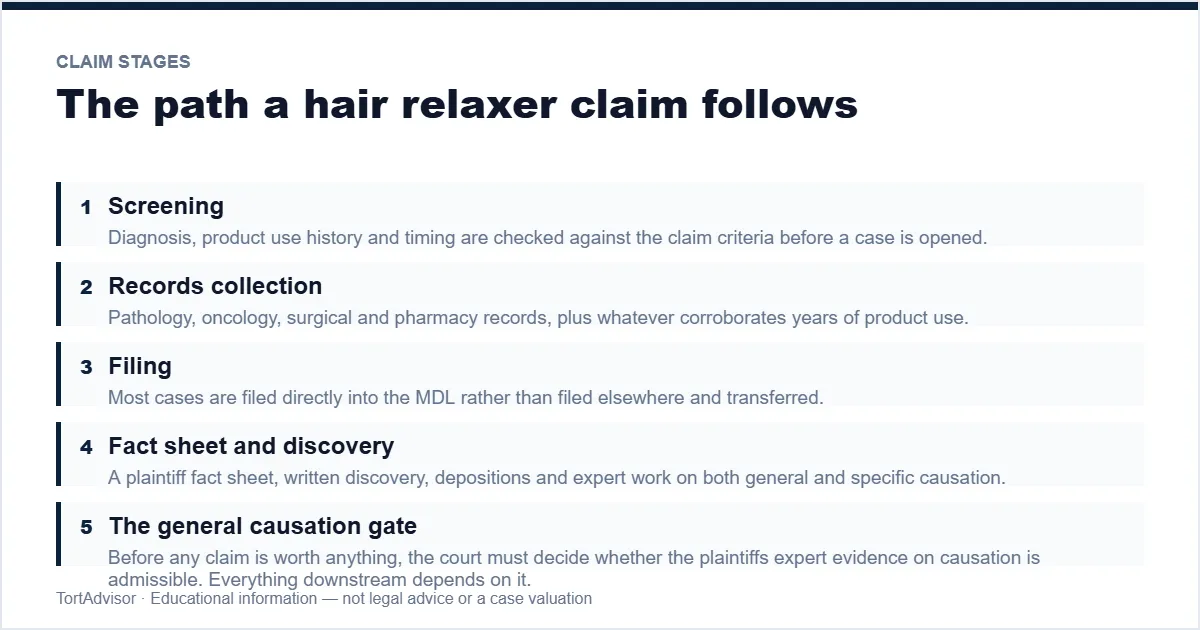
The hair relaxer docket is in the middle of its life, not at the end of it. The sequence below is what the public record shows, with the source for each step.
NIH reported findings from the Sister Study, a cohort of 33,497 US women followed for nearly 11 years, in which 378 uterine cancers were diagnosed. Women who used straightening products more than four times a year were more than twice as likely to develop uterine cancer as women who did not use them. The first hair relaxer lawsuits were filed within weeks.
The Panel centralised nine actions from four districts before Judge Mary M. Rowland in the Northern District of Illinois, noting that 53 actions across nineteen districts were already involved. It named thirteen defendant entities including L’Oréal USA, SoftSheen-Carson, Namaste Laboratories, Strength of Nature and Revlon Consumer Products.
A proposed rule to prohibit formaldehyde and formaldehyde-releasing chemicals in hair smoothing and straightening products entered the Unified Agenda. It has not been issued. It also addresses a different product category from the alkaline relaxers at the centre of this litigation, a distinction covered below.
Researchers following nearly 45,000 Black women for up to 22 years found that postmenopausal women who had used relaxers more than twice a year, or for more than five years, had a greater than 50 percent increased risk of uterine cancer compared with those who never or rarely used them. This is the largest study of the population most affected.
Filings rose past sixteen thousand. The central contest is whether the plaintiffs’ expert evidence that these products cause uterine cancer is admissible. Until that question is resolved, no hair relaxer claim has a settlement value, because neither side knows what the litigation is worth.
The JPML report published that morning shows 12,381 actions pending in MDL 3060 out of 16,828 filed since the MDL was created. No settlement programme, no bellwether verdict and no announced resolution exists.
Confirmed Facts vs. TortAdvisor Editorial Estimates
On the hair relaxer docket the line is unusually clean, because almost everything in the confirmed column is scientific or procedural and almost nothing is financial.
Confirmed public facts
- MDL 3060 exists and is large. Created February 6, 2023 before Judge Rowland in the Northern District of Illinois, with 12,381 actions pending of 16,828 filed.
- Thirteen defendant entities were named in the transfer order, including L’Oréal USA, SoftSheen-Carson, Namaste Laboratories, Strength of Nature, House of Cheatham, PDC Brands and Revlon.
- The Sister Study found more than double the uterine cancer risk among frequent users, across 33,497 women and 378 cases.
- The Black Women’s Health Study found more than 50 percent increased risk for heavy or long-duration use among postmenopausal women, across nearly 45,000 women.
- Absolute risk remains low. NIH put the estimated risk of uterine cancer by age 70 at 1.64 percent for non-users and 4.05 percent for frequent users.
- FDA has a formaldehyde rule on the agenda that has not been issued, and it concerns hair smoothing products rather than alkaline relaxers.
Not established, whatever you have read
- Any hair relaxer settlement amount. There is no settlement, no fund, no administrator and no grid.
- Whether the general causation evidence will be admitted. That question is still live and it governs everything.
- Which ingredient, if any, is responsible. Neither major cohort collected brand or ingredient data.
- When a bellwether will be tried, or whether one will be tried at all.
- Whether any individual claim will be paid. On a docket with no resolution, that is genuinely unknown.
Hair Relaxer Claim Profiles, Without Invented Figures
We publish no dollar range for a hair relaxer claim, because none exists to publish. What follows describes how these claims differ from one another. The profiles carry no figures on purpose.
Advanced or fatal uterine cancer
- Late-stage diagnosis, or death from the disease
- Extensive surgery, chemotherapy and radiation
- Long and heavily documented product use history
- Diagnosis at a comparatively young age
- Substantial economic loss and care costs
Treated uterine cancer with recovery
- Earlier-stage diagnosis treated successfully
- Hysterectomy with or without adjuvant therapy
- Documented but less extensive product use
- Ongoing surveillance and lasting effects
Other alleged injuries
- Uterine fibroids, endometriosis or other conditions alleged in some filings
- Injuries with thinner epidemiological support than uterine cancer
- Shorter or less documented use histories
- Higher risk of not surviving the causation stage at all
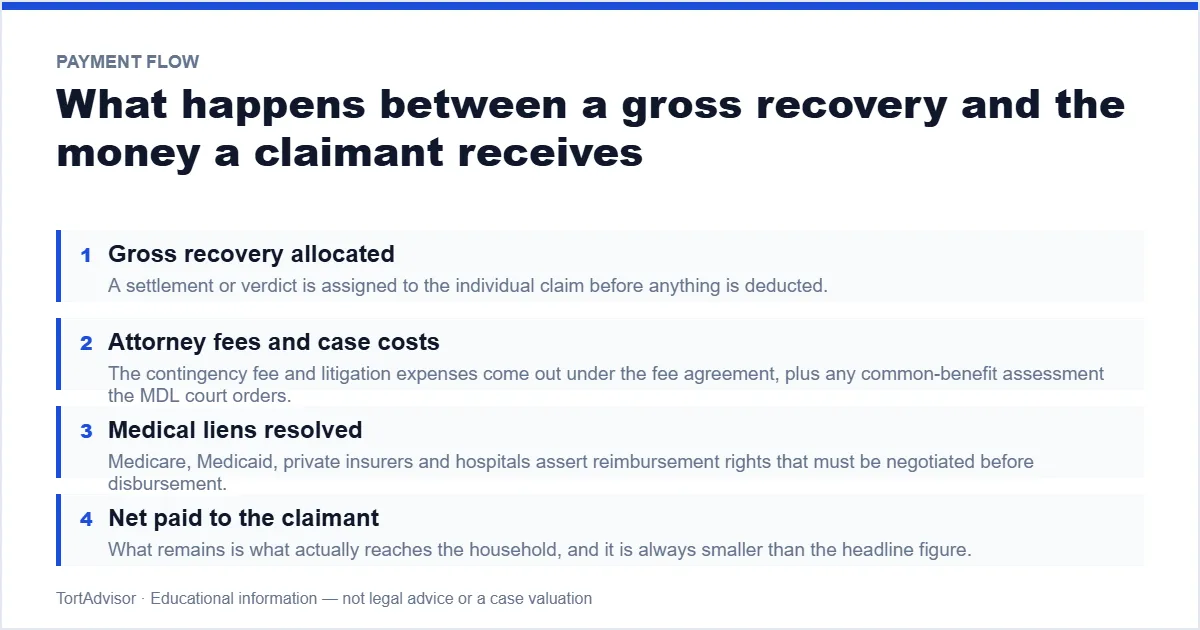
What Would Happen Between a Gross Hair Relaxer Recovery and a Deposit
No hair relaxer claim has been through this yet. It is worth understanding in advance, because the headline figure and the deposit are never the same number.
Allocation
A settlement or verdict is assigned to the individual claim, typically by a matrix or a court-appointed allocator in an aggregate resolution.
Fees and costs
The contingency fee and case expenses come out under the fee agreement, plus any common-benefit assessment the MDL court orders on cases that used the shared work product.
Liens
Cancer treatment is expensive and almost always billed to an insurer. Medicare, Medicaid, private plans and hospitals assert reimbursement rights that must be resolved first.
Net to the claimant
What remains is what reaches the household. On a docket with heavy expert costs, the deduction between gross and net can be larger than people expect.
This flow is descriptive, not predictive. It explains what would happen to a hair relaxer recovery, not that there will be one.
How TortAdvisor Compiles This Hair Relaxer Page
The method behind our hair relaxer research is deliberately narrow, and on a docket with no settlement it mostly consists of refusing to fill the gap.
Controlling court first
Orders from the MDL court outrank every commentary and every firm summary of them.
Then the JPML
Case counts come from the Panel’s own monthly report, never from a site that rounds them up.
Then federal agencies
NIH for the epidemiology, FDA for the regulatory position, each linked so you can check it.
Then peer review
Published cohort studies, quoted with their actual effect sizes and their stated limitations.
The Hair Relaxer Science, Stated Precisely
Because there are no hair relaxer settlement figures to tabulate, the honest thing to put here is the evidence the litigation actually rests on, with its real numbers and its real limits.
| Source | Population | Finding | Stated limitation |
|---|---|---|---|
| Sister Study (NIH/NIEHS), 2022 | 33,497 US women aged 35 to 74, followed nearly 11 years, 378 uterine cancers | Frequent users, more than four times a year, were more than twice as likely to develop uterine cancer | No brand or ingredient data was collected. The relationship did not differ by race. |
| Black Women’s Health Study, 2023 | Nearly 45,000 Black women followed up to 22 years | More than 50 percent increased uterine cancer risk in postmenopausal women with heavy or long use | Observational. The specific causal ingredient is not identified. |
| NIH on absolute risk | Same Sister Study cohort | Estimated risk by age 70 rises from 1.64 percent to 4.05 percent | Uterine cancer remains a relatively rare cancer, which NIH stated explicitly. |
| FDA regulatory position | Hair smoothing and straightening products | A proposed rule to prohibit formaldehyde and formaldehyde-releasing chemicals sits on the Unified Agenda | Not issued, and directed at smoothing products rather than the alkaline relaxers in MDL 3060. |
The distinction that most coverage gets wrong. The FDA formaldehyde proposal concerns keratin-style smoothing treatments that release formaldehyde when heated. The products at the centre of the hair relaxer litigation are alkaline relaxers, and the alleged mechanism there is phthalates and other endocrine-disrupting chemicals, which the JPML named in its transfer order. Treating an unissued formaldehyde rule as regulatory support for the relaxer claims conflates two different products and two different chemistries.
Free Hair Relaxer Case Review
Wondering how the figures on this page relate to your own situation? Share a few details below — a trained case advisor reviews every submission FREE and with no obligation, and your information stays confidential.
- Free — no cost, no obligation
- About a minute to complete
- Reviewed by a trained case advisor
- Nothing you submit is published
Your details are sent over a secure connection and reviewed confidentially.
Why the Third-Largest Docket in the Country Has Produced No Figure
Hair relaxer is the third-largest active products docket in the United States and it has produced no money, no verdict and no settlement of any kind. That combination confuses people, because scale usually implies value. It does not here. MDL 3060 was created on February 6, 2023 and 16,828 actions have been filed into it since, of which 12,381 were pending before Judge Mary M. Rowland in the Northern District of Illinois on October 1, 2026. In three and a half years not one of those cases has been tried, and no defendant has announced a resolution programme. Case volume measures how many people believe they were harmed. It does not measure what a court has decided a claim is worth, and the two are routinely presented as though they were the same number.
The litigation is still at the stage where the science gets decided. Three bellwether cases were selected from the parties’ submissions in April 2026, bellwether-specific fact discovery closed on June 10, 2026, and Daubert and summary judgment motions are due on November 16, 2026. That November deadline is the single most important date in this litigation, because it is where the defendants will argue that the epidemiology does not establish general causation. Until a judge rules on those motions, nobody — not the plaintiffs’ leadership, not the defendants, and certainly not a website — knows whether these claims will reach a jury at all. First trials are broadly expected in 2027.
One figure circulating for this tort deserves direct correction. Litigation trackers report a Revlon bankruptcy reserve of roughly $44 million as though it were an allocated hair relaxer claim fund. Revlon’s bankruptcy did produce a trust, but it is the Old RevCo Talc Personal Injury Liquidating Trust, established on May 2, 2023 to evaluate talc personal injury and wrongful death claims, and it closed to new claims on February 29, 2024. It covers talc, not chemical straighteners. No Revlon fund for hair relaxer claims has been established or disclosed, and a talc trust cannot be cited as a hair relaxer recovery.
The same applies to the per-case ranges that appear on claim-marketing pages, typically presented as $150,000 to $750,000 for a cancer claim. There is no settlement programme, no bellwether verdict and no court-approved matrix in this litigation from which such a band could be derived; it is an attorney’s forecast rather than a reading of any record, and it is offered before the causation ruling that will decide whether any claim has value. This page publishes claim profiles without figures instead. Our hair relaxer lawsuit guide covers eligibility and the named defendants, the hair relaxer settlement calculator organises the product-use and diagnosis records a claim turns on, and the wider settlement amounts library follows the same rule throughout.
Who May Have a Hair Relaxer Claim
These are the criteria the hair relaxer litigation has actually organised itself around, not a promise that any claim will be accepted, survive the causation stage or be paid.
Commonly present in these claims
- A diagnosis of uterine or endometrial cancer, confirmed by pathology
- A history of chemical hair relaxer or straightener use, usually beginning young and continuing for years
- Use frequent enough to matter under the published research, commonly several times a year over an extended period
- Use that preceded the diagnosis by a plausible latency period
- Records or recollection identifying brands, salons or purchase patterns
- A claim brought within the limitation period the relevant state applies
What weakens or complicates a claim
- No usable product use history, which is the most common problem in this litigation
- Very light or short-duration use, where the epidemiology reports little or no elevated risk
- Strong documented alternative explanations in the medical record
- An injury other than uterine cancer, where the published support is thinner
- A limitation period that has already run under the applicable state rule
Eligibility is a legal question that depends on the medical records, the use history and the law of the state involved, and only an attorney reviewing the actual file can answer it. Our hair relaxer lawsuit guide covers the claims and defendants in more detail, and the hair relaxer settlement calculator organises these factors without deciding any of them.
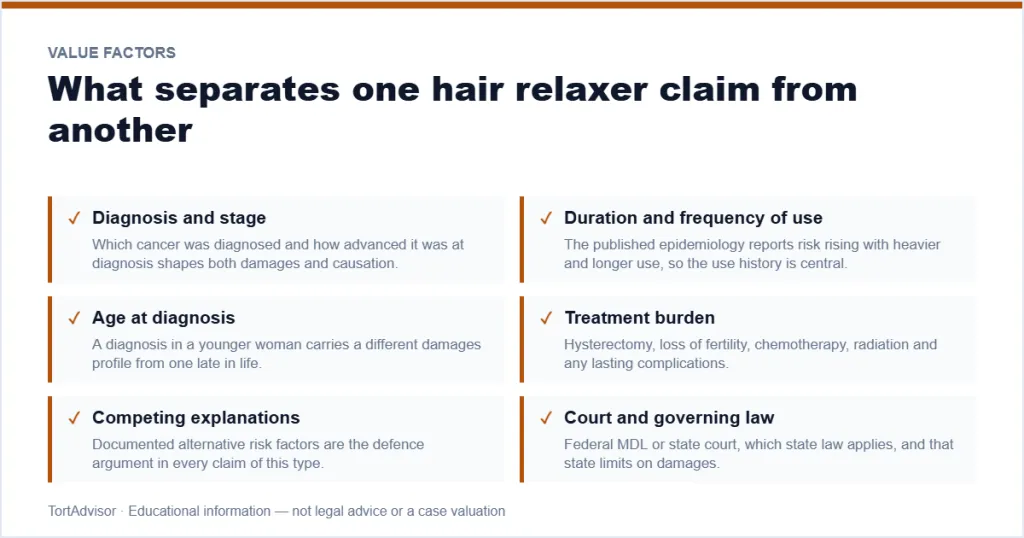
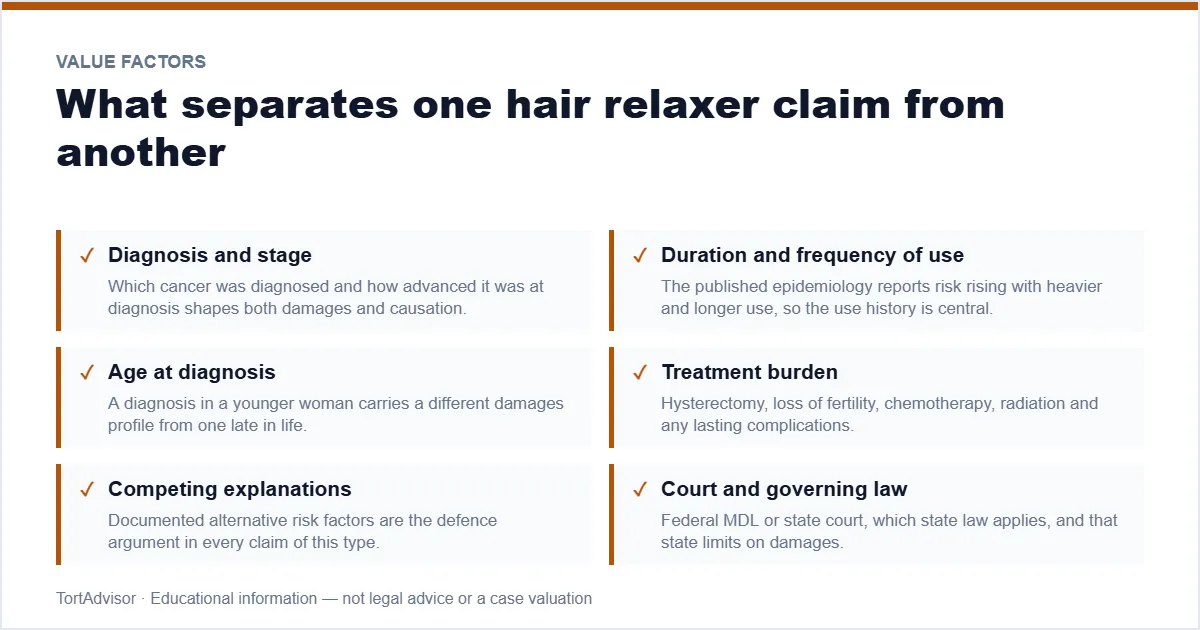
What Would Move the Value of a Hair Relaxer Claim
These are the differences the hair relaxer litigation treats as material. On a docket with no settlement, they describe relative position rather than any amount.
Diagnosis and stage
Which cancer was diagnosed and how advanced it was. Stage drives both the damages and, in practice, how hard the causation argument has to work.
Duration and frequency of use
Both major cohorts report risk rising with heavier and longer use, so a documented decades-long use history is worth more to a hair relaxer claim than any other single fact.
Age at diagnosis
A diagnosis in a woman’s forties carries a different economic and non-economic profile from one at seventy-five, and the litigation treats them differently.
Treatment burden
Hysterectomy, loss of fertility, chemotherapy, radiation and any permanent complication, together with the documented cost of all of it.
Competing explanations
Documented alternative risk factors in the chart are the defence argument in every claim of this type, and how well the record answers them matters.
Court and governing law
Federal MDL or state court, which state’s law applies, and that state’s rules on damages and limitations. Two identical injuries in two states are not two identical claims.
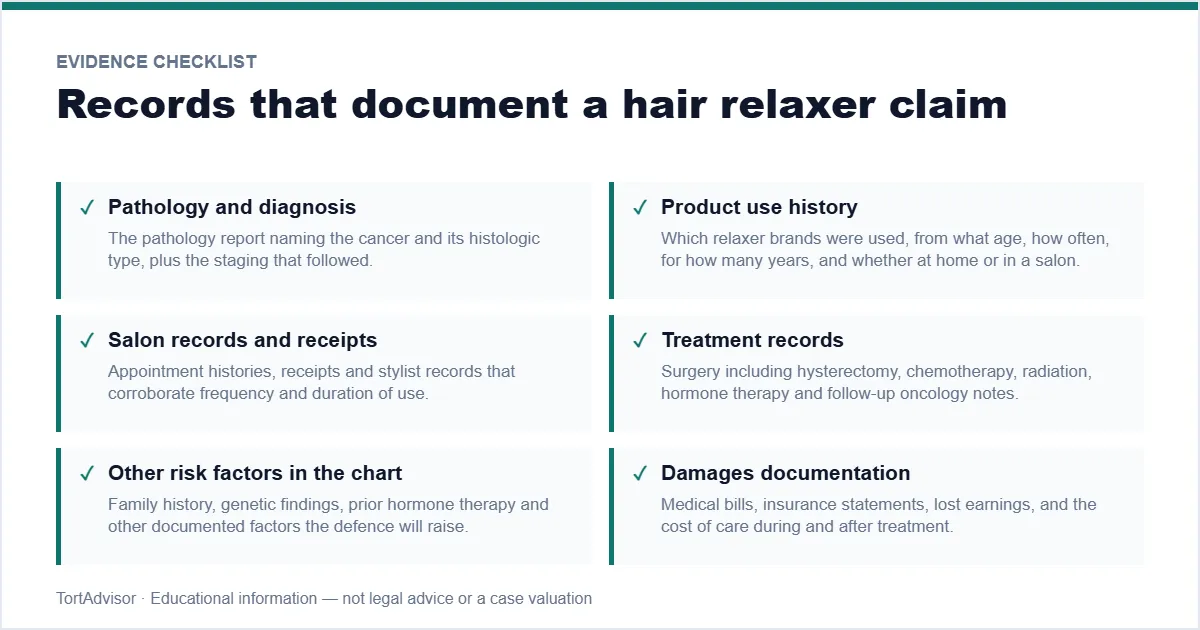
The Records a Hair Relaxer Claim Is Built From
A hair relaxer claim asks for something unusual: a medical record and a personal history stretching back decades. The second half is the part people can still do something about.
Pathology and diagnosis
The pathology report naming the cancer and its histologic type, together with the staging that followed. This is the foundation and nothing substitutes for it.
Product use history
Which relaxer brands were used, from what age, how often, for how many years, and whether at home or in a salon. Write it down now while it can still be recalled accurately.
Salon records and receipts
Appointment histories, receipts, loyalty records and stylist recollection. Anything that corroborates frequency and duration strengthens a hair relaxer claim considerably.
Treatment records
Surgery including hysterectomy, chemotherapy, radiation, hormone therapy and the oncology follow-up that documents what the treatment cost in health terms.
Other risk factors
Family history, genetic findings and prior hormone therapy will be raised by the defence. Knowing what the chart says about them early is better than being surprised by it.
Damages documentation
Medical bills, insurance statements, lost earnings and out-of-pocket costs during and after treatment, which is the part of a claim that is proved with paper.
The use history is the piece only you hold. Medical records can be requested at any time. A memory of which relaxer was used in 1994 and how often cannot be reconstructed from anywhere else, and it degrades every year it is not written down.
Deadlines in a Hair Relaxer Claim
Limitation periods in a hair relaxer lawsuit are unusually easy to get wrong, because the exposure ran for decades and the diagnosis came at a single point in time.
Why time may still be available
- Most states run the clock from the diagnosis, or from when the connection to the product was reasonably discoverable, rather than from the last use
- The discovery rule matters here because the first widely reported study appeared in October 2022
- Cases are generally filed directly into MDL 3060 rather than filed elsewhere and transferred
- The MDL remains open and continues to receive filings
Why time may already have run
- Limitation periods for personal injury claims are commonly two or three years and vary substantially by state
- Wrongful death claims usually run from the date of death and are frequently shorter
- Some states apply a statute of repose that can cut off a claim regardless of when it was discovered
- The publicity following October 2022 may start the discovery clock earlier than a claimant expects
Take the Hair Relaxer Settlement Calculator Below
The calculator organises what you know about the diagnosis, the treatment, the years of product use and the financial loss, then shows which factors carry the most weight. It takes a few minutes and asks for no documents.
The result is educational and is not a guaranteed case value or settlement offer.
Before You Start
- The diagnosis and roughly when it was made
- Which relaxer brands were used, if you recall them
- Roughly what age you started and how often you used them
- What treatment followed, including any surgery
- Any lasting effects and ongoing care
Primary Sources for This Page
Every figure above, and every statement we make about hair relaxer settlement amounts, traces to one of these. We link them so you can check the page rather than trust it.
JPML transfer order creating MDL 3060
The February 6, 2023 order centralising the hair relaxer cases, naming the transferee judge, the thirteen defendant entities and the common questions, including whether exposure to phthalates or other endocrine-disrupting chemicals causes reproductive injury. Read the transfer order (PDF)
JPML pending MDL report
The Panel’s monthly statistics, the source of the 12,381 pending and 16,828 total figures for MDL 3060. See the pending MDL statistics
NIH on the Sister Study
The National Institutes of Health report on the NIEHS Sister Study: 33,497 women, nearly 11 years of follow-up, 378 uterine cancers, more than double the risk among frequent users, and an estimated absolute risk by age 70 rising from 1.64 to 4.05 percent. Chang et al., Journal of the National Cancer Institute, 2022. Read the NIH release
Black Women’s Health Study
Boston University’s report on the largest study of relaxer use among Black women: nearly 45,000 participants followed up to 22 years, with a greater than 50 percent increased uterine cancer risk in postmenopausal heavy or long-duration users. Published in Environmental Research, 2023. Read the study summary
FDA on formaldehyde in hair smoothing products
FDA’s own page on products that release formaldehyde when heated, setting out the acute and chronic effects and the cancer association at high or prolonged exposure. Read the FDA page
The unissued FDA rule, RIN 0910-AI83
The Unified Agenda entry for a proposed rule prohibiting formaldehyde and formaldehyde-releasing chemicals in hair smoothing or straightening products, which remains at the proposed rule stage. See the Unified Agenda entry
Questions People Ask
What is the average hair relaxer settlement amount?
There is no average, because there have been no settlements. MDL 3060 has produced no announced resolution, no bellwether verdict and no compensation grid. Any page giving you a hair relaxer settlement figure has built it from other torts or from nothing at all.
Why do so many sites publish ranges anyway?
Because a range attracts enquiries and nothing stops anyone printing one. The ranges you see are typically borrowed from settled litigations with different products, different science and different defendants. They are not evidence about the hair relaxer docket, and treating them as hair relaxer settlement amounts is how families end up with expectations nobody can meet.
Does the research prove hair relaxers cause uterine cancer?
No, and the researchers do not claim it does. Both major studies are observational cohorts reporting an association, and neither collected data on brands or ingredients. That is precisely the gap the general causation fight in the hair relaxer MDL is about. An association strong enough to publish is not the same as proof admissible in court.
How large is the risk in absolute terms?
NIH put the estimated risk of developing uterine cancer by age 70 at 1.64 percent for women who did not use straighteners and 4.05 percent for frequent users, and stated plainly that uterine cancer is a relatively rare cancer. The relative risk more than doubles; the absolute risk stays small.
Is the FDA banning hair relaxers?
No. A proposed rule on formaldehyde and formaldehyde-releasing chemicals in hair smoothing and straightening products has sat on the Unified Agenda since 2023 and has not been issued. It also targets a different product category from the alkaline relaxers in this litigation.
Which companies are defendants?
The JPML transfer order named thirteen entities, including L’Oréal USA, SoftSheen-Carson, Dabur International, Namaste Laboratories, Strength of Nature, Godrej SON Holdings, House of Cheatham, PDC Brands and Revlon Consumer Products.
How long will this take?
Nobody can say. The MDL was created in February 2023 and by October 2026 had produced no hair relaxer verdict or settlement. Dockets of this size and scientific complexity routinely take longer than the first estimates suggest, and the general causation ruling will reset expectations in both directions.
Does TortAdvisor handle hair relaxer claims?
No. TortAdvisor is a legal research publisher. We do not represent claimants, give legal advice, accept cases or review claims, and using this page or the calculator does not create an attorney-client relationship. Our purpose is to show you what the public record says before you speak with an attorney of your own choosing.
See Which Factors May Affect a Hair Relaxer Claim
Answer the questions you can about hair relaxer use, a uterine cancer diagnosis, treatment, records, expenses and long-term impact. The calculator organizes those inputs into an educational settlement range and highlights the factors that may matter most when a claim is reviewed.
The result is educational and is not a guaranteed case value or settlement offer.
Helpful Information to Have Ready
You do not need every record in hand. Answer what you know; these details can make the estimate more useful.
Reading this page is separate from any request to be contacted. The consent boxes on this form are unchecked unless you tick them yourself.