
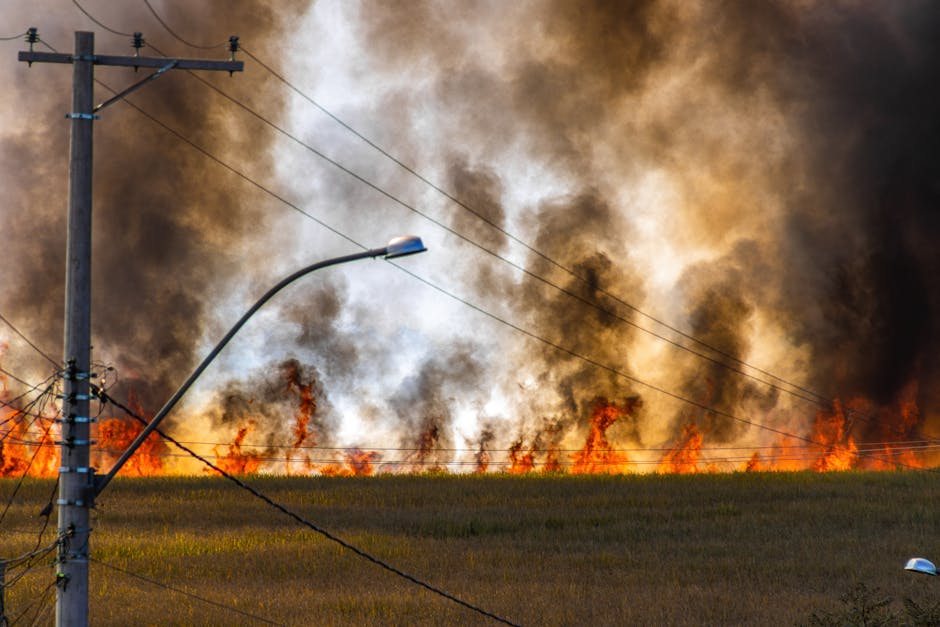

Understanding Your Rights After a California Wildfire
Wildfire lawsuit California options are available for victims of fires caused by utility company negligence. If your property was destroyed or damaged by fires like the Fairview or Dixie Fire, you may be entitled to compensation beyond what your insurance policy pays.
Who Can File a Claim:
- Homeowners and renters with property loss
- Business owners with lost income
- Individuals injured by fire or smoke
- Families who lost loved ones
Common Defendants:
- Pacific Gas & Electric (PG&E)
- Southern California Edison (SCE)
Types of Compensation:
- Property damage and rebuilding costs
- Medical expenses and lost wages
- Emotional distress and trauma
- Alternative living and business losses
This is not a new problem. California utilities have a long history of causing catastrophic fires. PG&E’s equipment sparked the 2018 Camp Fire, which killed 85 people, and the 2021 Dixie Fire. The company paid $13.5 billion to settle claims and faced criminal charges. Southern California Edison has also paid hundreds of millions in settlements for the 2017 Thomas Fire and 2018 Woolsey Fire.
If you’ve suffered losses, you’re likely overwhelmed. Insurance often falls short, with coverage gaps and low limits leaving victims unable to rebuild. The California FAIR Plan, for example, caps coverage at $3 million, often below replacement costs.
Legal action can help. Victims can pursue compensation directly from negligent utility companies to recover the full cost of rebuilding, replacing property, lost income, medical bills, and emotional trauma.
My name is Mason Arnao. While my background is in technology, I’ve spent years researching complex legal issues like wildfire lawsuit California cases. We’ve seen how vital it is for victims to connect with experienced attorneys who can fight for full compensation. Understanding your legal rights is the first step forward.
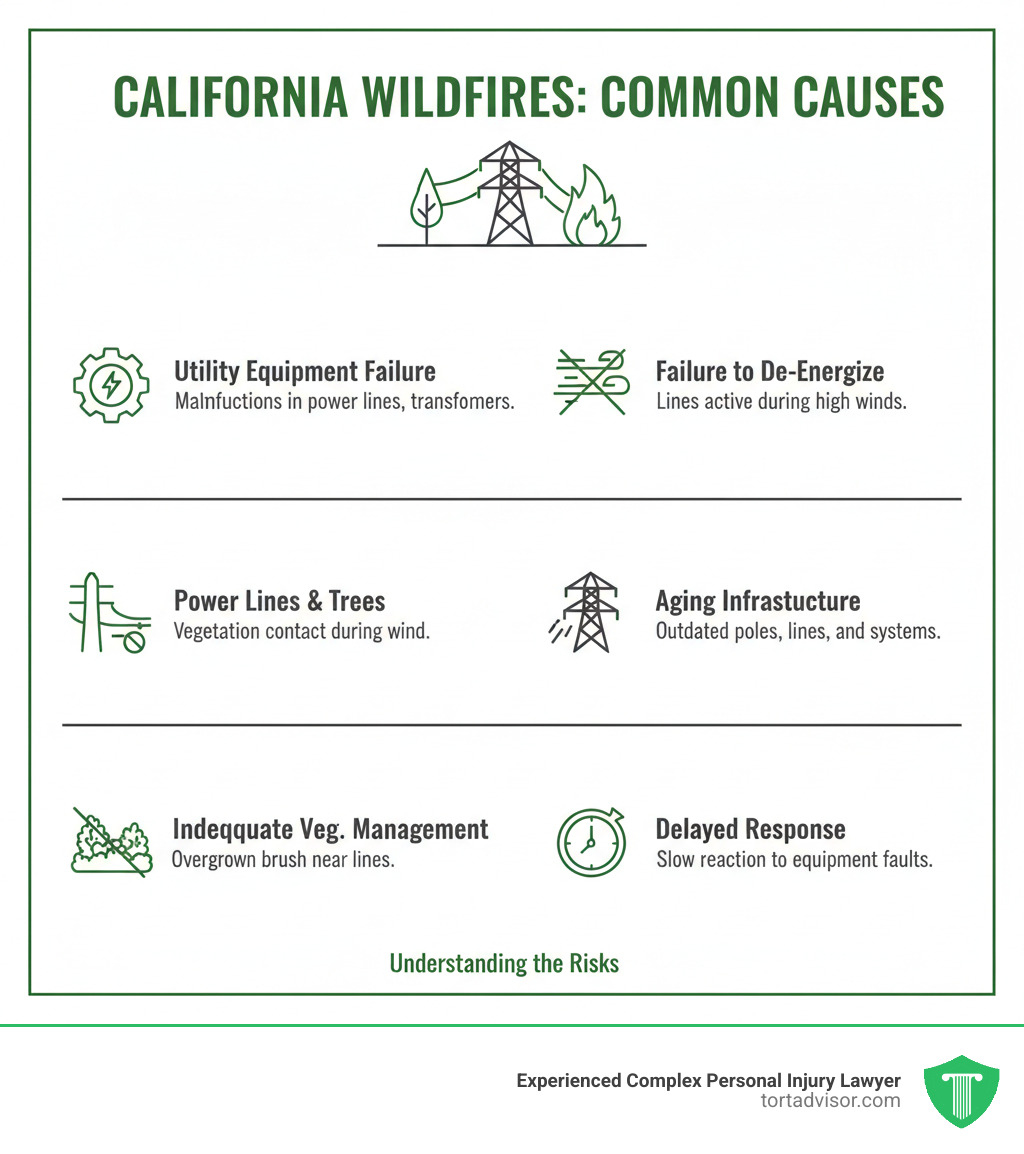
Step 1: Immediate Actions to Take After a Wildfire
The aftermath of a wildfire is overwhelming, but taking practical steps now can protect your legal rights for a future wildfire lawsuit California claim. Your safety is the priority; do not return to your property until authorities declare it safe. Once you can, the actions you take are critical for securing full compensation.
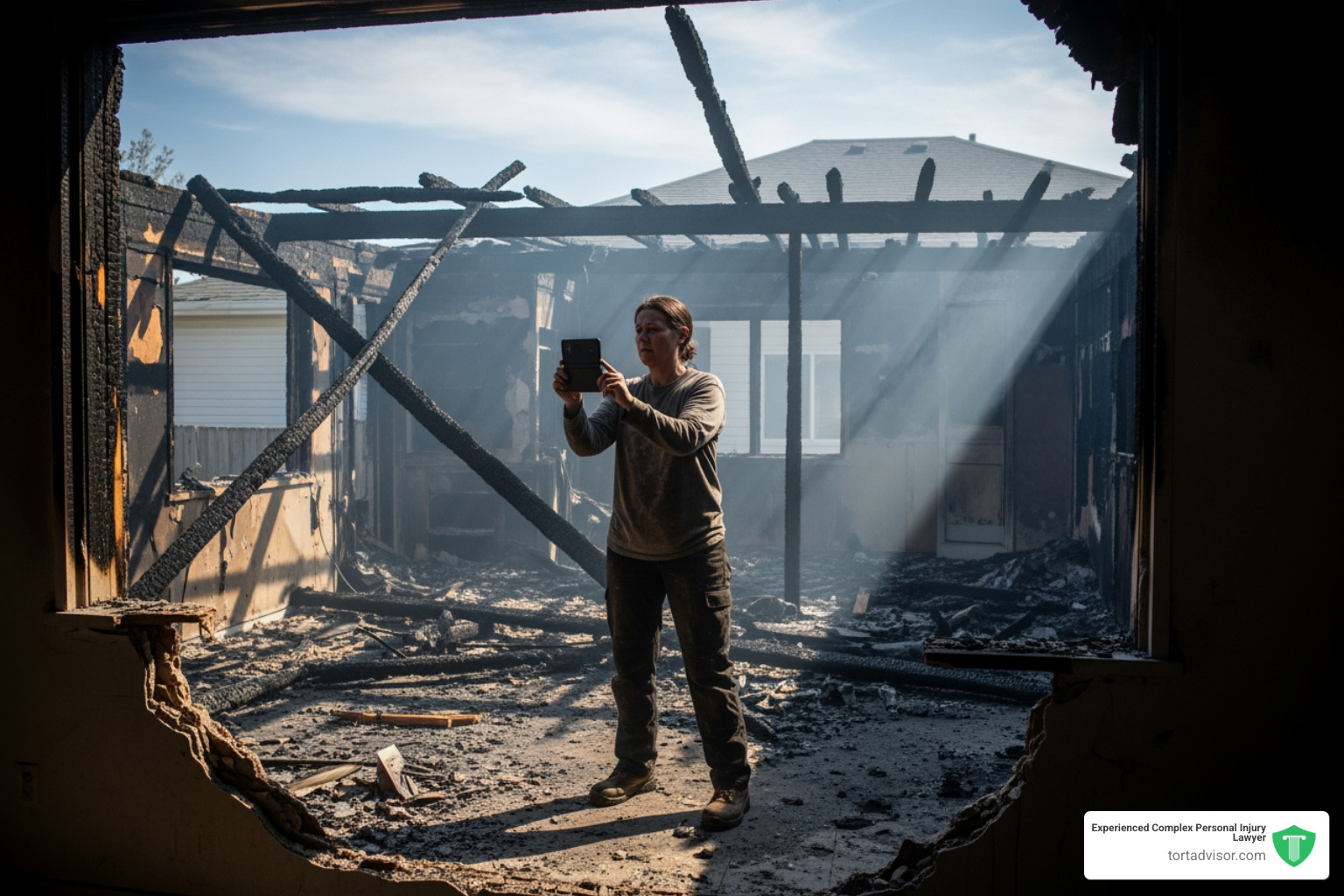
Documenting Your Losses
Think of documentation as building the foundation of your case. Every photo, receipt, and record tells the story of your loss. Though painful, this evidence is essential for seeking compensation.
- Photos and Videos: Take wide shots of the overall damage and close-ups of specific items. Document the exterior and interior of your home, vehicles, and land. Photograph everything, even if it seems completely destroyed.
- Property Records: Gather deeds, blueprints, and renovation records to prove ownership and value. Recent appraisals are especially helpful.
- Inventory List: Create a detailed list of all lost or damaged items, including furniture, clothing, and electronics. Use old photos and credit card statements to help jog your memory and prove ownership.
- Medical Records: Collect all bills and records for injuries, including burns, smoke inhalation, and mental health impacts like PTSD and anxiety.
- Lost Income: Document lost wages with pay stubs or business financial statements if you missed work.
- Repair Estimates: Get estimates from licensed contractors to establish the cost of rebuilding.
- Evacuation Receipts: Save all receipts for hotels, meals, clothing, and other expenses incurred while evacuated.
Our Wildfire Property Damage Claim Complete Guide offers a more detailed checklist for this process.
Dealing with Insurance
Contact your insurance company as soon as it’s safe to do so. File your claim promptly, as most policies have strict deadlines. Before you file, review your policy to understand your coverage limits, deductible, and exclusions for wildfire, smoke damage, and alternative living expenses (ALE).
The hard truth is that insurance companies often underpay or deny valid claims, hoping victims will accept a lowball offer out of desperation. Insurance rarely covers the full scope of your loss. It won’t compensate you for emotional distress, and policies often have caps well below the actual cost to rebuild, especially with the California FAIR Plan.
Do not accept an inadequate settlement. An experienced attorney can challenge a low offer and fight for what you truly deserve. The wildfire lawsuit California process can recover damages far beyond what insurance covers, including health impacts from toxic smoke. Our resource on Wildfire Smoke Damage Claims provides more information on this topic.
Step 2: Identifying Liable Parties in a Wildfire Lawsuit California
After a wildfire, victims naturally ask who is responsible. In California, the answer often points to major utility companies that have a legal duty to safely maintain their equipment. A successful wildfire lawsuit California case typically proves a utility’s negligence caused the fire through faulty equipment, poor maintenance, or failure to de-energize lines during high winds.
California’s inverse condemnation doctrine is also a powerful tool. It can hold utilities liable for damages caused by their equipment even without proving negligence. Because their infrastructure serves a public benefit, they must compensate owners when it damages private property. You can learn more on our California Wildfire Legal Claims page.
PG&E’s History of Wildfires (Dixie, Camp Fire)
Pacific Gas & Electric’s track record highlights the tragic consequences of prioritizing profits over safety.
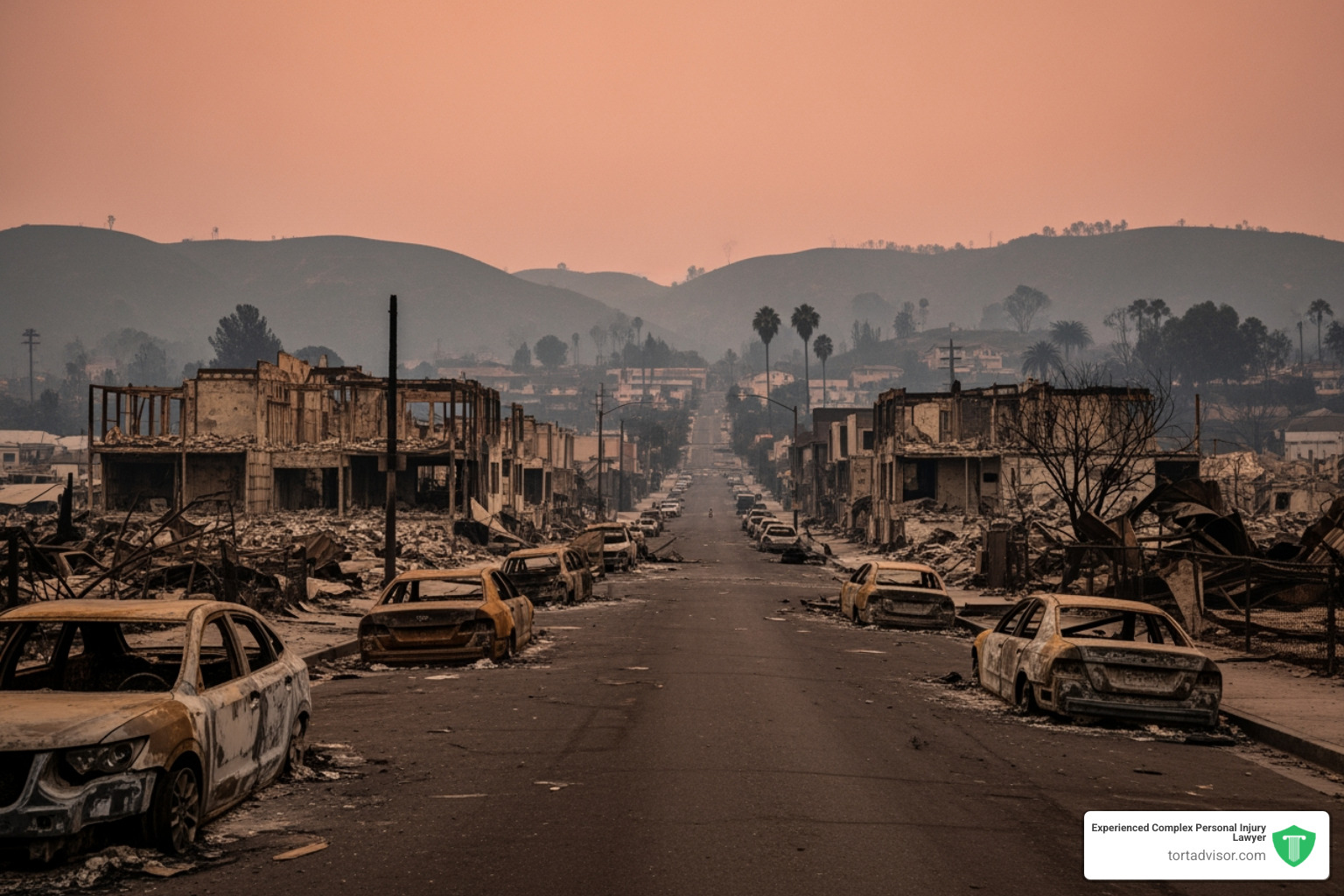
The 2018 Camp Fire, caused by a worn PG&E transmission line, killed 85 people and destroyed the town of Paradise. The disaster forced PG&E into bankruptcy and led to a $13.5 billion settlement for victims. The company also pleaded guilty to 84 counts of involuntary manslaughter.
The 2021 Dixie Fire, California’s second-largest single wildfire, started when a tree fell on a PG&E power line. Cal Fire investigators found PG&E’s delayed response was negligent. Forest landowners filed a $225 million lawsuit for destroyed timber and property, highlighting how the utility’s failures devastated local economies. More details are in this report: Lawsuit Filed Against PG&E for Damages From Dixie Fire.
Southern California Edison (SCE) and Recent Fires (Bobcat, Fairview)
Southern California Edison (SCE) faces similar accusations in the southern part of the state. The U.S. Department of Justice has filed lawsuits against SCE for the 2020 Bobcat Fire and Fairview Fire.
The lawsuit for the 2020 Bobcat Fire alleges SCE’s negligently maintained equipment sparked the blaze, which burned nearly 116,000 acres. The federal government is seeking at least $82.5 million for fire suppression costs and damages.
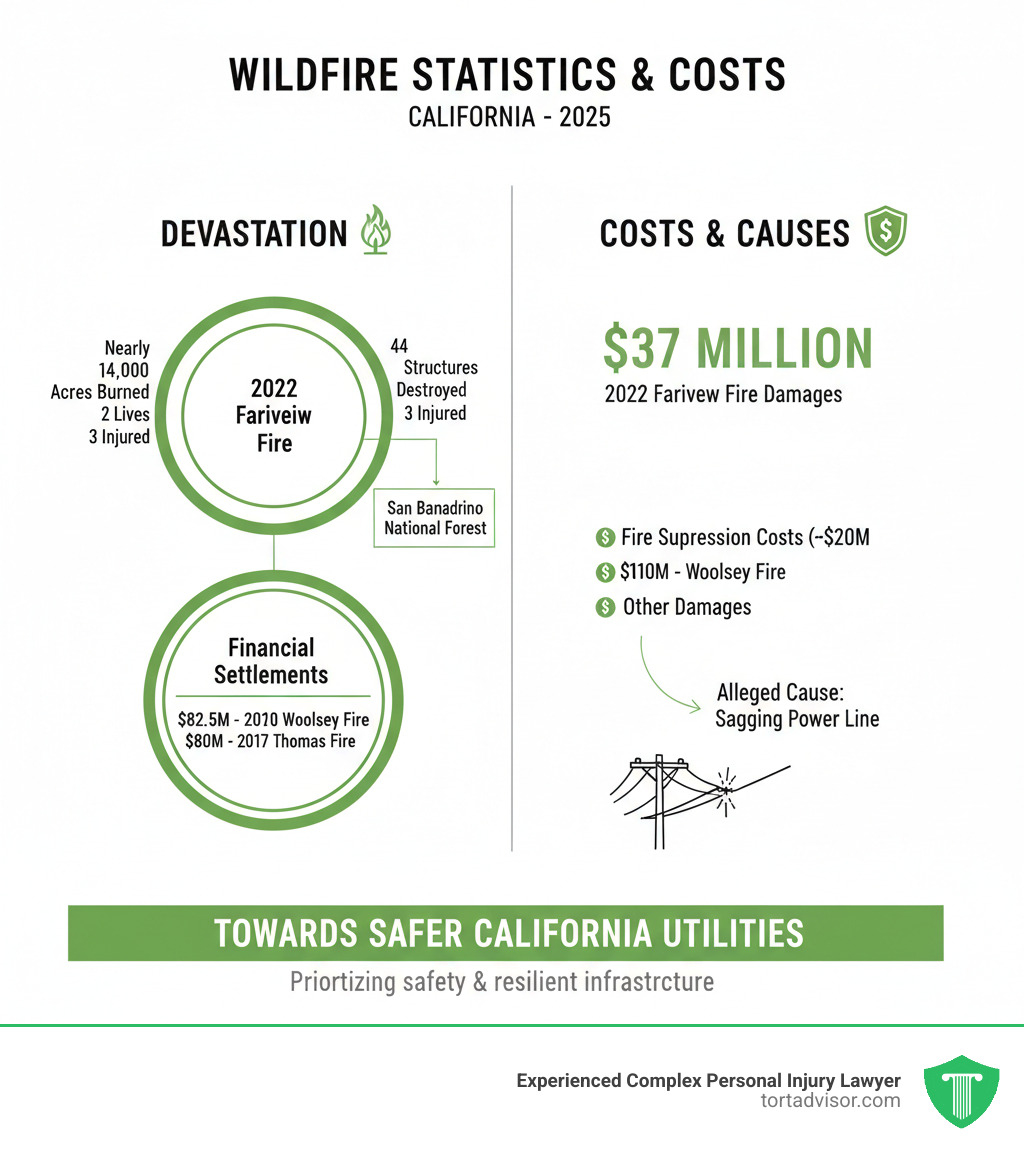
For the 2022 Fairview Fire, which killed two people, the government is seeking $37 million. Investigators determined a sagging SCE power line contacted another cable, creating sparks. Again, the allegation centers on failed maintenance.
This is a clear pattern. SCE has paid massive settlements for other fires, including the 2018 Woolsey Fire ($210 million) and 2017 Thomas Fire ($80 million). As the Acting U.S. Attorney stated, these lawsuits aim to force a “culture change” at the utility. These federal cases strengthen the claims of individual victims. You can review the official lawsuit details here: United States Sues Southern California Edison Co., Seeking Tens of Millions of Dollars in Damages for Bobcat and Fairview Fires.
Step 3: Determining the Compensation You Can Claim
After a wildfire, understanding the full scope of compensation you can claim is crucial for rebuilding your life. A wildfire lawsuit California can help you recover far more than just the value of your home, addressing every way the fire impacted you.
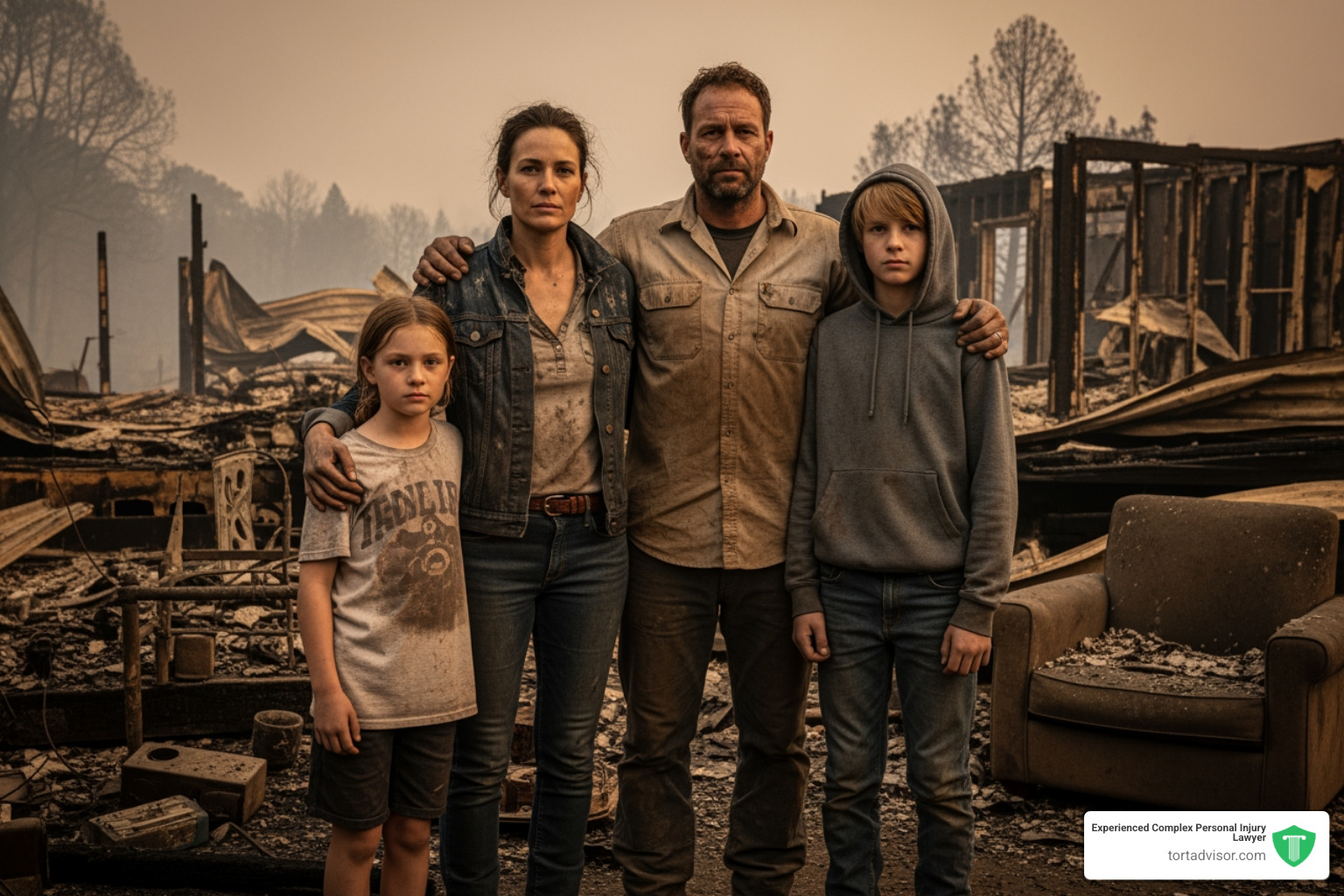
Compensation can cover:
- Property Damage: The cost to rebuild your home, replace all possessions, and restore your land.
- Personal Injuries: Medical bills for burns, smoke inhalation, and long-term health effects.
- Wrongful Death: Funeral expenses, lost financial support, and loss of companionship if a family member was lost.
- Lost Income & Business Losses: Wages you couldn’t earn and damages to your business operations.
- Emotional Distress: Compensation for trauma, anxiety, and PTSD.
- Evacuation Costs: Temporary housing, meals, and other emergency expenses.
To get a preliminary estimate of your claim’s potential value, you can use our California Wildfire Settlement Calculator.
Understanding Economic vs. Non-Economic Damages in a wildfire lawsuit California
Legal claims are divided into two types of damages: economic and non-economic.
Economic damages are tangible, financial losses you can document with receipts and bills. This includes medical expenses, lost wages, and property repair costs.
Non-economic damages compensate for intangible losses that don’t have a price tag, such as pain and suffering, emotional trauma, PTSD, and loss of enjoyment of life. These invisible wounds are just as real as physical ones.
Critically, insurance typically only covers some economic damages. It will not pay for your trauma, anxiety, or grief. A lawsuit is essential to pursue these non-economic damages that insurance companies ignore.
| Type of Damage | Description | Examples |
|---|---|---|
| Economic Damages | Tangible, measurable financial losses with documented proof | Medical bills, lost wages, property repair costs, business income losses, evacuation expenses |
| Non-Economic Damages | Intangible losses without a specific dollar amount but significant impact on quality of life | Pain and suffering, PTSD, anxiety, loss of enjoyment of life, emotional distress, loss of companionship |
The Role of Fire Victim Trusts
When a utility’s negligence causes widespread harm and leads to bankruptcy, a Fire Victim Trust may be created to compensate victims. The PG&E Fire Victim Trust is a prominent example, established to handle claims from the 2015 Butte, 2017 North Bay, and 2018 Camp Fires.
As of late 2024, the Trust has made significant progress, awarding $19.57 billion and paying out $13.70 billion. The payment percentage for claims increased to 70% in October 2024, a major milestone for victims. You can read more here: Fire Victim Trust to Increase Pro Rata Payments to California Wildfire Survivors to 70%.
While these trusts provide a vital pathway to compensation, they operate with a limited fund, meaning victims may not receive 100% of their approved claim value. These mass tort settlements are designed to handle thousands of claims efficiently. Our page on Mass Tort Lawsuit Settlements explains more about how these large-scale cases work.
Step 4: Navigating the Legal Process
Navigating a wildfire lawsuit California can feel complex, but the right legal team makes the path clear. We are here to guide you through every step.
Understanding the statute of limitations is critical. In California, you generally have two years to file for property damage and personal injury, but this can vary. Missing the deadline could mean losing your right to compensation, so consulting an attorney early is vital.
The legal process involves gathering evidence, exchanging information with the other side (findy), and using expert testimony to prove the utility’s fault. Throughout this process, we pursue settlement negotiations to get you fair compensation efficiently. If a fair offer isn’t made, we are prepared to go to trial. Many wildfire cases are consolidated into mass tort litigation, which you can learn about on our Mass Tort Litigation Support page.
How to Start a California Wildfire Legal Claim
Starting your claim is straightforward.
- Free Consultation: Your first step is a no-obligation conversation to discuss what happened and review your options. We’ll listen to your story and answer your questions.
- Case Evaluation: We then dig into the specifics of your case, assessing liability and the full scope of your damages to build the strongest claim possible.
- Hiring an Attorney: If you move forward, you’ll hire an attorney on a contingency fee basis. This means you pay nothing upfront. Our fee is a percentage of the compensation we recover for you. If we don’t win, you don’t pay.
From there, we handle all legal documentation and communications, allowing you to focus on rebuilding. For more guidance, visit our Wildfire Lawsuit Attorney page.
What to Expect in a wildfire lawsuit California
Wildfire litigation can be a lengthy process, but knowing the steps can reduce anxiety.
- Investigation: We collect evidence, interview witnesses, and consult fire experts to build a compelling legal argument.
- Findy: Both sides exchange information through written questions and document requests. We will guide you through this process.
- Depositions: These are formal, out-of-court interviews where you answer questions under oath. We will prepare you thoroughly and be with you the entire time.
- Settlement: Negotiations can happen at any point. Many cases settle before trial, but we will only recommend an offer that fully reflects your losses.
- Timeline: A trial can take months or even years, especially in mass tort cases with many victims. Throughout the process, we provide regular updates and ensure you are always informed.
Our page on How Much Does Mass Tort Lawsuits Receive offers more insight into potential compensation and timelines.
Frequently Asked Questions about California Wildfire Lawsuits
After a wildfire, it’s natural to have questions. Here are answers to some of the most common concerns we hear from victims.
Can I file a lawsuit if I have homeowner’s insurance?
Yes, absolutely. Filing a wildfire lawsuit California is often essential even if you have insurance. Insurance rarely covers the full extent of your losses. Policies have coverage limits, and you still have to pay a deductible. Most importantly, insurance does not compensate for non-economic damages like pain and suffering, emotional trauma, or PTSD.
A lawsuit allows you to seek full compensation for all your losses, including the intangible ones. Many victims use their insurance payout for immediate needs while pursuing a lawsuit to truly rebuild and recover what they’ve lost.
How much does it cost to hire a wildfire lawyer?
It costs nothing upfront. Reputable wildfire attorneys work on a contingency fee basis. This means the lawyer’s fee is a percentage of the settlement or award they secure for you. If we don’t win your case, you generally don’t owe any attorney fees.
This model ensures that everyone has access to top-tier legal representation, regardless of their financial situation. It allows you to fight back against massive utility companies without worrying about hourly legal bills while you’re trying to put your life back together.
How long does a wildfire lawsuit take to resolve?
The timeline for a wildfire lawsuit California varies, ranging from several months to a few years. Several factors influence how long it takes.
- Case Complexity: Proving a utility’s negligence requires extensive investigation, expert analysis, and reviewing thousands of documents, which takes time.
- Number of Victims: Cases with thousands of victims are often consolidated into mass torts. While efficient, coordinating so many claims can extend the timeline. The PG&E Fire Victim Trust, for example, is still processing claims years after the fires.
- Settlement vs. Trial: Many cases settle, which is often faster. However, if the utility disputes fault or makes a low offer, going to trial may be necessary, which significantly lengthens the process.
While waiting is frustrating, rushing to accept an inadequate settlement is a mistake. Our commitment is to secure the fullest compensation you deserve, and we will keep you informed every step of the way. Learn more on our page about How Much Does Mass Tort Lawsuits Receive.
Conclusion: Taking the First Step Towards Justice and Recovery
The path to recovery after a wildfire is challenging, but you don’t have to walk it alone. If utility negligence caused your loss, the legal system offers a way to seek justice and rebuild. Pursuing a wildfire lawsuit California not only helps you recover your losses but also contributes to a larger goal: forcing utilities to prioritize safety.
As the U.S. Attorney’s office stated, “Hardworking Californians should not pick up the tab for Edison’s negligence.” Legal action sends a clear message that negligence has consequences, protecting future communities from similar disasters.
Experienced legal counsel is critical. Wildfire cases are complex and require attorneys who understand the technical evidence and have a proven track record against billion-dollar corporations. Tort Advisor connects victims with specialized attorneys who have won these fights. They work on a contingency fee basis, so you pay nothing upfront.
Rebuilding your life is a marathon. Taking legal action now protects your rights and helps secure the resources you need to fully recover. The statute of limitations is ticking, and evidence must be preserved. The sooner you act, the stronger your case will be.
Your fight for justice starts with a single step: a free, no-obligation consultation. It’s an honest conversation about your options.
For more information and to explore your next steps, please visit our California Wildfire Lawsuit Guide. We are here to help you get the full compensation you deserve.
Free Confidential Case Evaluation
Complete the short form below to get an immediate FREE case review with an expert in your specific claim. Don't wait, your case could be time sensitive to file a claim.
Related Posts

Hire a breast cancer lawyer for misdiagnosis claims. Learn causes, proof, compensation & FAQs in this ultimate guide.
Check your gummy bear implant recall status in 2026. Learn BIA-ALCL risks, FDA updates, recalled models & legal options now.
Find the best pfas attorney near me for PFAS lawsuits. Learn rights, eligibility, settlements & how to choose top local experts now.

Find a consumer product attorney near me in Canada. Expert guide to defective products, claims, top lawyers in Toronto, Montreal & more.
Hire a Tucson auto accident lawyer to prove liability, recover compensation & navigate Arizona laws after your crash. Get expert help now!