


Why Finding the Right Products Liability Lawyers Can Make or Break Your Case
Products liability lawyers help people who have been injured by defective or dangerous products get the compensation they deserve.
Here is a quick overview to help you decide what you need:
| Your Situation | What You Need |
|---|---|
| Injured by a defective product | Plaintiff-side products liability lawyer |
| Company facing a defect claim | Defense-side products liability lawyer |
| Part of a group harmed by the same product | Class action products liability lawyer |
| Cross-border or international claim | Lawyer with multi-jurisdictional experience |
Key facts to know right away:
- Product liability law covers three main defect types: design defects, manufacturing defects, and failure to warn
- You can sue the manufacturer, distributor, retailer, or anyone else in the chain of distribution
- Most lawyers handle these cases on a contingency fee basis – meaning no upfront cost to you
- Statutes of limitations vary by state (for example, New York allows 3 years from the date of injury)
- Both individuals and groups of people can file claims
When a product causes serious harm, the legal system gives you the right to hold the responsible parties accountable. As the Supreme Court of Canada has noted, manufacturers create a relationship of reliance with consumers who have far less knowledge about the dangers a product may carry. That same principle drives product liability law across North America.
The process can feel overwhelming – especially when you are dealing with an injury, medical bills, and lost income all at once. That is exactly why choosing the right legal representation matters so much.
I’m Mason Arnao, and my background in data systems, internet marketing, and lead generation has given me a unique lens for researching and evaluating how products liability lawyers connect with the people who need them most. My experience cutting through complex technical and legal information helps me break down what really matters so you can make a confident, informed decision.
Quick look at products liability lawyers:
Core Legal Theories and Defect Types
When we talk about product liability, we are looking at the legal responsibility that manufacturers, distributors, and retailers have for injuries caused by the products they sell. At its heart, this area of law ensures that if a company puts a dangerous item into the hands of a consumer, they are on the hook for the consequences.
There are three primary legal theories that products liability lawyers use to build a case:
- Negligence: This requires proving that the defendant failed to use “ordinary care” in the design or manufacture of the product. Essentially, they were careless.
- Strict Liability: This is often the most powerful tool for plaintiffs. Under strict liability, you don’t have to prove the company was “careless.” You only need to prove the product was defective and unreasonably dangerous when it left their hands, and that the defect caused your injury.
- Breach of Warranty: This applies when a product fails to live up to the promises made by the manufacturer, whether those promises were written (express) or implied by law.
For a general overview of the doctrine, see Product liability.
Identifying Design vs. Manufacturing Defects
Understanding the difference between these two is vital because the evidence needed for each is very different.
- Design Defects: These are “blueprint flaws.” The product was manufactured exactly as intended, but the design itself is inherently dangerous. If a car is designed with a high center of gravity that makes it prone to rollovers, that is a design defect. Every single unit coming off the line has the same flaw.
- Manufacturing Defects: These are “assembly errors.” The design was safe, but something went wrong during production. Maybe a bolt was left out of a bicycle, or a batch of medication was contaminated. Only a specific item or batch is affected.
For more detailed insights on how these injuries impact your life, you can explore product liability personal injury resources. Navigating these distinctions requires local experts who understand the specific safety standards in your area.
Who Can Be Held Liable in a Claim?
One of the most complex parts of these cases is identifying everyone who should be sued. In the “chain of distribution,” liability can extend to:
- Component Suppliers: The company that made a faulty battery or airbag.
- Manufacturers: The primary company that assembled the product.
- Wholesalers and Distributors: The “middlemen” who moved the product.
- Retailers: Even the store where you bought the item can sometimes be held liable under strict liability.
- Advertisers: If the marketing materials misrepresented the product’s safety.
Navigating this web requires specialized Attorneys for Defective Products who know how to track down every responsible party.
Navigating Complex Litigation and Class Actions

Product liability cases rarely involve just one person and a small local company. They often evolve into massive legal battles involving thousands of plaintiffs and multinational corporations. This is where terms like “class actions” and “mass torts” come into play.
A class action occurs when a large group of people (the “class”) has been harmed by the same product in a similar way. Instead of thousands of individual trials, the court handles common issues in one proceeding. This is common for defective drugs, medical devices, or widespread automotive defects.
The Role of Experts in Proving a Case
You can’t win a product liability case just by saying, “The heater caught fire.” You need experts to explain why. Products liability lawyers work with a network of professionals, including:
- Forensic Engineers: To take apart the product and identify the exact mechanical or electrical failure.
- Medical Professionals: To link your specific injuries to the product defect (causation).
- Accident Reconstructionists: Common in automotive cases to show how a defect led to a crash.
Specialized expertise is a hallmark of a strong legal strategy. Without high-level technical analysis, it’s nearly impossible to overcome the defense teams hired by big corporations.
How Class Actions Impact Product Safety
Class actions do more than just get people paid; they force companies to change. When a manufacturer faces a C$1-billion claim—like the one involving life-saving cardiac devices defended by firms like Blakes—it sends a massive signal to the industry. These lawsuits often lead to recalls and stricter safety standards.
For those navigating these waters, a Defective Product Lawyer Guide can be an essential roadmap. If you are in the Northeast, looking for a Product Liability Lawyer New York will connect you with firms experienced in handling these high-stakes, multi-district litigations.
Comparing Global Standards: US vs. Canadian Law
While the US and Canada share many legal principles, there are key differences, especially when dealing with cross-border litigation. For international manufacturers, navigating these two systems requires a sophisticated defense strategy.
In Canada, firms like Blakes and Lenczner Slaght are recognized as titans in product liability defense. Blakes, for instance, was the first Canadian firm to defend a medical products class action through a 146-day trial to a defense verdict. They also handled a C$80-million fire protection system case that involved 20 different claims and cross-claims.
| Feature | United States | Canada (Ontario Focus) |
|---|---|---|
| Statute of Limitations | Varies (often 2-3 years) | Generally 2 years (Discovery Rule) |
| Strict Liability | Widely applied in most states | Intersected with negligence and contract law |
| Class Actions | Very frequent, multi-district | Increasingly certified in product cases |
| Damages | Can include high punitive awards | Punitive awards are generally lower/rarer |
Industry-Specific Expertise in Pharma and Auto
Leading products liability lawyers don’t just know the law; they know the industry.
- Pharmaceuticals: Cases involving Ozempic, Suboxone, or talcum powder require deep knowledge of FDA/Health Canada regulations and clinical trial data.
- Automotive: Defending or prosecuting claims regarding airbags, brakes, or autonomous driving software requires an understanding of manufacturing blueprints.
- Medical Devices: Pelvic mesh, hip replacements, and cardiac monitors are high-frequency areas for litigation.
If you are dealing with an injury in the Garden State, a New Jersey Defective Product Injury Attorney can provide localized expertise in these specific industrial sectors.
Defense Strategies for International Manufacturers
On the defense side, the goal isn’t just winning in court—it’s risk management. Top-tier firms advise businesses on:
- Regulatory Compliance: Ensuring products meet all safety standards before they hit the shelf.
- Warning Labels: Crafting “failure to warn” defenses by proving that instructions were clear and comprehensive.
- Reputation Management: Handling the public relations fallout of a major recall or lawsuit.
Local guides, such as the Jersey City Defective Product Injury Guide, often highlight how these defense strategies play out in specific jurisdictions.
Choosing the Right Products Liability Lawyers for Your Case
Selecting a lawyer is the most important decision you will make. You need to decide between a plaintiff-side lawyer (who helps the injured) or a defense-side lawyer (who protects the company).
Look for these credentials:
- Peer Rankings: Check the Canadian Legal Lexpert Directory, Chambers Canada, or Best Lawyers.
- Ratings: Look for Super Lawyers or Martindale-Hubbell AV-Preeminent ratings.
- Trial Experience: Ask how many product liability cases they have actually taken to a jury. Many firms settle, but you want a lawyer the other side fears in a courtroom.
If you are in the South, an Atlanta Product Liability Attorney with a strong track record of results is your best bet for navigating Georgia’s specific tort laws.
What is the statute of limitations for products liability lawyers to file?
Timing is everything. If you miss the deadline, your case is over before it begins.
- New York: Generally 3 years from the date of the injury or the date you discovered the injury.
- Discovery Rule: This is crucial for “latent injuries” (like illnesses caused by long-term chemical exposure) where the clock doesn’t start until you actually know you are sick.
Consulting a Product Liability Lawyer New Mexico or an expert in your specific state is the only way to ensure you meet these strict filing requirements.
How do products liability lawyers calculate damages?
When we build a case for compensation, we look at several categories:
- Economic Damages: Medical bills, future rehabilitation costs, and lost wages (both past and future).
- Non-Economic Damages: Pain and suffering, emotional distress, and loss of enjoyment of life.
- Punitive Damages: These are rare and intended to punish the company for especially reckless or intentional misconduct.
Experienced Defective Product Lawyers use life-care planners and economists to ensure that the settlement covers your needs for the rest of your life.
Frequently Asked Questions about Product Liability
What evidence is needed to prove a product liability case?
You generally need the product itself (do not throw it away!), receipts or proof of purchase, medical records documenting your injury, and expert testimony showing that the product was defective. Photos of the accident scene and the product’s packaging/warnings are also vital.
How has AI and software changed product liability law?
This is the new frontier. As software becomes a “product” (like in self-driving cars or AI medical diagnostics), courts are debating whether software errors count as “manufacturing defects” or “design flaws.” Modern products liability lawyers must stay updated on these evolving technological standards.
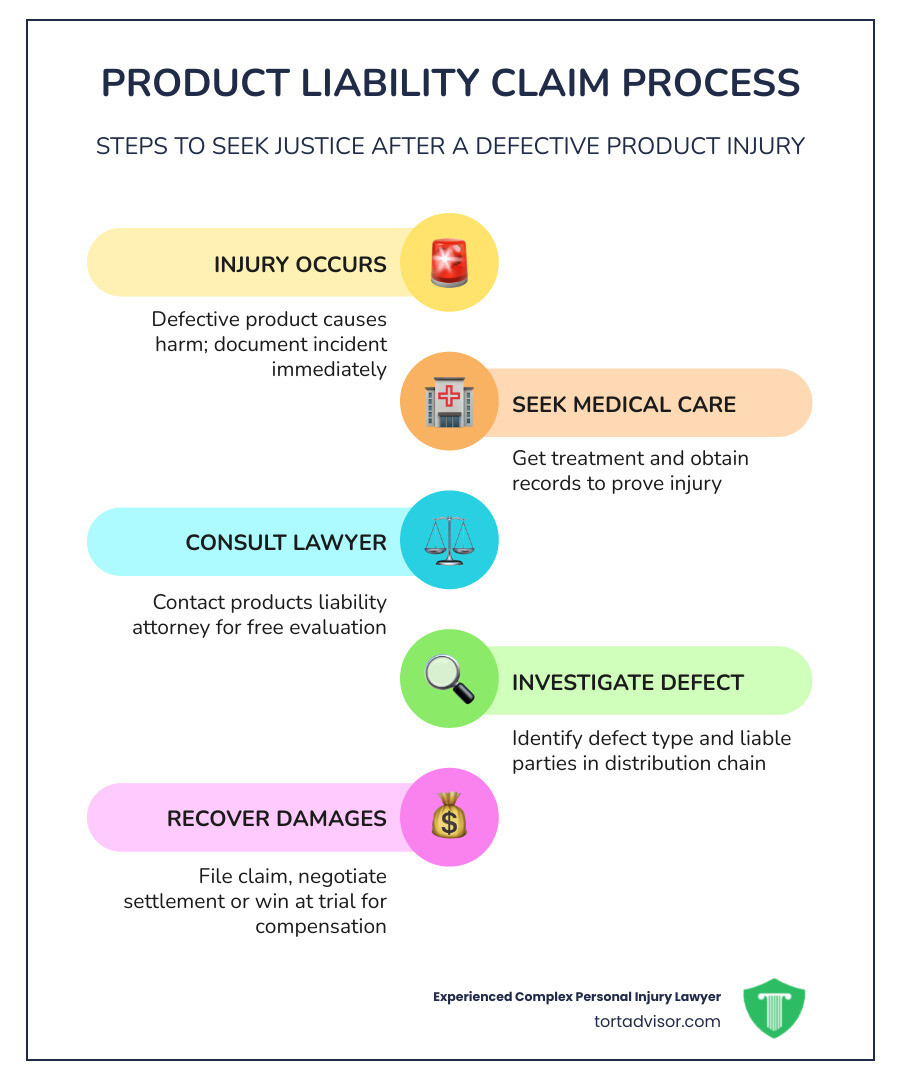
What should I do immediately after a product injury?
- Seek Medical Care: Your health is the priority, and medical records are evidence.
- Save the Product: Keep it in a safe place. Do not try to “fix” it or take it apart.
- Keep Packaging: The box, the manual, and the warnings are all evidence.
- Document Everything: Take photos and write down exactly what happened while it’s fresh in your mind.
- Contact an Attorney: Do not talk to the manufacturer’s insurance company until you have legal representation.
Conclusion
Dealing with a defective product injury is a life-altering event. Whether it’s a household appliance that caught fire or a medical device that failed, the path to justice requires a deep understanding of complex legal theories and a network of technical experts.
At Tort Advisor, we connect clients with top-rated specialty attorneys who have proven results in these difficult cases. We work exclusively with highly skilled professionals to ensure you have the best possible chance at a favorable outcome.
If you or a loved one has been harmed, don’t wait. Preserve your evidence, seek medical attention, and reach out to experienced Defective Product Lawyers to protect your rights and your future.
Free Confidential Case Evaluation
Complete the short form below to get an immediate FREE case review with an expert in your specific claim. Don't wait, your case could be time sensitive to file a claim.
Related Posts

Find top products liability lawyers for defective product claims. Expert guides on defects, class actions, statutes & compensation.

Explore your california wildfire arson neighbor lawsuit options: Palisades Fire case, liability proof, claims vs charges, and victim recovery.

Discover why Utah car accidents are spiking, explore stats & laws, and learn safety steps to protect yourself.
Hire a breast cancer lawyer for misdiagnosis claims. Learn causes, proof, compensation & FAQs in this ultimate guide.
Check your gummy bear implant recall status in 2026. Learn BIA-ALCL risks, FDA updates, recalled models & legal options now.
Find the best pfas attorney near me for PFAS lawsuits. Learn rights, eligibility, settlements & how to choose top local experts now.