
Left Turn Motorcycle Accident: Who Is at Fault and Why
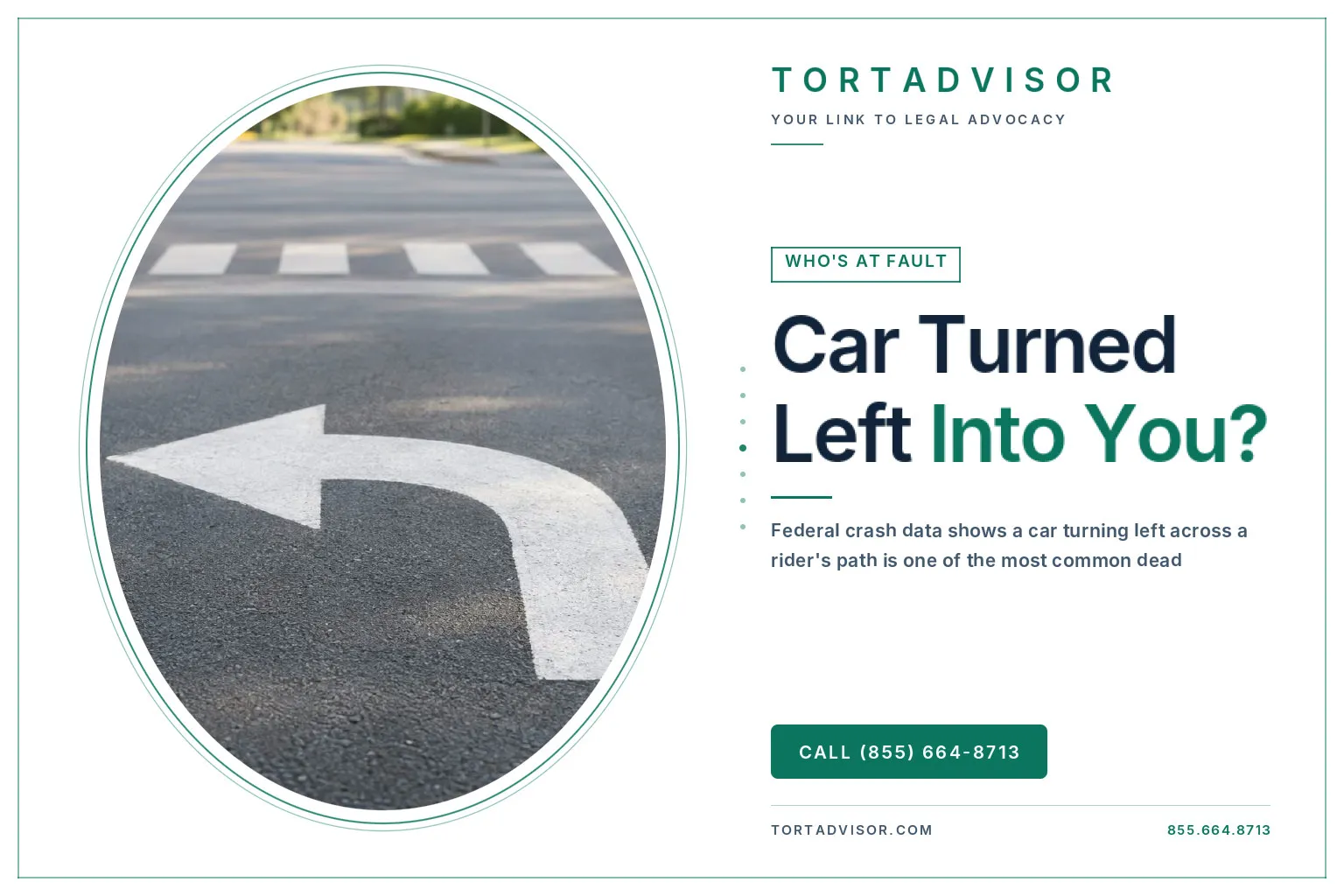
No, a driver who turns left in front of you is not automatically at fault, but in a left turn motorcycle accident the turning driver often has a lot to explain, because many state right-of-way statutes set out when drivers must yield. If the driver or their insurer says you were partly to blame, you may still have a claim: most jurisdictions now use comparative negligence, which lets an injured person who was partly at fault recover the other side’s share, though Maryland, Virginia, Alabama and North Carolina still follow the stricter contributory negligence rule.
If this happened to you, you are far from alone. In 2024, NHTSA counted 3,396 fatal two-vehicle motorcycle crashes, and 1,532 of them involved the other vehicle turning left while the motorcycle was going straight, passing or overtaking. Federal safety investigators have also found that other drivers often reported not detecting the motorcycle before a crash.
This guide covers what the latest federal data shows about left-turn crashes, why they happen, how yielding rules apply to motorcycles, and what evidence can show who had the right of way. It also explains how comparative fault works if you are accused of speeding or poor lane position, and the practical next steps to consider after a driver turned left in front of you.
Find out if you may have a claim
Answer a few questions and a trained case advisor will review your situation — most people finish in about a minute.
- Free — no cost, no obligation
- About a minute to complete
- Reviewed by a trained case advisor
- Nothing you submit is published
Your details are sent over a secure connection and reviewed confidentially.
Who is usually at fault in a left turn motorcycle accident?
The driver who turned left is often the main focus, because the turn crossed the path of the oncoming motorcycle. That does not make the driver automatically at fault. Fault depends on what actually happened and on the law of the state where the crash occurred.
In traffic law, right of way means the right to proceed, and many state statutes spell out when drivers must yield. Your state’s yielding rules are where any fault analysis begins.
Federal safety guidance points in a similar direction. NHTSA’s Share the Road guidance says motorcyclists have the same rights as other drivers. It notes that motorcycles are smaller and harder to see, and it tells drivers to look for motorcyclists before turning left at an intersection. The same guidance also expects riders to obey signs and signals, so the actions of both people matter.
What actually decides fault
- Signal phase: what the light or sign showed each person at the moment of the turn.
- Speed: how fast the motorcycle and the turning vehicle were moving.
- Visibility: whether glare, other vehicles, curves or hills blocked anyone’s view.
- Each person’s actions: signaling, lane position, braking and attention.
The type of turn does not settle the question. An insurance adjuster weighs the evidence and assigns fault, and if a case goes further, a court decides. Results vary from case to case. No one can promise an outcome based only on how a crash happened.
For the wider picture, including how fault fits into a claim for your injuries, see our motorcycle accident lawsuit guide.
If you are dealing with an insurer right now, a step-by-step guide on how to file a motorcycle accident insurance claim explains which policies pay and what evidence protects the claim.
Motorcycle left turn crash statistics: what NHTSA’s 2024 data shows
The latest federal figures show how often a driver turning left plays a part in a deadly motorcycle crash. In 2024, close to half of all fatal crashes between a motorcycle and one other vehicle involved that vehicle turning left while the rider was going straight, passing or overtaking. The numbers below come from NHTSA’s Traffic Safety Facts 2024 Data: Motorcycles fact sheet (DOT HS 813 824).
| Measure (data year 2024) | Figure |
|---|---|
| Motorcyclists killed | 6,228 |
| Share of all traffic deaths | 16% |
| Motorcyclists injured (estimate) | About 86,887 |
| Fatal crashes involving a motorcycle and one other vehicle | 3,396 |
| Of those, crashes where the other vehicle was turning left while the motorcycle went straight, passed or overtook | 1,532 (about 45%) |
| Motorcycles in fatal two-vehicle crashes that were hit on the front | 78% |
How to read these numbers
The death counts and the crash-type breakdown describe fatal crashes only. They come from NHTSA’s Fatality Analysis Reporting System (FARS), a record of crashes in which someone died. They do not show how many non-fatal left-turn crashes happen each year.
The injury figure works differently. It is an estimate, not a case-by-case count, so treat it as an approximate picture of how many riders were hurt.
Two more points matter if you were hurt in a crash like this:
- The 45% figure describes how these crashes happened. It does not decide who was legally at fault in any single crash.
- The high share of front impacts fits the classic pattern: a rider moving forward meets a vehicle turning across their path.
Why left-turn crashes with motorcycles happen
Federal research points to one cause above others: the other driver often does not see the motorcycle in time. That finding doesn’t decide who is at fault in a particular crash, but it helps explain why so many left-turn collisions follow the same pattern.
What the NTSB found
The National Transportation Safety Board studied this in its 2018 safety report on risk factors in motorcycle crashes. The report drew on data from the Federal Highway Administration’s Motorcycle Crash Causation Study. Its key findings included:
- Detection problems: In many multiple-vehicle crashes, the other driver said they did not detect the motorcycle or did not realize there was a danger.
- Driver error: Of the multiple-vehicle crashes the NTSB analyzed, 64% were attributed to an error by the other vehicle’s driver. This figure covers multiple-vehicle crashes in general, not only left-turn crashes.
- Prevention: The NTSB concluded that many of these conflicts could be avoided if drivers were better at detecting motorcycles when turning, crossing or changing lanes.
Why motorcycles are easy to miss
Size and visibility play a part. NHTSA’s Share the Road guidance notes that motorcycles are smaller and harder to see than other vehicles. A rider can be hidden by traffic or other objects, or simply overlooked by a driver who is scanning for cars and trucks.
None of this means every driver is careless or every rider is blameless. It does explain why “I didn’t see the motorcycle” comes up so often after a left-turn crash. It also explains why that statement usually raises questions rather than settling them.
How this differs from other crash types
Fault questions change with the type of collision. In a left-turn crash, the focus is usually on whether the turning driver yielded and why they missed an approaching rider. If you want a comparison, our guide explains how fault works in rear-end collisions, where the questions look quite different.

Left turn right of way and the motorcycle: how yielding rules apply
In most left-turn crashes, the key question is simple: who had the right to go first? In traffic law, right of way means the right to proceed, and many state statutes spell out when a driver must yield. A driver turning left across oncoming traffic is often the one expected to wait. Whether that applies to your crash depends on the facts and on your state’s rules.
Why your state’s rules matter
Each state writes its own vehicle code. The exact wording, the exceptions and the penalties for failing to yield can differ from one state to the next. Some details that can change the analysis:
- Signals and arrows: how a turn arrow, flashing signal or plain green light affects who must yield
- Signs and markings: stop signs, yield signs and turn-lane markings at the intersection
- Exceptions: situations where the usual yielding rule does not apply
To understand how the rules apply to your crash, look up your own state’s vehicle code or talk with a licensed attorney in your state.
A motorcycle has the same right of way as a car
A motorcycle is not a lesser vehicle on the road. NHTSA’s Share the Road guidance says motorcyclists have the same rights as other drivers. It tells drivers to look for motorcycles before turning left at an intersection.
The same guidance says riders must obey signs and signals too. That is why an insurer or the other driver may raise questions about what you were doing as you approached, such as whether you had a green light or stopped where required. Those questions do not automatically shift the blame to you, but you should expect them as fault is sorted out.
Evidence in a left-turn motorcycle crash: what can show who had the right of way
Left-turn crashes often come down to two different stories about the same few seconds. Evidence that doesn’t depend on anyone’s memory can help show what really happened. This matters because, in a National Transportation Safety Board review of motorcycle crash causes, drivers of the other vehicle often reported that they never detected the motorcycle. A claim that you “came out of nowhere” is easier to test when there is independent proof of sight lines, speed and timing.
These are the kinds of evidence commonly used to rebuild a left-turn crash:
- The police crash report: the officer’s notes, diagram, and any statements or citations recorded at the scene.
- Photos of where the vehicles ended up and their damage: the resting positions, debris, skid marks and the impact points on both vehicles. Front-end damage to the motorcycle is common in these crashes. NHTSA’s 2024 motorcycle data reports that 78% of motorcycles in fatal two-vehicle crashes were hit in the front.
- Signal timing and intersection layout: whether there was a green arrow or a regular green light, the number of lanes, any curves or hills, and objects that could block a driver’s view.
- Witness contact details: names and phone numbers of people who saw the crash, collected before they leave the scene.
- Dashcam or helmet-cam video: footage from your own camera or from other drivers who stopped.
- Nearby business video: security cameras at gas stations, stores or banks facing the intersection. These recordings may be overwritten, so it helps to ask early.
- Medical records made soon after the crash: emergency room and follow-up notes that connect your injuries to the collision.
No single item settles the question of fault. Together, though, they can give a clearer picture than one driver’s account. If you want background on how motorcycle and other vehicle cases have turned out where you live, you can browse motor vehicle verdicts and settlements by state. Past results reflect the facts of those cases and don’t predict what any one claim is worth.
Comparative fault in a motorcycle accident: if you’re blamed for speeding or lane position
Being blamed for part of a crash does not automatically end your claim. What happens next depends mostly on the shared-fault rule in the state where the crash happened. In some states, any fault on your part can block recovery. In most, it reduces what you can recover instead.
The two basic approaches
| Rule | What it means for an injured rider | Where it applies |
|---|---|---|
| Contributory negligence | A plaintiff who was negligent at all cannot recover. | Maryland, Virginia, Alabama and North Carolina still follow it. |
| Comparative negligence | A plaintiff who was partly negligent can still recover the defendant’s share of the blame. | Most jurisdictions. |
Both rules come from the Cornell Legal Information Institute’s explanation of contributory negligence, which describes the shift away from the strict older rule.
Why your own state’s rule matters
Comparative negligence is not one single rule. States use different versions, and the details can change how much a fault finding affects your claim. Check the rule in the state where the crash happened, either by reading that state’s own statutes or by asking a licensed attorney there.
Arguments a rider might hear
A driver’s insurer may try to shift some of the blame onto you. It might argue that you were:
- Going faster than was safe as you approached the intersection
- Riding in a lane position that made you harder to see
- Hard to spot because of lighting or what you were wearing
These are only possible arguments. They are not findings. Raising one does not prove you were at fault, and the evidence will decide whether any of it holds up.
To understand how a shared-fault finding can fit into a claim, read how injury settlement amounts are figured. You can also try TortAdvisor’s injury settlement calculators for a general starting point. Calculator results are estimates, not predictions of what you will receive. If you’re unsure how these rules might apply to your situation, you can contact the TortAdvisor team.

Next steps if a driver turned left in front of you
Start with your health. Get checked by a medical professional, even if you feel you can manage, and keep every record: visit notes, imaging, prescriptions, receipts and work notes. These records show what the crash did to you.
Next, protect the evidence you already have:
- Keep everything from the scene: photos, the police report number, names and phone numbers of witnesses, and any dashcam or helmet-cam footage.
- Do not repair or throw away your bike or gear until you know whether anyone needs to inspect them.
- Write down what you remember while it is fresh: the color of the signal, how fast you were going, where you were in the lane, and when you first saw the turning car. Date the notes. Small details fade quickly.
Deadlines and fault rules are not the same everywhere. Most states use some form of comparative fault, but a few states still follow contributory negligence, and filing deadlines also differ from state to state. A licensed attorney in your state can tell you which rules apply to your case.
If you want a general picture of the process before you talk to anyone, a guide to personal injury claims explains how to find the insurer or party that pays, how injuries and losses are proven, and the deadlines that can end a claim.
When people think about damages, they usually look at concrete costs such as medical bills and lost income, plus harder-to-measure harms like pain and lasting limits on daily life. Our settlement amounts hub explains how these pieces are usually weighed. TortAdvisor’s settlement calculators can give you a rough educational estimate. They do not predict what your claim is worth.
If you have general questions about our research, you can reach us through our contact page. TortAdvisor is not a law firm and cannot give legal advice about your situation.
Keep researching on TortAdvisor
Frequently asked questions
Is the left-turning driver always at fault in a motorcycle crash?
Not always, but the driver turning left often carries much of the blame. In traffic law, right of way is the right to proceed, and many state statutes spell out when drivers must yield. A driver turning across oncoming traffic usually has to wait for a safe gap. Fault still depends on the facts, such as signals, speed, visibility and what witnesses saw. Your state’s rules decide how any shared blame affects your claim.
How common are left-turn crashes involving motorcycles?
They are one of the most common deadly crash patterns for riders. NHTSA’s 2024 data counted 3,396 fatal two-vehicle crashes involving a motorcycle, and 1,532 of them involved the other vehicle turning left while the motorcycle was going straight, passing or overtaking. That is nearly half of those fatal crashes. The same report found that 78% of motorcycles in fatal two-vehicle crashes were struck in the front.
Why do drivers say they didn’t see the motorcycle?
Because it is a well-documented pattern. A federal safety study by the NTSB, which drew on Motorcycle Crash Causation Study data, found that other drivers often reported not detecting the motorcycle, and 64% of the multiple-vehicle crashes analyzed were attributed to an error by the other driver. The NTSB concluded that better detection by drivers, especially when turning, could prevent many of these conflicts. “I didn’t see them” explains what happened. It does not excuse a failure to look.
Can I still have a claim if I was partly at fault?
In most states, yes. Most jurisdictions have moved to comparative negligence, which lets an injured person who was partly negligent recover the other party’s share of the damages. Maryland, Virginia, Alabama and North Carolina still follow the stricter contributory negligence rule, where your own negligence can block recovery. If an insurer says you were speeding or poorly positioned in your lane, the state where the crash happened matters a great deal.
Do motorcyclists have the same right of way as cars?
Yes. NHTSA states that motorcyclists have the same rights and privileges as other drivers. Riders also have to obey the same signs and signals. Because motorcycles are smaller and harder to see, NHTSA specifically urges drivers to look for them before turning left at an intersection. A rider’s smaller size does not reduce a driver’s duty to yield.
Sources
- Traffic Safety Facts 2024 Data: Motorcycles (DOT HS 813 824) · National Highway Traffic Safety Administration (NHTSA), National Center for Statistics and Analysis · 2026-07-01
- Contributory negligence (Wex legal encyclopedia) · Legal Information Institute, Cornell Law School
- Share the Road: It's Everyone's Responsibility · National Highway Traffic Safety Administration (NHTSA)
- Select Risk Factors Associated with Causes of Motorcycle Crashes (Safety Report NTSB/SR-18/01) · National Transportation Safety Board (NTSB) · 2018-01-01
- Right of way (Wex legal encyclopedia) · Legal Information Institute, Cornell Law School · 2021-04-01
This article is general information, not legal advice. Laws and deadlines vary by state and change over time; check the linked sources or speak with a licensed attorney about your situation.
Who had the right of way is the starting question—not simply whose vehicle struck the other. Explore intersection scenarios, evidence and clearly labeled state-law examples before researching compensation.
Start with official sources for San Antonio crash updates, then learn how to interpret their limitations. This guide keeps live incident information separate from the records needed to research an injury claim.
A hospital stay raises practical questions about bills, missed work and continuing care. This California-focused guide explains the evidence behind injury compensation and distinguishes medical coverage from a damages claim.