Roundup Class Action Lawsuit: Settlement Status, the Durnell Ruling and Who Qualifies
The Roundup Controversy Unpacked
The class action lawsuit against Roundup represents one of the largest mass tort litigations in history, with thousands of individuals claiming the popular weed killer caused their cancer diagnoses.
📋 Table of Contents
- The Roundup Controversy Unpacked
- The Scientific and Legal Basis: Why is Roundup Being Sued?
- Navigating the Roundup Litigation Landscape
- Are You Eligible? Qualifying for a Roundup Lawsuit
- Compensation and Outcomes: What a Roundup Claim May Pay
- Frequently Asked Questions about the Roundup Lawsuits
- Conclusion: Your Next Steps in the Roundup Legal Battle
Quick Facts About Roundup Lawsuits:
- Current Status: The proposed class settlement of up to $7.25 billion was still awaiting final approval on October 1, 2026, after a September 14 fairness hearing, and claims cannot be filed until it is approved; 1,104 cases were pending in the federal MDL on October 1, 2026
- Settlement Amount: Up to $10.9 billion agreed in 2020; for the proposed 2026 class settlement, the official FAQ lists average awards of $10,000 to $165,000 by tier, plus quick-pay awards of $6,000 to $14,500
- Supreme Court: Monsanto Co. v. Durnell (June 25, 2026) held 7–2 that federal pesticide law preempts a state failure-to-warn claim that would require a cancer warning on the Roundup label
- Main Health Concern: Non-Hodgkin’s Lymphoma linked to glyphosate exposure
- Verdicts: $2.1 billion in Georgia (Barnes, March 2025); by February 2026, Bayer listed only three adverse verdicts still outstanding: Anderson, Dennis and Durnell
- Canada: A separate national class proceeding with its own court-approved notice and deadlines
- Eligibility: Those diagnosed with Non-Hodgkin’s Lymphoma after “significant exposure” to Roundup
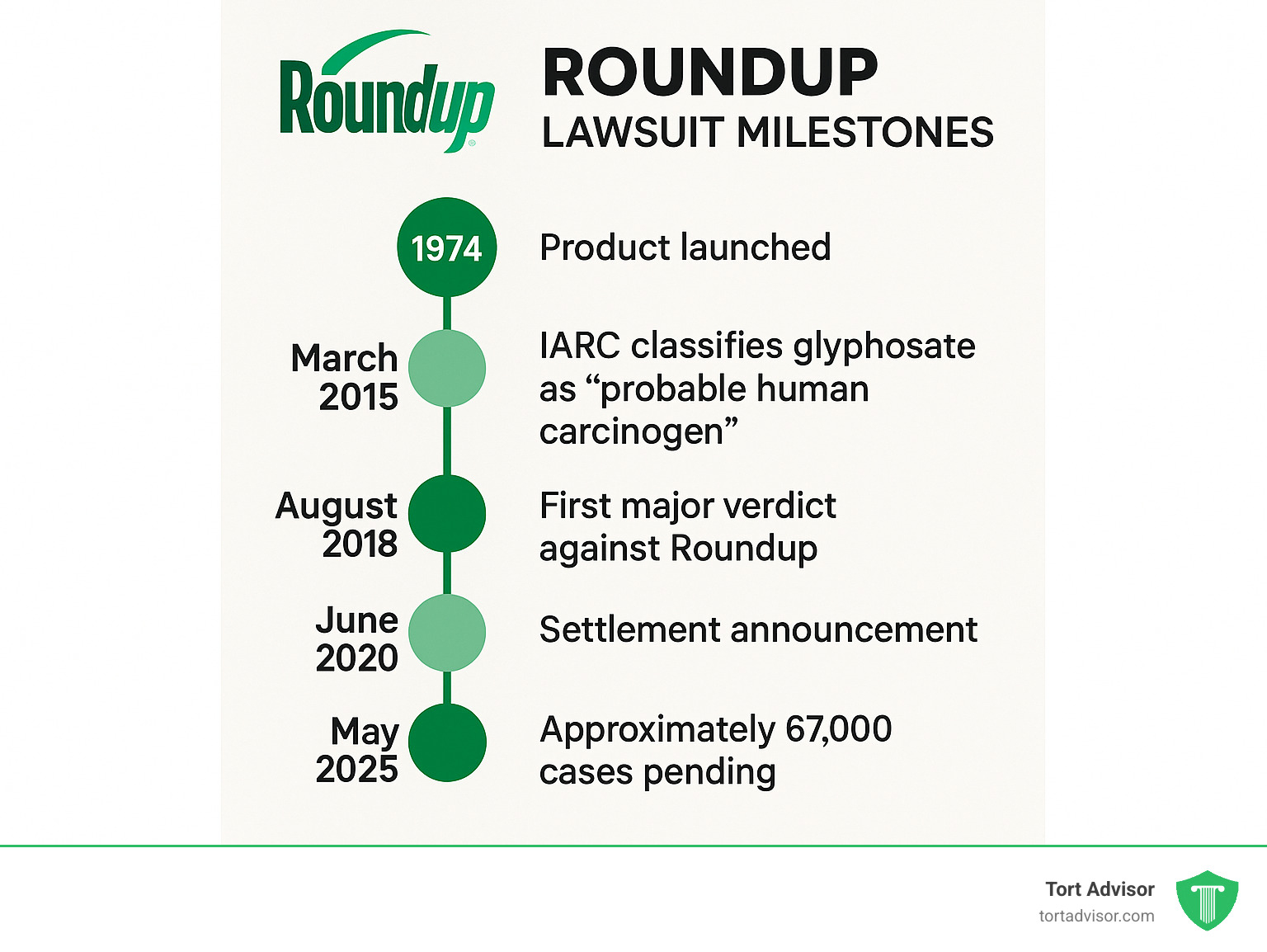
The controversy centers on glyphosate, Roundup’s active ingredient, which the World Health Organization’s International Agency for Research on Cancer classified as a “probable human carcinogen” in 2015. The EPA concluded in 2017 that glyphosate is not likely to be carcinogenic to humans and expects to finish an updated cancer evaluation in late 2026.
Find out if you may have a claim
Answer a few questions and a trained case advisor will review your situation — most people finish in about a minute.
- Free — no cost, no obligation
- About a minute to complete
- Reviewed by a trained case advisor
- Nothing you submit is published
Your details are sent over a secure connection and reviewed confidentially.
Bayer, which acquired Monsanto in 2018, inherited these massive legal liabilities. The company is accused of failing to warn consumers about cancer risks and using deceptive marketing practices. Internal documents known as the “Monsanto Papers” allegedly revealed corporate efforts to influence scientific studies and downplay health concerns.
The stakes are enormous, with recent jury verdicts reaching billions, though they are often reduced on appeal. Agricultural workers, landscapers, and home gardeners diagnosed with lymphoma after regular Roundup use form the core of the plaintiffs.
I’m Mason Arnao. My work with large-scale legal and health data systems has allowed me to track the evolution of the Roundup litigation. This data management background provides unique insights into how these litigations develop and resolve.
Related Roundup guides:
- Roundup settlement amounts and the Roundup settlement calculator
- Roundup verdicts and the largest settlements
- Latest Monsanto and Roundup lawsuit news
The Scientific and Legal Basis: Why is Roundup Being Sued?
The Roundup litigation is rooted in serious health concerns and claims that Monsanto intentionally hid cancer risks from the public.
The Health Risks: Glyphosate’s Link to Cancer
The controversy escalated in 2015 when the World Health Organization’s International Agency for Research on Cancer (IARC) classified glyphosate as a “probable human carcinogen”. Supporting this, a major University of Washington study found that high glyphosate exposure led to a 41% higher risk of developing Non-Hodgkin’s Lymphoma.
Non-Hodgkin’s Lymphoma is the cancer most commonly linked to Roundup, but some studies also suggest connections to leukemia and other blood cancers. Scientists believe glyphosate may damage DNA or disrupt gut bacteria, potentially leading to cancer. However, the EPA maintains that glyphosate is safe when used as directed, creating a conflicting assessment that has become a key battleground in court.
The Allegations Against Monsanto and Bayer
The legal case alleges Monsanto chose profits over public health. The main claims in the Roundup lawsuits center on failure to warn consumers about potential cancer risks and misrepresentation of product safety. Lawsuits allege Monsanto marketed Roundup as harmless while knowing of potential dangers, even claiming it targets enzymes “not found in people or pets.”
The most damaging evidence comes from internal documents known as “The Monsanto Papers.” These leaked files allegedly show corporate ghostwriting of scientific articles and efforts to discredit independent scientists, suggesting a pattern of deceptive marketing. For those who trusted Roundup’s safety, these revelations are a betrayal, and the courts must now determine Bayer’s accountability.
Navigating the Roundup Litigation Landscape
Understanding the complex legal framework is crucial for anyone affected. This section clarifies the litigation’s structure, current status, and important dates.
Class Action vs. MDL: Understanding Your Lawsuit
Most personal injury lawsuits linking Roundup to cancer are not traditional class actions. Instead, they are part of a Multidistrict Litigation (MDL).
- In a traditional class action lawsuit, one group represents everyone with similar claims.
- In an MDL, individual lawsuits are moved to one federal court for pretrial work, but each person retains their individual case. If there’s no settlement, the case can return to its original court for trial.
The Roundup cases are consolidated under Roundup MDL 2741 in the Northern District of California, which has been essential for managing the high volume of cases. Court certification is the judicial approval for a case to proceed as a class action. MDLs consolidate cases rather than certifying them as a class. For more background, you can read our personal injury lawsuits guide.
Current Status and Key Deadlines in the Roundup Litigation
In 2020, Bayer agreed to pay up to $10.9 billion to resolve Roundup claims. On February 17, 2026, Monsanto announced a separate proposed nationwide class settlement, King v. Monsanto, in the Circuit Court of the City of St. Louis. It would pay up to $7.25 billion in declining capped annual payments over up to 21 years and covers people exposed to Roundup before February 17, 2026 who have non-Hodgkin lymphoma or are diagnosed within a 16-year period after the settlement takes effect. The court granted preliminary approval on March 4, 2026; the deadline to opt out or object was June 4, 2026; and the fairness hearing was held on September 14, 2026. As of October 1, 2026, final approval had not been granted, and registration and claims stay closed until it is. Bayer’s latest published count, as of October 15, 2025, was about 197,000 claims in total, of which about 132,000 had been settled or found ineligible.
On June 25, 2026, the U.S. Supreme Court held 7–2 in Monsanto Co. v. Durnell that federal pesticide law (FIFRA) preempts a state-law failure-to-warn claim that would require a cancer warning on the Roundup label. The question before the Court was limited to failure-to-warn claims, so other theories, such as design defect, were not decided. On June 30, 2026, the Court vacated the Anderson, Salas and Johnson judgments and sent them back to be reconsidered in light of Durnell. As of October 1, 2026, 1,104 cases were pending in the federal Roundup MDL (MDL 2741).
Juries have returned very large verdicts, including $2.1 billion in Georgia’s Barnes case in March 2025 ($65 million compensatory and $2 billion punitive). By February 2026, Bayer reported 28 concluded Roundup trials and only three adverse verdicts still outstanding: Anderson, Dennis and Durnell. Durnell has since been reversed by the Supreme Court, Anderson was sent back for reconsideration, and Monsanto’s petition in Dennis was still pending at the Supreme Court in October 2026.
Bayer pulled glyphosate-based Roundup from U.S. retail shelves by early 2023 for home use but continues to sell commercial versions. The company is also aggressively appealing verdicts.
Sources: Supreme Court opinion in Monsanto Co. v. Durnell; Supreme Court order list, June 30, 2026; official class settlement FAQ; Monsanto settlement announcement; JPML pending MDL report, October 1, 2026; Bayer Q3 2025 quarterly statement; Bayer Annual Report 2025; Supreme Court docket 26-139; EPA glyphosate page.
Canada has a separate national class proceeding with its own court-approved notice and deadlines, so Canadian residents should follow the notice issued in that case.

Are You Eligible? Qualifying for a Roundup Lawsuit
Eligibility for a Roundup claim hinges on two main factors: your exposure to Roundup and a subsequent diagnosis of Non-Hodgkin’s Lymphoma.
Who Can Join the Roundup Lawsuits?
You may qualify if you were diagnosed with Non-Hodgkin’s Lymphoma after using Roundup. Those who typically qualify include:
- Agricultural workers: Farmers and farm workers with regular, large-scale exposure.
- Professional landscapers and groundskeepers: Individuals who applied Roundup in commercial settings.
- Regular homeowners and gardeners: People who used Roundup for routine weed control over several years.
The key requirement is a diagnosis of Non-Hodgkin’s Lymphoma after exposure, as this cancer has the strongest statistical link to glyphosate. Family members may also file wrongful death claims if a loved one passed away from NHL potentially linked to Roundup.
Defining ‘Significant Exposure’
“Significant exposure” refers to meaningful, repeated contact over time. Frequency and duration of use are critical. For example, the Canadian class action defines it as applying glyphosate herbicides on more than two occasions in a 12-month period AND more than 10 occasions in a lifetime. While not a strict U.S. rule, it illustrates the type of use considered significant. The method of application, such as mixing concentrates or spraying without protective gear, also contributes to exposure levels.
Proving your exposure is crucial. This can be done through purchase receipts, employment records, or testimony from family and coworkers. Experienced attorneys can help you gather the necessary evidence. For more details on eligibility, see our Roundup lawsuit guide. Every case is different, so a professional evaluation of your situation is essential.
Compensation and Outcomes: What a Roundup Claim May Pay
The financial and personal stakes in this litigation are immense. This section examines potential compensation and the broader implications of these cases.
What Compensation Can Plaintiffs Receive?
Compensation from a Roundup claim aims to cover the full harm of a cancer diagnosis. Plaintiffs may receive compensation for:
- Medical expenses: Costs for doctor visits, tests, chemotherapy, surgeries, and medications.
- Lost wages: Income lost during treatment and recovery, as well as diminished future earning capacity.
- Pain and suffering: Compensation for the physical agony and emotional distress of a cancer diagnosis.
- Punitive damages: Awarded to punish the company for egregious behavior, such as hiding known dangers.
While recent jury verdicts have reached billions, these awards are often significantly reduced on appeal. Even so, the final amounts can be life-changing. Under the proposed 2026 class settlement, the official FAQ lists average awards of $10,000 to $165,000 depending on exposure type, age and the form of lymphoma, plus quick-pay awards of $6,000 to $14,500. An individual award can range from 80% to 120% of its tier average, and nothing is paid unless the court grants final approval.
Potential Implications for Bayer and Consumers
The litigation’s implications are broad. Bayer’s finances have been hit hard, with up to $10.9 billion committed in its 2020 settlement and its stock price impacted. In response, Bayer made changes to Roundup products, introducing glyphosate-free versions for U.S. residential use in 2023, though commercial versions still contain it. Public awareness about glyphosate has soared, leading consumers to seek alternatives. The future of pesticide regulation is also in question, as the lawsuits highlight conflicts between regulatory agencies and scientific bodies, prompting some countries to restrict or ban glyphosate. For details on the payment process, see our guide on when Roundup settlement checks are expected. This litigation is a watershed moment, showing that even large companies are accountable for product safety.
Frequently Asked Questions about the Roundup Lawsuits
Is it too late to file a Roundup lawsuit?
No, new claims are still being accepted, but time is limited. The statute of limitations, which is the legal deadline to file a lawsuit, varies by state. Because these deadlines are strict, it is critical to consult an attorney immediately to determine your specific time limit and protect your right to file a claim.
For the current litigation status, evidence requirements and settlement research behind this topic, see TortAdvisor’s toxic exposure lawsuits research.
What is the difference between the US and Canadian Roundup lawsuits?
The legal structures differ significantly. In the U.S., most federal cases are part of a Multidistrict Litigation (MDL), which consolidates individual lawsuits for pretrial efficiency. A separate proposed nationwide class settlement is awaiting final approval in Missouri state court. Canada has its own national class proceeding, with separate rules and deadlines set out in its court-approved notice.
How do I find a lawyer for my Roundup claim?
These complex cases require an attorney with specialized expertise in mass tort litigation and a proven track record against large corporations. Look for lawyers who understand the science and legal strategies specific to Roundup lawsuits. Most personal injury attorneys work on a contingency fee basis, meaning you pay no upfront fees; they are paid only if you receive a settlement or win your case. This allows individuals to challenge major corporations without financial risk. At Tort Advisor, we connect people with top-rated specialty attorneys who have the experience and proven results necessary for these complex cases, ensuring you receive expert legal guidance.
Conclusion: Your Next Steps in the Roundup Legal Battle
The Roundup litigation is a pivotal moment for corporate accountability. For thousands of families affected by Non-Hodgkin’s Lymphoma after using Roundup, these lawsuits offer a path to justice. This litigation shows the power of ordinary people—agricultural workers, gardeners, and landscapers—holding a global corporation responsible, with billions of dollars in verdicts and settlements validating their claims.
The legal battle is ongoing. Bayer agreed in 2020 to pay up to $10.9 billion, and its proposed class settlement of up to $7.25 billion was awaiting final approval after the September 14, 2026 fairness hearing. Large jury awards show that courts continue to take these claims seriously.
Time is a critical factor. State-specific statutes of limitations set deadlines for filing a claim. Waiting too long could forfeit your legal rights.
Your next steps are important:
- Gather documentation of your Roundup use (receipts, employment records).
- Seek experienced legal guidance. The Roundup litigation is too complex to steer alone.
At Tort Advisor, we connect clients with attorneys who have proven success in these specific cases. The attorneys in our network work on contingency, so you pay nothing unless you win. These lawsuits create lasting change, from product reformulations to increased public awareness, making communities safer. If you or your family have been affected, understanding your rights is the first step forward.

Find an experienced attorney for your Roundup lawsuit.
Additional Resources
Related Posts

How VCF registration works: who should register, the two-year deadline and when it starts, how to register online or by phone, and how it fits with the WTC Health Program.
Paraquat exposure explained from EPA, CDC and court records: how it happens, who is most at risk, drift and vapor, the safety rules since 2016, Parkinson’s research, and the records that help show exposure.

The Supreme Court's June 25, 2026 ruling in Monsanto v. Durnell held that FIFRA can preempt state failure-to-warn claims, unsettling a central theory in paraquat cases. With 6,602 actions pending in MDL 3004 as of 1 October 2026 and a global settlement agreed in principle but no terms disclosed, here is what is verified and what is not.