
When Doctors Wait Too Long: Understanding Delayed Diagnosis

When Doctors Wait Too Long: Understanding Delayed Diagnosis
When a Delayed Breast Cancer Diagnosis Puts Lives at Risk
Delayed breast cancer diagnosis is one of the most serious — and preventable — causes of worse outcomes for women with breast cancer. If you’re looking for a quick answer, here’s what the evidence shows:
Key facts about delayed breast cancer diagnosis:
Find out if you may have a claim
Answer a few questions and a trained case advisor will review your situation — most people finish in about a minute.
- Free — no cost, no obligation
- About a minute to complete
- Reviewed by a trained case advisor
- Nothing you submit is published
Your details are sent over a secure connection and reviewed confidentially.
- What it means: A gap of weeks, months, or even years between when symptoms appear (or a cancer is present) and when it is correctly identified and treated
- Who causes delays: Both patients (fear, lack of awareness, cost) and healthcare providers (age bias, imaging errors, poor referral pathways)
- How much it matters: Women who wait more than 3 months from symptoms to treatment have significantly worse survival than those treated sooner
- The 8-week rule: Surgery more than 8 weeks after diagnosis is linked to meaningfully worse survival odds
- Tumor growth is real: In one Dutch screening study, average tumor size grew from 10.2 mm to 17.3 mm during a diagnostic delay — a statistically significant jump
- Legal implications: When a delay results from a provider’s failure to meet the standard of care, it may constitute medical malpractice
Breast cancer remains one of the most diagnosed cancers in women worldwide. Early detection saves lives — that much is clear. Yet delays of months or even years still happen regularly, and they happen for reasons that are often entirely preventable.
Some delays start with patients who dismiss a lump or put off a doctor’s visit. But a significant share of delays begin in the clinic itself — with providers who attribute a mass to benign causes, order no follow-up imaging, or misread a screening result. For young women in particular, the consequences can be devastating, because breast tumors in younger patients grow faster than in older women, meaning every extra month matters more.
This article breaks down why delays happen, what they do to outcomes, and what you can do about it.
I’m Mason Arnao, and while my background is in technology, data systems, and digital lead generation rather than medicine, I’ve spent years researching complex personal injury topics — including delayed breast cancer diagnosis — to help people understand their rights when the healthcare system lets them down. If you believe a diagnostic delay has harmed you or someone you love, read on — this guide will help you understand exactly what happened and what your options are.
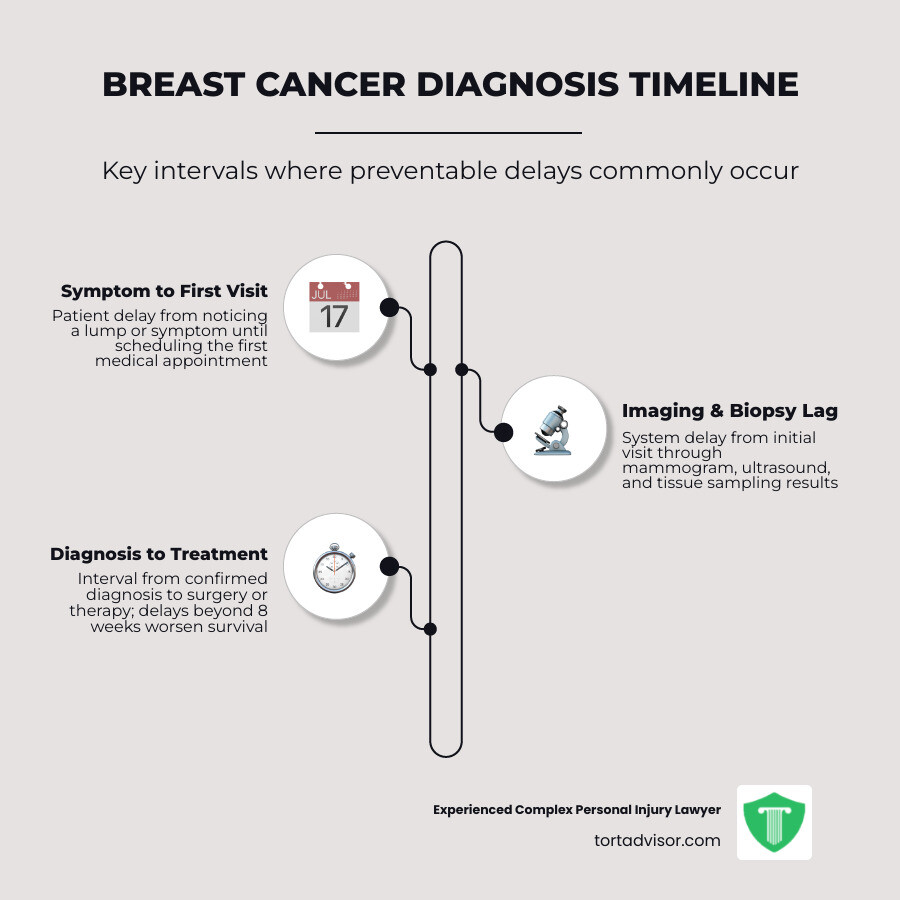
Delayed breast cancer diagnosis helpful reading:
What a Delayed Breast Cancer Diagnosis Means
A delayed diagnosis means breast cancer was not confirmed as quickly as it reasonably should have been. That delay can happen before the first appointment, during testing, after screening recall, or even after diagnosis when treatment is pushed back.
The main categories are:
- Patient delay: time from noticing symptoms to seeking care
- System delay: delays in appointments, imaging, biopsy, pathology, referral, or treatment
- False-negative delay: cancer is present, but imaging or recall is read as normal or benign
- Follow-up failure: an abnormal result is not acted on
How delayed breast cancer diagnosis is different from misdiagnosis
A misdiagnosis means the condition is identified incorrectly. A delayed diagnosis means the right diagnosis comes too late. Sometimes they overlap. For example, a lump may be labeled a cyst or fibroadenoma, then months later confirmed as cancer.
In screening programs, delay may happen after recall if a suspicious lesion gets a false-negative BI-RADS assessment or a negative biopsy that should have triggered more follow-up.
The main types of delay patients face
Most delays fall into a familiar sequence:
- Symptom appraisal delay: “Maybe it’s nothing.”
- First-visit delay: trouble getting evaluated
- Imaging delay: mammogram, ultrasound, or MRI scheduled too late
- Biopsy delay: lesion seen, tissue diagnosis postponed
- Treatment delay: surgery or oncology care starts late
That is a lot of opportunities for the ball to be dropped. Medicine should not work like a group project where no one knows who had the assignment.
Why Delayed Breast Cancer Diagnosis Happens

Delayed breast cancer diagnosis usually comes from a mix of human error, biology, and access problems.
Common causes include:
- Provider reassurance based on age rather than evidence
- Dense breasts making lesions harder to detect
- Pregnancy or lactation changes masking cancer
- Screening interpretation errors
- Referral breakdowns between primary care, radiology, and surgery
- Cost, transportation, insurance, and scheduling barriers
Healthcare-provider causes of delayed breast cancer diagnosis in young women
Young women face a special problem: many clinicians still think “too young for breast cancer.” Research on provider-related delays in young women shows that age bias is a major factor.
Provider-related causes include:
- Dismissing a lump as hormonal or benign
- Mistaking triple-negative tumors for fibroadenomas on imaging
- Labeling pregnancy-associated cancers as galactoceles, mastitis, or abscesses
- Using mammography alone in dense breasts when ultrasound or MRI may be more useful
- Failing to perform a full triple assessment: clinical exam, appropriate imaging, and biopsy
This matters because tumors in women 40 and under often grow faster. They are also more likely to be biologically aggressive, including triple-negative and HER2-positive disease. So a “wait and see” approach can be much riskier in younger patients.
Patient-related delays vs system-related delays
Patient delays and system delays both matter, but they do not look the same.
| Type | Common causes | Typical effect |
|---|---|---|
| Patient-related | fear, stigma, cost, transportation, lack of awareness | later first presentation |
| System-related | appointment backlog, referral gaps, imaging delay, biopsy lag, communication failure | later confirmation and treatment |
In a nationwide study from Turkiye, patient-related causes were more common than provider delays in that setting, with lack of knowledge, fear, and practical barriers playing large roles. By contrast, U.S. studies show access barriers, social vulnerability, race, insurance status, and travel burdens can strongly affect timeliness.
Why hospitals and screening programs vary so much
Not all hospitals process recalls the same way. Workflow matters.
In a Dutch follow-up study of repeated screening recalls, the proportion of women with a delay of at least 2 years ranged from 0% to 4.8% across hospitals. The biggest cause in the more recent cohort was an erroneous BI-RADS classification after recall, responsible for 74.5% of delays. Despite better imaging over time, long delays did not disappear.
Better-performing programs tend to have:
- Multidisciplinary review
- Consistent radiology staffing
- Prior images available for comparison
- Rapid access to biopsy
- Clear escalation rules when imaging and symptoms do not match
For more on system and screening delay patterns, see the cited scientific research on screening recall delays.
What Happens When Breast Cancer Is Diagnosed Late
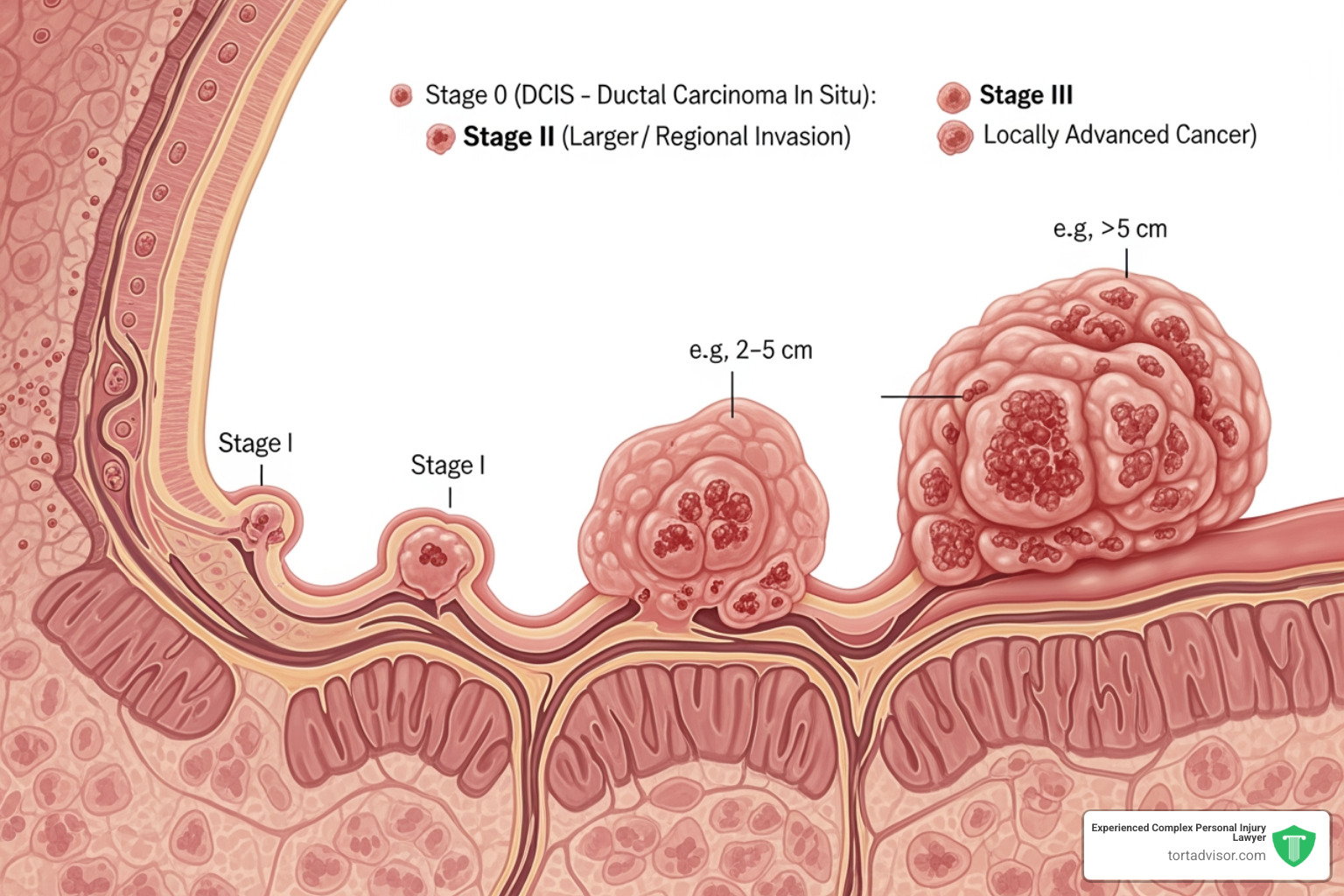
The short version: cancers are often larger, higher-stage, more likely to involve lymph nodes, and harder to treat.
How delay changes tumor size and stage at diagnosis
The evidence is pretty consistent on stage progression.
Research found that patients with delays of at least 6 weeks had more advanced disease than those diagnosed faster:
- 35% stage I, 52% stage II, 12% stage III with longer delay
- 52% stage I, 42% stage II, 5% stage III with shorter delay
Patients delaying more than 6 months were about twice as likely to have tumors 4 cm or larger and roughly 40% more likely to have axillary metastases than those delaying 6 months or less.
In the Dutch screening study, average tumor size increased from 10.2 mm at false-negative recall to 17.3 mm by the next recall. Another screening analysis found primary diagnostic delay was linked to larger tumors, more lymph node metastases, and higher mastectomy rates.
Survival outcomes after diagnosis and treatment delays
Survival also worsens when delays get long enough.
A meta-analysis of 87 studies found women who started treatment 3 to 6 months after symptom onset had significantly worse survival than women treated within 3 months.
Other key numbers:
- 5-year survival was 80% when surgery was delayed more than 6 weeks, versus 90% when delay was under 2 weeks
- Among late-stage patients, a diagnosis-to-treatment interval of 60 days or more was associated with worse breast cancer-specific survival, with a hazard ratio of 1.85
- Large U.S. data suggest surgery after about 8 weeks from diagnosis is associated with poorer survival
That does not mean every short delay changes the outcome. It means avoidable delays should never be shrugged off.
Why tumor biology can make the data look confusing
Here is the tricky part: some studies show longer delay but not worse survival, or even the opposite. That is the “survival paradox.”
Why? Because aggressive tumors often become obvious fast. They cause symptoms, look alarming on imaging, and get worked up quickly. Slower-growing tumors may be harder to interpret and take longer to diagnose. So tumor biology can partly drive both prognosis and speed of diagnosis.
This does not mean delay is harmless. It means we should interpret delay data carefully. Fast-growing cancers in young women, especially triple-negative disease, can move from small to advanced much faster than slower tumors.
How Delay Patterns Differ Across Countries and Communities
Developed vs developing vs underdeveloped settings
In high-income countries, more than 70% of breast cancers are diagnosed at early stages in many settings, helped by organized screening and quicker diagnostics. Five-year survival often exceeds 90%.
In lower-resource settings, the picture is very different. Research cited in the Turkiye study notes 5-year survival around 66% in India and about 40% in South Africa. In Sub-Saharan Africa, many women present with stage III or IV disease.
The PLOS Medicine study on healthcare access and timeliness also shows that delays are shaped by multidimensional access barriers, not just one factor like distance.
Who is most likely to experience delays in the U.S.
Across the U.S. locations we serve, delay risk is not evenly distributed. Studies show higher odds of delay among:
- Black women
- Hispanic patients
- Medicaid-insured or uninsured patients
- People in neighborhoods with high poverty or unemployment
- Patients facing housing or transportation instability
- People with longer or more complicated travel to surgery
- Communities with high non-English-speaking populations
An Arkansas study found 12% of patients had surgery more than 60 days after diagnosis, and non-Hispanic Black patients had 82% higher odds of delay than non-Hispanic White patients.
Why community beliefs and social conditions still matter
The patient-perspective study from Tanzania is a reminder that delays are not only medical. They are social. Stigma, family pressure, fear of mastectomy, religious beliefs, and economic hardship can all postpone care. You can read it here: scientific research on patient perspectives in Tanzania.
In the U.S., the exact beliefs may differ, but the pattern is familiar: fear, denial, cost, work obligations, child care, transportation, and distrust can all slow diagnosis. That is why patient navigation and community outreach matter.
How to Reduce the Risk of a Delayed Breast Cancer Diagnosis
What healthcare systems can do right now
Healthcare systems can reduce delay by doing the basics better and faster:
- Train clinicians not to dismiss breast symptoms based on age alone
- Use age-appropriate imaging, especially ultrasound or MRI in dense breasts
- Standardize triple assessment for suspicious findings
- Create rapid referral pathways to breast specialists
- Offer same-day or fast-track imaging and biopsy where possible
- Audit BI-RADS decisions and false-negative recalls
- Track timeliness as a quality metric
What patients can do when symptoms are dismissed
If a symptom is brushed off, we recommend being politely persistent.
Red flags that need prompt follow-up:
- A new breast lump that does not resolve
- Skin dimpling, nipple inversion, or bloody discharge
- A mass that grows
- Persistent swelling, asymmetry, or underarm lump
- “Benign” imaging that does not match symptoms
Advocacy checklist:
- Write down when the symptom started and how it changed
- Ask what imaging is appropriate and why
- Ask whether biopsy is needed if the lump persists
- Request copies of imaging reports and pathology
- Seek a second opinion from a breast specialist if reassurance does not fit the facts
When a delayed diagnosis may raise legal concerns
Not every delay is malpractice. But legal concerns may arise when a provider failed to meet the standard of care and that failure caused real harm, such as a later stage, more invasive treatment, or worse prognosis.
Potential warning signs include:
- Clear symptoms were documented but not investigated
- Abnormal imaging was misread or not followed up
- Referral or biopsy was unreasonably delayed
- Results were not communicated
- Persistent symptoms were repeatedly dismissed
If that sounds familiar, these resources may help:
Frequently Asked Questions About Delayed Breast Cancer Diagnosis
Can a false-negative mammogram or recall delay breast cancer for years?
Yes. In the Dutch screening research, 2.2% to 2.8% of women diagnosed with breast cancer had a delay of at least 2 years after an initial false-negative recall. Many of those delays were tied to incorrect BI-RADS 1 or 2 assessments. False reassurance can absolutely delay diagnosis for years.
Is a short delay always dangerous, or does tumor biology matter more?
Tumor biology matters a lot. Some cancers are slower-growing, while others progress quickly. Young women often have faster-growing tumors, so a short delay may matter more for them. Still, avoidable delay is never ideal, and once delays stretch into months, the evidence for harm becomes much stronger.
What should I do if I think my delayed breast cancer diagnosis caused harm?
Start with the paper trail:
- Request your records
- Build a timeline of symptoms, visits, imaging, and treatment
- Get a second medical opinion if needed
- Ask whether earlier diagnosis likely would have changed stage or treatment
- Consider a legal review if the delay appears preventable
Conclusion
A delayed breast cancer diagnosis can begin with a missed symptom, a false-negative scan, a delayed biopsy, or a doctor who says “you are probably fine” when the evidence says otherwise. The best protection is early action, timely imaging, timely biopsy, and informed self-advocacy.
When the system fails, understanding what happened is the first step. At Tort Advisor, we help connect people with experienced attorneys who handle complex injury and malpractice matters nationwide. If you are also researching related breast injury claims, you can read more about breast implant lawsuits.
Related Posts

How VCF registration works: who should register, the two-year deadline and when it starts, how to register online or by phone, and how it fits with the WTC Health Program.
Paraquat exposure explained from EPA, CDC and court records: how it happens, who is most at risk, drift and vapor, the safety rules since 2016, Parkinson’s research, and the records that help show exposure.

The Supreme Court's June 25, 2026 ruling in Monsanto v. Durnell held that FIFRA can preempt state failure-to-warn claims, unsettling a central theory in paraquat cases. With 6,602 actions pending in MDL 3004 as of 1 October 2026 and a global settlement agreed in principle but no terms disclosed, here is what is verified and what is not.