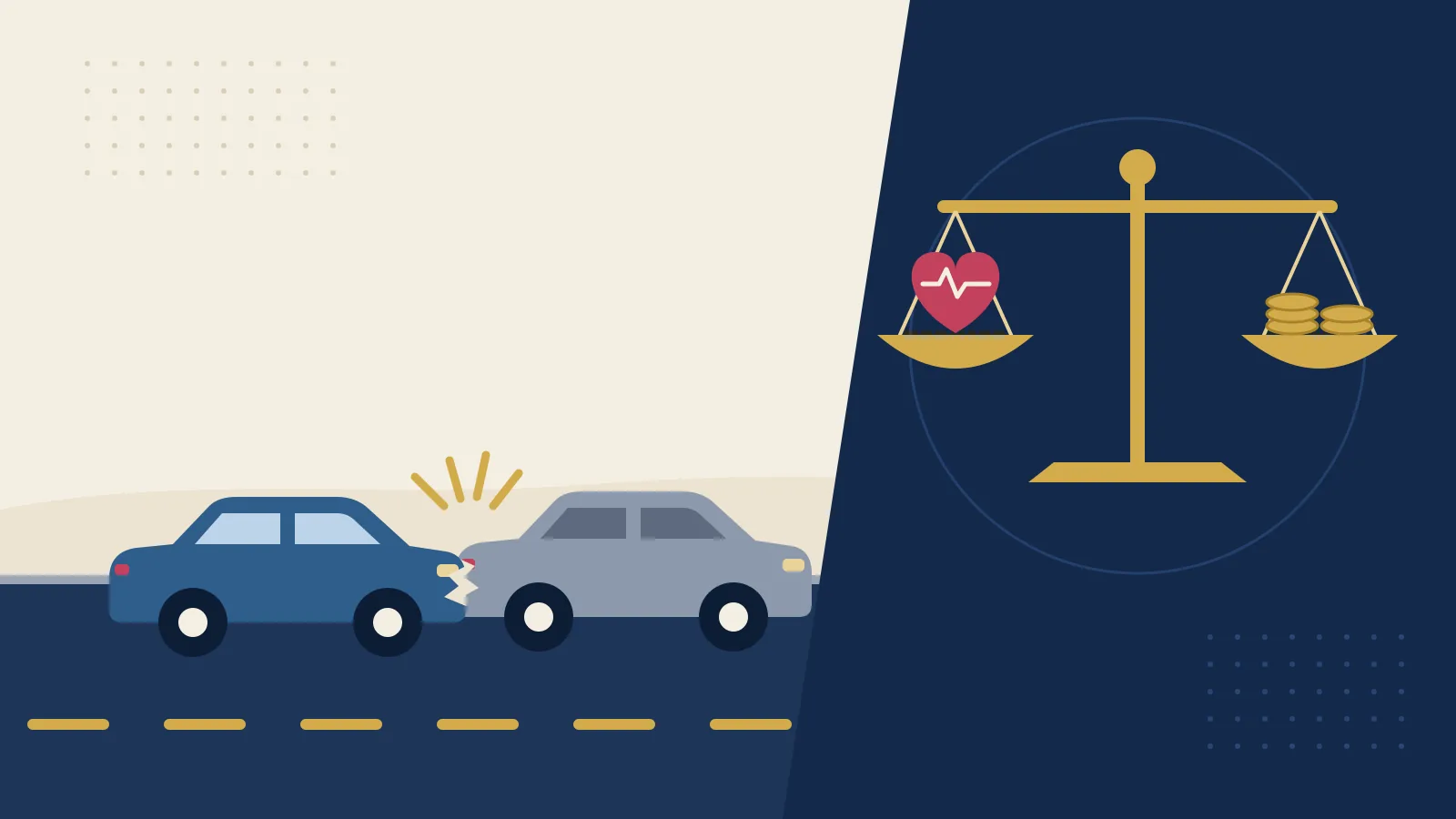
Florida Car Accident Lawsuit: Fault and HB 837 Deadlines

Yes, you may be able to pursue a florida car accident lawsuit after HB 837, but your crash date is a starting point for determining when your claim accrued and which deadline applies under HB 837’s transition rules.
Under Florida’s current comparative-fault law, your share of fault reduces recovery, and being more than 50% at fault bars recovery in covered negligence actions; meanwhile, Florida’s medical-expense rules mean your medical bills alone do not establish the amount of medical damages you can recover.
The current negligence filing deadline is two years, but a lawyer should review which rules apply to your particular claim. This article explains the deadline changes, how fault affects recovery, what compensation a crash claim can address, how medical expenses are evaluated, and what evidence and questions to bring to a Florida lawyer.
Find out if you may have a claim
Answer a few questions and a trained case advisor will review your situation — most people finish in about a minute.
- Free — no cost, no obligation
- About a minute to complete
- Reviewed by a trained case advisor
- Nothing you submit is published
Your details are sent over a secure connection and reviewed confidentially.
Can you pursue a Florida car accident lawsuit?
You may be able to pursue a lawsuit if evidence shows that another party failed to use reasonable care and that this failure legally caused your claimed harm. An injury or an insurance claim alone does not establish liability; those negligence and causation questions are addressed in Florida civil jury instructions 401.4, 401.12 and 401.18.
Start by organizing these four areas. This checklist is an organizational aid, not a determination that you qualify to sue:
- Relevant dates: Record the collision date and the dates of medical visits, insurance communications and any court filings.
- How the collision happened: Gather photographs, witness information, available video and the crash report. Note what each person observed rather than assuming who was responsible.
- Injury evidence: Collect medical records and describe your symptoms, treatment and changes in daily activities.
- Documented losses: Organize bills, receipts, wage records and vehicle-repair documents without treating their totals as a promised recovery.
This article focuses on liability claims against potentially responsible parties and evidence supporting compensation. It does not address Florida personal injury protection (PIP) eligibility, benefit amounts, treatment deadlines or application procedures. For broader help organizing your situation, see TortAdvisor’s accident injury claims guide.
Editorial and publication checks
Reservation request: Request campaign-wide reservation of the primary keyword “Florida car accident lawsuit” and proposed slug “florida-car-accident-lawsuit” before drafting proceeds. Reservation remains pending, not acquired; confirm slug availability in WordPress.
Publication gate: Florida legal review is required. Evidence ledger: source [6], instructions 401.4, 401.12 and 401.18. Verify case-specific applicability, instruction selection and current amendments before publication.
Which deadline applies after HB 837?
Florida’s current general deadline for an action founded on negligence is two years under section 95.11(5)(a). That is the general negligence rule—not a universal deadline for every claim connected to a car crash. A lawyer should identify the claims involved before calculating your filing deadline.
HB 837 became law and took effect on March 24, 2023. The enacted amendment replaced the former four-year negligence limitation period with two years, but its transition provisions use different triggers: section 28 applies the limitation amendments to causes of action accruing after the effective date, while section 30 generally applies the act to causes of action filed after the effective date, except as otherwise expressly provided. Section 29 separately protects rights under insurance contracts issued before the effective date. These distinctions appear in chapter 2023-15, sections 3 and 28–31. For an older accrued negligence claim, the former four-year period may therefore be relevant; filing after the reform took effect does not, by itself, settle which negligence limitation period applies. Nor does an older accrual date mean the claim remains timely today.
Ask a Florida lawyer to determine when your claim accrued, which provisions apply and the actual filing deadline. If accrual or filing falls on March 24, 2023, flag that boundary date specifically for review rather than treating the law’s word “after” as “on or after.” Bring the crash date, treatment records and any existing claim or lawsuit paperwork to that discussion.
How Florida comparative negligence affects recovery
Being partly at fault does not automatically prevent you from recovering compensation. For negligence actions governed by the amended rule, your share of fault proportionately reduces your damages. Fault greater than 50 percent bars recovery; exactly 50 percent does not trigger that bar, although the proportional reduction still applies. Judgment generally reflects each liable party’s percentage of fault rather than making one party responsible for everyone’s share. These rules appear in Florida’s comparative-fault statute, section 768.81(2), (3) and (6).
Allocating fault to someone who is not a party to the lawsuit also requires more than an accusation. Under subsection (3), a defendant seeking that allocation must meet pleading requirements and prove the nonparty’s fault. Ask your lawyer which people or entities may be responsible and what evidence supports each proposed allocation.
Do not treat an insurer’s proposed fault percentage as a court finding. If an adjuster says you share responsibility, ask what evidence supports that position. Bring your lawyer the insurer’s explanation along with available crash reports, photographs, witness information and other evidence that may help evaluate fault.
For a broader comparison, see TortAdvisor’s car accident fault rules and deadlines by state; use this Florida guide for the more detailed discussion to take to a lawyer.

What compensation can a Florida crash claim address?
A Florida crash claim may address financial losses and the personal effects of an injury. Potential categories include medical expenses, lost earnings, reduced earning ability and vehicle damage. Florida civil jury instruction 501.2 identifies these types of damages, but which categories apply—and what amounts can be recovered—depends on the evidence and applicable limitations.
A separate threshold for certain noneconomic damages
For motor-vehicle tort actions within its scope, Florida’s motor-vehicle tort threshold restricts recovery for pain, suffering, mental anguish and inconvenience to injuries that include one of the following:
- Significant and permanent loss of an important bodily function.
- Permanent injury within a reasonable degree of medical probability, other than scarring or disfigurement.
- Significant and permanent scarring or disfigurement.
- Death.
This is not a blanket requirement that every crash lawsuit involve a permanent injury. The restriction concerns the specified noneconomic damages in covered actions; it does not impose that same injury threshold on every damage category.
Assess value through evidence, not a formula
To organize a settlement discussion, separate documented losses from disputed issues. Gather medical records and expense information, wage records, information about work limitations, and vehicle repair estimates. Also identify disagreements about fault, whether the crash caused the injuries, and the extent of any lasting effects.
Our guide to what determines car accident settlement value can help you organize those questions. For a Florida claim, keep the financial-loss evidence separate from the medical evidence relevant to the noneconomic-damages threshold.
Why medical bills alone do not establish medical damages
A medical bill’s original charge is not automatically the amount recoverable in a Florida crash claim. For past medical expenses that have been satisfied, evidence offered to prove their amount is limited to what was actually paid, regardless of who paid it, under section 768.0427(2)(a).
The same statute sets different evidence rules for other medical expenses:
- Unpaid bills: Subsection (2)(b) addresses evidence based on insurance coverage and payment circumstances, including amounts coverage would pay and the patient’s responsibility. An outstanding billed charge is not automatically the recoverable amount.
- Future care: Subsection (2)(c) addresses evidence of future medical expenses, with rules that also depend on coverage and payment circumstances. A projected charge alone does not establish what can be recovered.
- Letters of protection: When treatment is provided under a letter of protection, subsection (3) requires specified disclosures. These include the letter, itemized billing, coverage information and information about referrals; additional disclosures apply if the provider transfers the right to payment.
Subsection (4) also constrains medical-expense recovery: it cannot exceed the admitted evidence and is limited to the statute’s categories of amounts actually paid, amounts necessary to satisfy outstanding charges, and amounts necessary for reasonable and necessary future care.
For legal review, organize your original bills, payment explanations, coverage information and treatment records. Include any letter of protection and related paperwork. Keeping charges, payments and remaining balances separate can help a lawyer assess the evidence without treating every billed dollar as recoverable compensation.

Organize evidence around fault, injury and losses
Gather records that help explain what happened, how you were hurt and what losses followed. A negligence claim must connect negligent conduct to the claimed injury or loss through legal causation—not simply show that a crash occurred. See Florida civil jury instructions 401.12 and 401.18.
This practical checklist can help you prepare for a lawyer’s review:
- Crash photographs or footage: Collect available images of the vehicles, damage, roadway, traffic signs and scene, along with any dashcam footage.
- Witness contact details: List names and available contact information, noting what each person said they saw.
- Treatment history: Organize visit dates, providers, medical records, bills and a timeline of symptoms. Include relevant earlier conditions or treatment so a reviewer can understand the full history.
- Work-loss records: Gather pay records, missed-work dates and correspondence about changes to your duties or schedule.
- Vehicle repair information: Keep estimates, invoices and photographs documenting damage and repairs.
- Insurer correspondence: Save claim numbers, letters, emails and notes of conversations, including dates and who participated.
Separate observations from assumptions. Write down what you remember seeing, hearing and experiencing. Label information learned from others, and identify gaps—such as an unclear sequence of events—for professional review rather than assigning yourself or another driver a fault percentage.
This checklist is preparation, not a statutory filing requirement, and no individual item guarantees proof of liability. For broader orientation before discussing your Florida-specific questions with a lawyer, use TortAdvisor’s car accident lawsuit guide.
Questions to take to a Florida lawyer
A consultation can help you identify what still needs checking before deciding whether to pursue a claim. Bring your records and ask for explanations you can understand—not a promised outcome.
- Which rules apply to my dates? Ask how HB 837’s transition provisions and the current two-year negligence limitation in section 95.11(5)(a) affect your circumstances.
- What evidence supports or challenges fault? Ask which disputed facts matter and how Florida’s comparative-fault rules may affect your claim.
- Which losses need more documentation? Ask what records would help connect your injuries, missed work and other claimed losses to the collision.
- How should my medical-payment records be evaluated? Ask how bills, payments, insurance information and any letter of protection fit the medical-expense evidence and damages requirements.
A short discussion worksheet
- Dates: Collision, first treatment, later diagnoses and any lawsuit filing.
- Disputed collision facts: Each account, witnesses, photographs and available reports.
- Injuries and unpaid expenses: Treatment records, ongoing symptoms, outstanding bills and documented work losses.
- Proposed resolution: What would it cover, what remains uncertain and what would you be agreeing to?
Use the car accident settlement calculator only as an organizational starting point—not a Florida legal valuation, payout prediction or answer to statutory evidence questions.
For further reading, see our guide to car accident lawyers and compensation. You can also contact TortAdvisor with a research question. TortAdvisor provides independent legal-case research, not individualized legal advice or a promise of representation.
Editorial publication checks: reservation approval, WordPress slug check, completed evidence ledger, reviewed state-guide correction and Florida legal signoff.
Keep researching on TortAdvisor
Still unsure where you stand?
Have a trained case advisor review your own facts — free, confidential, and with no obligation.
- Free — no cost, no obligation
- About a minute to complete
- Reviewed by a trained case advisor
- Nothing you submit is published
Your details are sent over a secure connection and reviewed confidentially.
Frequently asked questions
Does HB 837’s shorter deadline apply to a claim that accrued before March 24, 2023?
Do not assume the shorter deadline applies to an older claim. Florida’s current statute provides a two-year limitation for an action founded on negligence, but that provision alone does not answer a transition question. For a claim that accrued before March 24, 2023, ask a Florida lawyer to review HB 837’s applicability provisions and your timeline before calculating the deadline.
Can I recover damages if I am exactly 50 percent at fault in Florida?
Yes—being exactly 50 percent at fault does not, by itself, trigger the current statute’s recovery bar. Florida’s comparative-fault statute bars recovery when a claimant is greater than 50 percent at fault and otherwise reduces damages proportionally. At exactly 50 percent, that means a 50 percent reduction, not an automatic bar. Whether this version of the law governs your case requires separate review.
Is a permanent injury required for every type of Florida car accident compensation?
No. Florida’s motor-vehicle tort threshold addresses specified noneconomic damages in covered cases, not every compensation category. Permanent injury is one qualifying condition; the statute also lists significant and permanent loss of an important bodily function, significant and permanent scarring or disfigurement, and death. The standard civil jury instructions separately identify categories such as medical expenses, lost earnings and property damage. Which categories apply depends on your claim.
Are my full medical bills automatically recoverable after HB 837?
No. A bill’s face amount does not automatically establish recoverable medical damages. Florida’s medical-expense statute sets different evidence rules for satisfied bills, unpaid bills and future treatment, imposes letter-of-protection disclosures, and limits recoverable medical expenses. Keep bills alongside payment records, insurance statements and any treatment financing agreements so a lawyer can evaluate the relevant amounts rather than relying only on the total billed.
Why do both the accrual date and lawsuit filing date matter?
They relate to different transition provisions. HB 837’s applicability sections make its limitation-period changes apply to causes of action accruing after its March 24, 2023 effective date, while its general applicability provision addresses cases filed after that date unless otherwise provided. The act also protects specified rights under existing insurance contracts. Bring your crash timeline and any filing records to a Florida lawyer for a case-specific transition review.
Sources
- Chapter 2023-15, Laws of Florida — HB 837 · Florida Department of State, Laws of Florida · 2023-03-24
- 2026 Florida Statutes, section 95.11 — Limitations other than for recovery of real property · Florida Legislature, Florida Senate
- 2026 Florida Statutes, section 768.81 — Comparative fault · Florida Legislature, Florida Senate
- 2026 Florida Statutes, section 627.737 — Tort exemption; limitation on right to damages · Florida Legislature, Florida Senate
- 2026 Florida Statutes, section 768.0427 — Medical-expense evidence and damages · Florida Legislature, Florida Senate
- Florida Standard Jury Instructions in Civil Cases — current complete set · The Florida Bar, Standard Jury Instructions Committee — Civil
This article is general information, not legal advice. Laws and deadlines vary by state and change over time; check the linked sources or speak with a licensed attorney about your situation.
Related Posts

There is no formula for pain and suffering in a car accident. What jury instructions say, which no-fault states limit it, which states cap it, and how it is taxed, with every rule sourced.
If an uninsured or underinsured driver hits you, the claim usually runs through your own policy. What UM and UIM coverage pay, how a claim works, hit-and-run rules and the deadlines to watch.

Anyone comparing settlement outcomes for a rear-end collision lawsuit needs to understand how fault is decided, what similar claims have [...]