Short answer: This article explains the key facts, eligibility issues, settlement factors, deadlines, and source-backed updates related to this legal topic. Results vary by case facts, evidence, jurisdiction, and representation.
When a Crime Leaves You Struggling Financially, Here’s Where to Turn
📋 Table of Contents
- When a Crime Leaves You Struggling Financially, Here’s Where to Turn
- Understanding the Crime Victims Assistance Fund and How It Works
- Regional Breakdown: Accessing Funds in the US and Canada
- Eligibility and Benefits: What Can You Claim?
- Specialized Compensation for Vulnerable Groups and Historical Cases
- Frequently Asked Questions about Crime Victim Compensation
- Conclusion
A crime victims assistance fund is a dedicated source of money that helps people recover financially after being hurt by a violent crime. These funds cover things like medical bills, counseling, lost wages, and even funeral costs — often without requiring a conviction first.
Here’s a quick look at the main options:
| Program | Where | Who It Helps | Key Benefit |
|---|---|---|---|
| Crime Victims Fund (CVF) | United States (federal) | All U.S. states & territories | Compensation + assistance grants |
| Victims’ Justice Fund (VJF) | Ontario, Canada | Victims of Criminal Code offences | Funds victim service programs |
| Crime Victim Assistance Program (CVAP) | British Columbia, Canada | Victims, families, witnesses | Medical, counseling, income support |
| Victims Fund | Federal Canada | Organizations serving victims | Project and awareness grants |
Being hurt by a crime is already devastating. Then come the bills.
Medical treatment. Time off work. Counseling. Costs that pile up fast — and most victims have no idea financial help even exists.
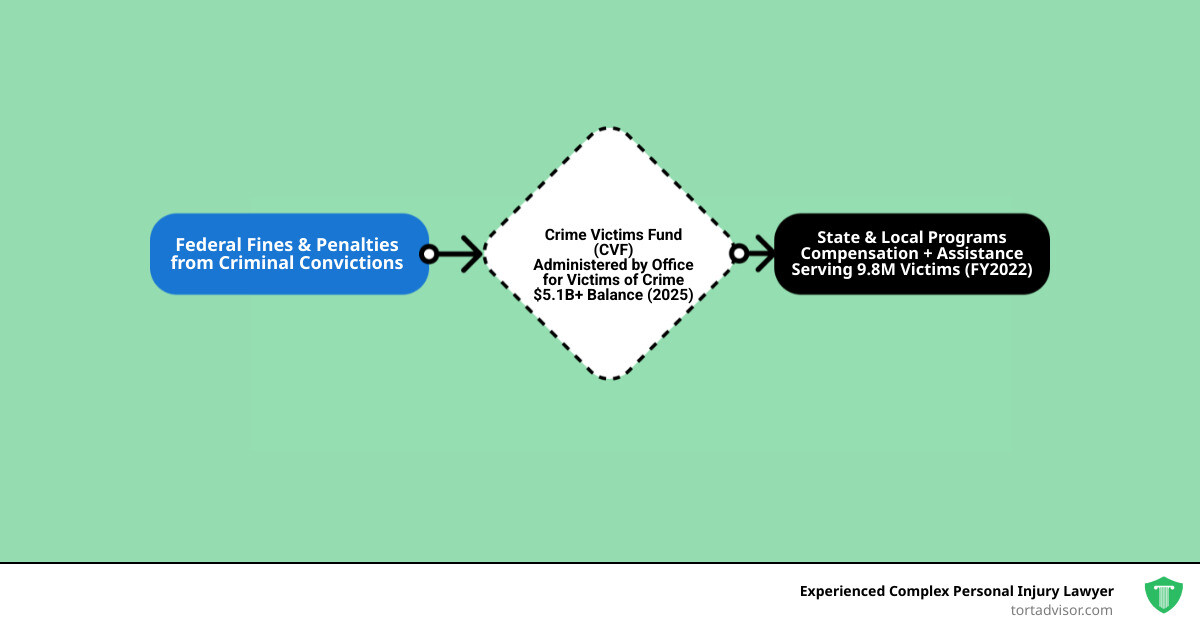
The good news: governments in both the U.S. and Canada have built systems specifically to ease that burden. In the U.S. alone, the federal Crime Victims Fund held over $5.1 billion as of May 2025, financed entirely by fines and penalties from federal convictions — not your tax dollars. In FY 2022, that fund helped serve 9.8 million victims through state programs.
Whether you’re in Ontario, British Columbia, or anywhere across the United States, there are real programs with real money set aside for people in your situation.
This guide breaks down exactly how these funds work, who qualifies, and how to access them.
My name is Mason Arnao, and while my background is rooted in technology and data systems, I’ve spent years researching complex compensation and legal topics — including how the crime victims assistance fund landscape operates across different jurisdictions. I’ll walk you through what I’ve found in plain language, so you can focus on what matters: getting the help you deserve.
Understanding the Crime Victims Assistance Fund and How It Works

When we talk about a crime victims assistance fund, we aren’t talking about a pot of taxpayer money. This is one of the most unique aspects of justice: the criminals themselves pay for the recovery of those they’ve harmed.
In the United States, the cornerstone of this system is the Victims of Crime Act (VOCA) of 1984. This landmark legislation established the federal Crime Victims Fund (CVF). Instead of using tax dollars, the fund is replenished by federal criminal fines, forfeited bail bonds, and special assessments. It’s essentially a “user-pay” system where the offenders foot the bill.
If you are looking for specific details on how these payouts work for individuals, you can explore our guide on the victim-compensation-fund. For a deeper dive into the legislative side, the Congressional Research Service provides an extensive report on The Crime Victims Fund (CVF): Federal Support for Victims of Crime.
The Role of the Federal Crime Victims Assistance Fund
The fund is managed by the Office for Victims of Crime (OVC), a component of the Department of Justice established in 1988. The OVC’s mission is to move these billions of dollars from the federal level down to the states, where they can actually reach people in need.
A major recent development was the VOCA Fix to Sustain the Crime Victims Fund Act of 2021. Before this “fix,” money from “deferred prosecution agreements” (where a company pays a penalty to avoid a trial) went into the general Treasury. Now, that money—which can amount to billions—goes directly into the crime victims assistance fund. This ensures the fund stays solvent even when traditional criminal fines fluctuate. You can find more info about victim compensation and how these changes impact survivors on the official OVC website.
Funding Sources and Annual Allocations
As of May 2025, the federal fund balance sits at over $5.1 billion. But how does that money get to your local community? The OVC uses a formula to distribute grants to every U.S. state and territory.
Each state starts with a base amount—typically $500,000 for victim assistance—and the rest is distributed based on population. For victim compensation (direct payments to individuals), the federal government provides an annual grant equal to 75% of the amount the state paid out to victims two years prior. This creates a cycle of ongoing support. You can see the exact breakdown in the 2024 Crime Victims Fund Allocations.
Regional Breakdown: Accessing Funds in the US and Canada
Navigating these programs depends heavily on where the crime occurred. While the federal government provides the “seed money,” state and provincial agencies handle the actual paperwork.
| Feature | Ontario (VJF) | British Columbia (CVAP) | U.S. Federal (CVF/VOCA) |
|---|---|---|---|
| Primary Funding | Victim fine surcharges | Provincial budget/fines | Federal fines & penalties |
| Direct Payouts? | No (funds programs) | Yes (to victims/witnesses) | Yes (via state programs) |
| Annual Revenue | $44M – $50M | Varies by year | $1.9B – $2.6B (caps) |
Navigating the Ontario Crime Victims Assistance Fund
In Ontario, the Victims’ Justice Fund (VJF) operates a bit differently than its U.S. counterparts. It doesn’t usually cut a check directly to a victim for “pain and suffering.” Instead, it collects between $44 million and $50 million annually—mostly from victim fine surcharges on Provincial Offences Act fines (like speeding tickets, but not parking)—to fund the infrastructure of support.
This money pays for the Victim/Witness Assistance Program (V/WAP), which helps people navigate the court system, and grants to community agencies that help survivors of sexual assault and domestic violence. If you need to find a specific service in Ontario, the Victim Support Directory is the best place to start. All of this is governed by the Criminal Code of Canada, which mandates these surcharges.
British Columbia’s Crime Victim Assistance Program (CVAP)
If you are in BC, the Crime Victim Assistance Program (CVAP) is your primary resource. Governed by the Crime Victim Assistance Act, this program is very robust.
As of January 2024, BC updated its rules to increase counseling rates and expand who can apply. It provides a wide range of recovery benefits, including medical and dental costs, vocational training, and even crime scene cleaning. It’s designed to be a “payer of last resort,” meaning if your private insurance doesn’t cover a therapy session, the CVAP will step in to fill the gap.
Eligibility and Benefits: What Can You Claim?
Many people assume they aren’t eligible for a crime victims assistance fund because they haven’t gone to trial yet. That is a myth! Most programs allow you to apply as long as a crime was reported to the police. You don’t need a conviction, or even an arrest, to start the application process.
Typical benefits include:
- Medical and Dental Expenses: Emergency room visits, surgeries, or fixing a broken tooth.
- Mental Health Counseling: This is often the most used benefit, covering sessions for victims and their families.
- Lost Wages: If you couldn’t work because of your injuries or because you had to attend court.
- Funeral and Burial Costs: Helping families with the unexpected costs of a tragic loss.
- Crime Scene Cleaning: Professional cleaning of a home where a violent act occurred.
If you’ve been a victim of a serious personal violation, speaking with an abuse-victim-lawyer can help you understand if you should pursue a sexual-abuse-lawsuit in addition to applying for these funds.
Who Qualifies for the Crime Victims Assistance Fund?
Eligibility usually falls into three buckets:
- Primary Victims: The person directly harmed by the crime.
- Immediate Family: Spouses, parents, or children of a victim (especially in cases of homicide).
- Witnesses: In places like British Columbia, witnesses to a violent crime can receive counseling if they are traumatized by what they saw.
Interestingly, Canada even offers financial assistance for Canadians victimized abroad. If a Canadian citizen is violently hurt in another country, the federal government may reimburse them for hospital bills or travel costs to get home.
Application Processes and Strict Time Limits
This is where things get tricky. Every crime victims assistance fund has a “statute of limitations”—a deadline to apply.
- United States: Most states require you to apply within one to three years of the crime.
- British Columbia: For crimes occurring on or after January 1, 2024, you have two years to apply. For older crimes, the limit was one year.
- Exceptions: Most jurisdictions have “tolling” rules for minors (the clock doesn’t start until they turn 18 or 19) and for victims of sexual assault, where the time limits are often much longer or non-existent.
You can find more on the Victim information and assistance page regarding the necessary forms and documentation.
Specialized Compensation for Vulnerable Groups and Historical Cases
Sometimes, the standard crime victims assistance fund isn’t enough to address the scale of a tragedy or the specific needs of a community. That’s where specialized programs come in.
Historical Settlements and the Crime Victims Assistance Fund
We’ve seen massive, stand-alone funds created for specific events. The September 11th Victim Compensation Fund (VCF) is the most famous example. Originally closed in 2004, it was reactivated in 2011 and recently made permanent (authorized through 2090) because first responders were developing cancers decades later.
Another major area is clergy abuse. In New Jersey, the five Catholic dioceses individually paid out over $50 million in settlements before a statewide compensation fund was even established. These funds often require victims to waive their right to sue in exchange for a guaranteed payout. If you are dealing with a case involving a religious organization, it is vital to understand your rights regarding a church-religious-organization-sexual-abuse claim.
Modern Initiatives: Black Justice Strategy and Victims Week
Governments are also recognizing that some communities face unique barriers to justice. In Canada, the 2024 Fall Economic Statement allocated $77.9 million to launch Canada’s Black Justice Strategy. This includes $4.4 million specifically through the Victims Fund for Black-specific supports that are culturally grounded.
Additionally, the federal government provides funding for projects for victims of crime through “Victims and Survivors of Crime Week.” Organizations can receive up to $10,000 to host workshops or awareness events. Similar specialized support exists for child-sexual-abuse-lawsuit survivors and those pursuing university-sexual-assault-lawsuits.
Frequently Asked Questions about Crime Victim Compensation
What does the fund typically exclude?
While these funds are generous, they aren’t a blank check. Most crime victims assistance fund programs will NOT cover:
- Property Loss: If your car was stolen or your window was smashed, these funds usually won’t pay for it.
- Pain and Suffering: These funds are meant for “out-of-pocket” losses. For pain and suffering, you generally need to file a civil lawsuit.
- Motor Vehicle Accidents: Most states exclude car crashes unless they were caused by a drunk driver or used as a weapon.
- Double Recovery: If your health insurance already paid the doctor, the fund won’t pay you again for the same bill.
Do I need a lawyer to apply for these funds?
You aren’t required to have a lawyer to apply for a crime victims assistance fund. The process is designed to be administrative. However, for complex cases—like a teacher-sexual-abuse-lawsuit—a lawyer can be invaluable.
Why? Because a lawyer can help you decide if the fund’s offer is fair or if you should pursue a civil lawsuit. In some cases, accepting money from a fund requires you to sign a “waiver of rights,” meaning you can’t sue the offender later. We can help you navigate these high-stakes decisions.
How do I contact immediate support services?
If you need help right now, don’t wait for a funding application.
- Ontario: Call the Victim Support Line at 1-888-579-2888 or chat online at 211ontario.ca.
- British Columbia: Call VictimLink BC at 1-800-563-0808.
- United States: Contact your state’s VOCA administrator or use the Directory of victims services to find local help.
Conclusion
Financial recovery is a critical part of the healing process. Whether it’s through a state-run crime victims assistance fund, a specialized federal program, or a civil lawsuit, there are pathways to justice.
At Tort Advisor, we believe that no one should have to choose between their health and their financial stability after a crime. If you’re ready to explore your options beyond government funds, we can connect you with specialty attorneys who have a proven track record of getting results for survivors.
Take the next step in your recovery journey and Access the Victim Compensation Fund resources today. You’ve been through enough—let us help you secure your future.
Related Posts

Tupelo hair relaxer cancer lawsuit victims: Get legal help to claim compensation for uterine/ovarian cancer linked to products. Act now!

Wildfire victim? Understand california wildfire lawsuits. Claim compensation, hold utilities accountable, and get justice.

Stay updated on Monsanto lawsuit news. Discover billions in verdicts, settlements, cancer links, and your legal options for claims.