
Time Speed and Distance: How Fast Was I Driving?

The relationship between time, speed and distance is straightforward: calculate a car’s speed by dividing the distance traveled by the elapsed time. Mathematically, that gives an average speed over the measured interval—not necessarily the car’s speed at impact or an explanation of why the crash happened.
This article explains how to convert feet per second to miles per hour, why travel distance differs from stopping distance, which includes perception-reaction and braking travel, and what vehicle event data recorders may capture about pre-crash movement and driver inputs. It also helps you identify the assumptions behind your estimate so you can bring clearer questions to a conversation about a possible claim.
How to estimate driving speed from distance and time
Speed = distance ÷ elapsed time. Using NASA’s speed formula, divide the distance your vehicle traveled by the time it took to cover that distance. The distance and elapsed time must describe the same interval—from the same start point to the same end point.
Find out if you may have a claim
Answer a few questions and a trained case advisor will review your situation — most people finish in about a minute.
- Free — no cost, no obligation
- About a minute to complete
- Reviewed by a trained case advisor
- Nothing you submit is published
Your details are sent over a secure connection and reviewed confidentially.
As a mathematical implication of this formula, dividing distance traveled over an interval by its elapsed time gives an average speed for that interval. The calculation alone does not identify your vehicle’s speed at the instant of impact. If your speed changed between the two points, the interval average does not show when or how it changed.
Fill in your distance and time
- Identify the interval: Start point = ____; end point = ____.
- Enter the distance: d = ____; distance unit = ____.
- Enter the elapsed time: t = ____; time unit = ____.
- Calculate the average speed: v = d ÷ t = ____ distance units per time unit.
Keep the units attached to your answer. For example, distance entered in feet and time entered in seconds produces feet per second—not miles per hour. A unit conversion is a separate step.
You can also rearrange the same cited formula algebraically:
- Distance = speed × time: d = v × t.
- Time = distance ÷ speed: t = d ÷ v.
These are mathematical rearrangements, not additional crash-analysis methods. For an interval in which speed changes, v represents the interval’s average speed. Keep your chosen endpoints, units and assumptions with the result so the estimate is not mistaken for a reconstruction of the collision.
Convert feet per second to miles per hour
If your distance is measured in feet and your elapsed time in seconds, dividing distance by time gives feet per second—not miles per hour. Convert that result before reading it as an mph estimate.
The following calculation is derived from NIST’s feet-per-second and miles-per-hour conversion factors: one foot per second equals 0.3048 meters per second, and one mile per hour equals 0.44704 meters per second.
mph = (distance in feet ÷ elapsed seconds) × 0.3048 ÷ 0.44704
This is a unit conversion derived from those factors, not a separately published crash-reconstruction formula. To follow the units, first multiply feet per second by 0.3048 to obtain meters per second. Then divide by 0.44704 meters per second per mph. The meters-per-second units cancel, leaving mph.
Before interpreting the result, check:
- Original units: Confirm that the distance entry is in feet and the time entry is in seconds.
- Elapsed-time entry: Check the decimal placement and make sure the time covers the same interval as the measured distance.
- Measurement notes: Review where the distance starts and ends and whether either measurement was estimated.
As a direct mathematical implication of the calculation, changing either input changes the calculated speed. With time held constant, a greater distance produces a higher speed; with distance held constant, a longer elapsed time produces a lower speed. The conversion changes the units, but it does not resolve uncertainty in the measurements.
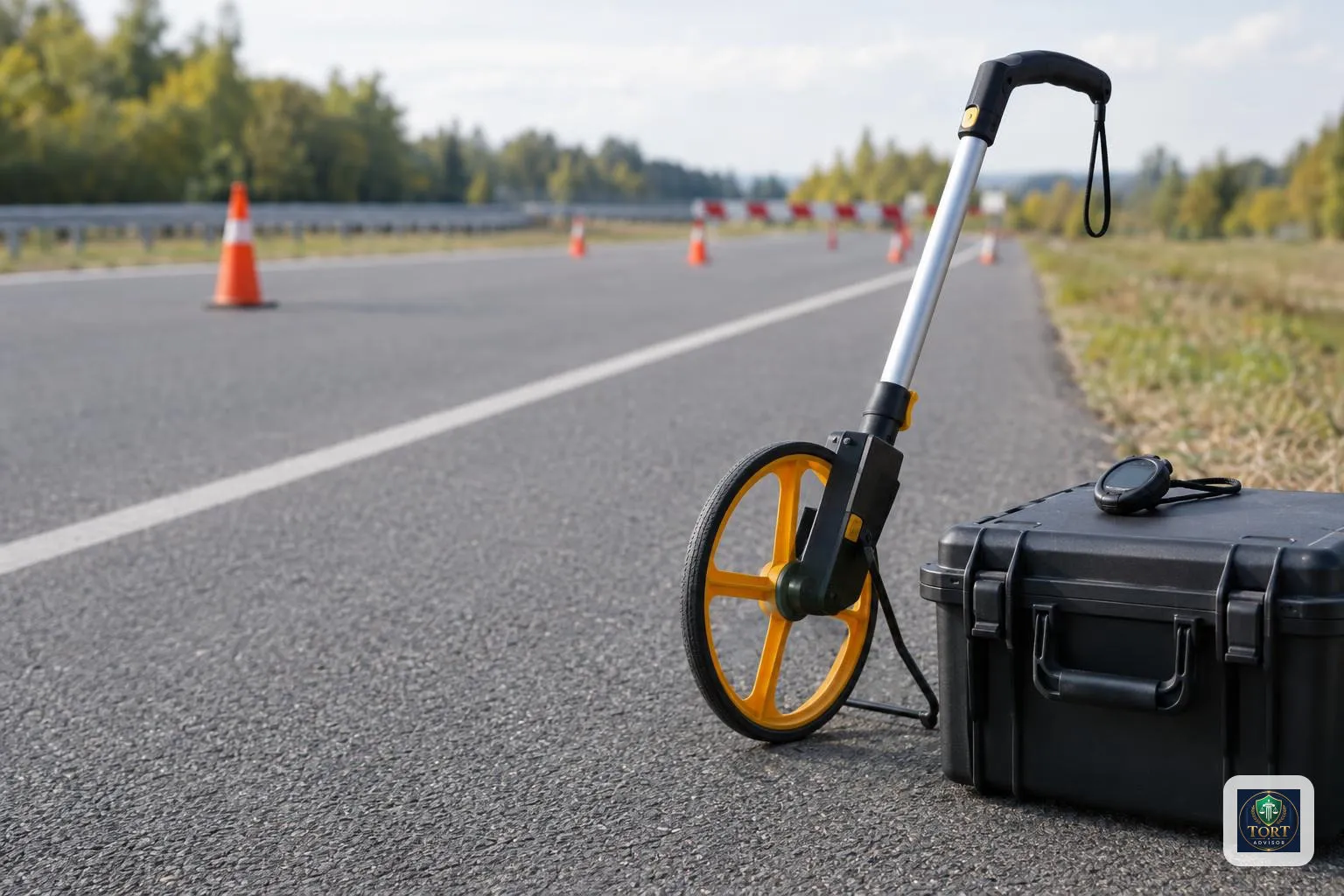
Travel distance is not the same as stopping distance
A time-and-distance calculation can help estimate travel speed, but it does not, by itself, tell you where a vehicle should have stopped. Stopping distance involves two distinct parts:
- Perception-reaction distance: the distance traveled while the driver perceives a hazard and reacts, before braking begins.
- Braking distance: the distance traveled after braking begins and before the vehicle stops.
FHWA’s stopping-sight-distance explanation includes both components. Its braking-distance models incorporate deceleration and account for roadway grade. Those models concern roadway design criteria; their assumptions are not measurements of your reaction time or your vehicle’s actual deceleration during a crash.
There is also an important mathematical distinction. Rearranging NASA’s speed = distance ÷ time relationship gives distance = speed × time. As a mathematical implication, using a constant speed in that equation describes constant-speed travel. It should not be applied unchanged across a braking interval, when speed is decreasing. A speed calculated from the total distance and elapsed time is an average over that interval—not a measurement of speed at every moment.
Keep your travel estimate separate from any stopping-distance assessment. The estimate alone cannot establish the driver’s reaction time, how quickly the vehicle slowed, or whether this particular collision could have been avoided.
What vehicle-recorded speed evidence can add
Your distance-and-time estimate is a starting point to compare with other available crash information—not a replacement for it. Vehicle-recorded data may help you examine how that estimate fits the information about the crash.
Event data recorders, or EDRs, may capture technical vehicle and occupant information around a crash, including pre-crash vehicle dynamics and driver inputs. They are not audio or video recorders. NHTSA’s event data recorder research overview explains that EDR information has limitations and should be used with other data sources. That does not establish that a recording exists for your crash or that every vehicle captures the same information.
Before discussing your estimate, organize the materials you already have; the car accident photos and records checklist can help you take stock. Keep these questions alongside your calculation:
- What interval does it cover? Identify the starting and ending points you used.
- How were distance and time obtained? Note whether each input was measured, estimated or taken from another record, and identify any uncertainty.
- Is vehicle-recorded information available? Treat availability and what it contains as questions, not assumptions.
- What agrees or conflicts? List other information that supports the estimate or raises questions about it.
Compare the calculation with the accident report, noting differences rather than assuming either account resolves them; TortAdvisor’s guide to understanding motor vehicle accident reports can help you review that document. Bring the estimate, its inputs and any unresolved differences to a discussion about your case.
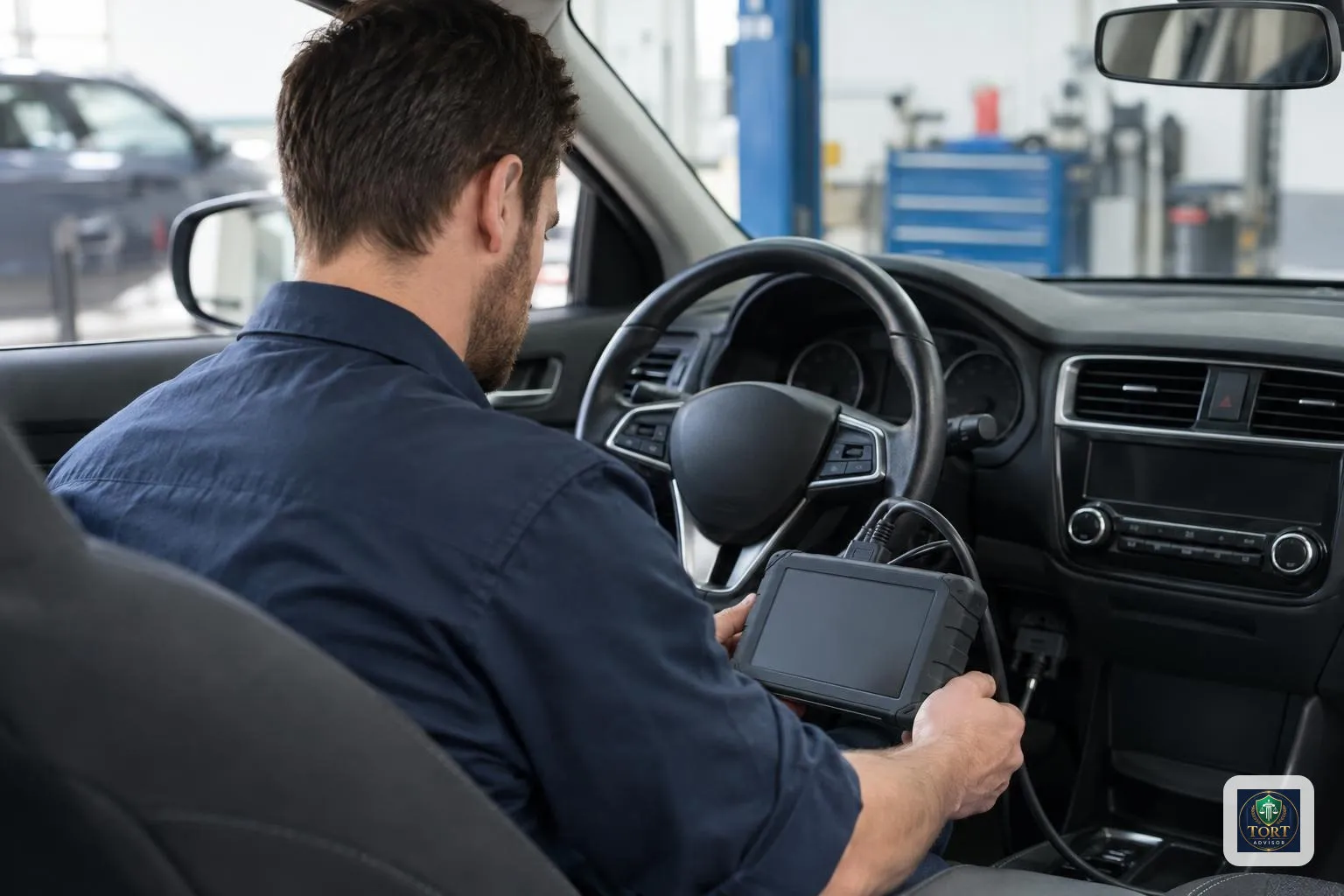
Bring the estimate—and its assumptions—to your case questions
Bring a short explanation of your calculation, not just the final speed estimate. Dividing distance by elapsed time gives an average speed over that interval—a mathematical implication of the speed-equals-distance-divided-by-time relationship, not a measurement of speed at every moment.
Your notes can include:
- Distance: The start and end points, the distance between them and how it was measured.
- Elapsed interval: The time used and where it came from, such as a video timestamp or your recollection.
- Units: The original distance and time units, plus any conversions.
- Uncertainty: Anything estimated, unclear or based on an assumption.
Use those notes to ask questions rather than draw conclusions about responsibility:
- Does this interval include braking, or only travel before braking began?
- What supports the distance and timing measurements?
- Would a reconstruction specialist help explain conflicting information?
- If vehicle-recorded information is available, how does it fit with the other evidence? NHTSA cautions that event data recorder information should be used with other data sources.
If you want help organizing that conversation, TortAdvisor’s guide to preparing questions for a personal injury attorney offers a starting point. TortAdvisor is an independent legal-information resource, not a law firm.
If you are also researching compensation, you can separately explore TortAdvisor’s lawsuit and injury settlement calculators and settlement amounts and compensation guide. Keep that research separate from the speed calculation; this estimate is not a liability opinion or a prediction of compensation.
Keep researching on TortAdvisor
Frequently asked questions
How do I calculate driving speed from distance and elapsed time?
Divide the distance traveled by the time it took to travel that distance. NASA’s glossary gives the relationship as speed equals distance divided by time. Keep your units consistent: distance in feet divided by time in seconds gives feet per second. To express that result in miles per hour, use the conversion explained below.
How do I convert feet per second to miles per hour?
Multiply feet per second by approximately 0.6818. This multiplier is mathematically derived from NIST’s conversion factors: one foot per second equals 0.3048 meters per second, and one mile per hour equals 0.44704 meters per second. Dividing 0.3048 by 0.44704 gives approximately 0.6818. For example, a calculated speed of 60 feet per second converts to approximately 40.9 miles per hour.
Does average speed tell me the speed at impact?
No—not by itself. As a mathematical implication of dividing distance by elapsed time, the result describes average speed across the measured interval, not necessarily speed at a particular instant. If the vehicle accelerated or slowed during that interval, the calculation alone cannot identify its impact speed. Label your result as an average and note exactly where the distance measurement begins and ends.
Is reaction distance included in stopping distance?
Yes. In FHWA’s stopping-sight-distance framework, the total includes travel during perception and reaction plus travel during braking. Its roadway-design braking calculations also account for deceleration and roadway grade. These are design criteria, not findings about your collision. A distance-and-time estimate should therefore identify which part of the vehicle’s travel it measures rather than treating all travel as braking.
Can an event data recorder help explain vehicle speed before a crash?
Yes, potentially. According to NHTSA’s event data recorder overview, an EDR records technical vehicle and occupant information around an event and may capture pre-crash vehicle dynamics and driver inputs. It is not an audio or video recorder. NHTSA cautions that EDR information should be used with other data sources, so treat any available recording as one part of understanding the crash—not a complete explanation by itself.
Sources
- NASA eClips Glossary · National Aeronautics and Space Administration
- NIST Guide to the SI, Appendix B.8: Factors for Units Listed Alphabetically · National Institute of Standards and Technology
- Self-Enforcing Roadways: A Guidance Report—Chapter 3. Relationship Between Speed and Geometric Design · Federal Highway Administration
- Event Data Recorder · National Highway Traffic Safety Administration
This article is general information, not legal advice. Laws and deadlines vary by state and change over time; check the linked sources or speak with a licensed attorney about your situation.
Related Posts

A practical checklist for collecting crash details and organizing medical, insurance and expense records. Start with safety, then use the record prompts when you are able.
Explore the deadline, shared-fault and medical-expense questions to discuss before pursuing a Florida crash injury claim. This guide focuses on liability and compensation, not PIP benefit applications.

There is no formula for pain and suffering in a car accident. What jury instructions say, which no-fault states limit it, which states cap it, and how it is taxed, with every rule sourced.