Talcum Powder Lawsuit 2026: Settlement Amounts, Eligibility & How to File a Claim
SourceJ&J statement31 Mar 2025J&J press release27 Jul 2026
Find out if you may have a claim
Answer a few questions and a trained case advisor will review your situation — most people finish in about a minute.
- Free — no cost, no obligation
- About a minute to complete
- Reviewed by a trained case advisor
- Nothing you submit is published
Your details are sent over a secure connection and reviewed confidentially.
Talcum powder has been a household staple for more than a century. But since 2013, when the first major jury verdict connected Johnson & Johnson Baby Powder to ovarian cancer, the talcum powder lawsuit has become one of the largest mass tort actions in U.S. history. Tens of thousands of claimants allege that decades of exposure to asbestos-contaminated talc caused life-altering cancers — and that the manufacturer concealed the risk. If you or a loved one used talcum-based body powder and later developed ovarian cancer or mesothelioma, this guide covers everything you need to know in 2026: current settlement amounts, eligibility requirements, the status of Johnson & Johnson’s bankruptcy maneuver, and exactly how to protect your legal rights before the statute of limitations expires.
What Is the Talcum Powder Lawsuit?
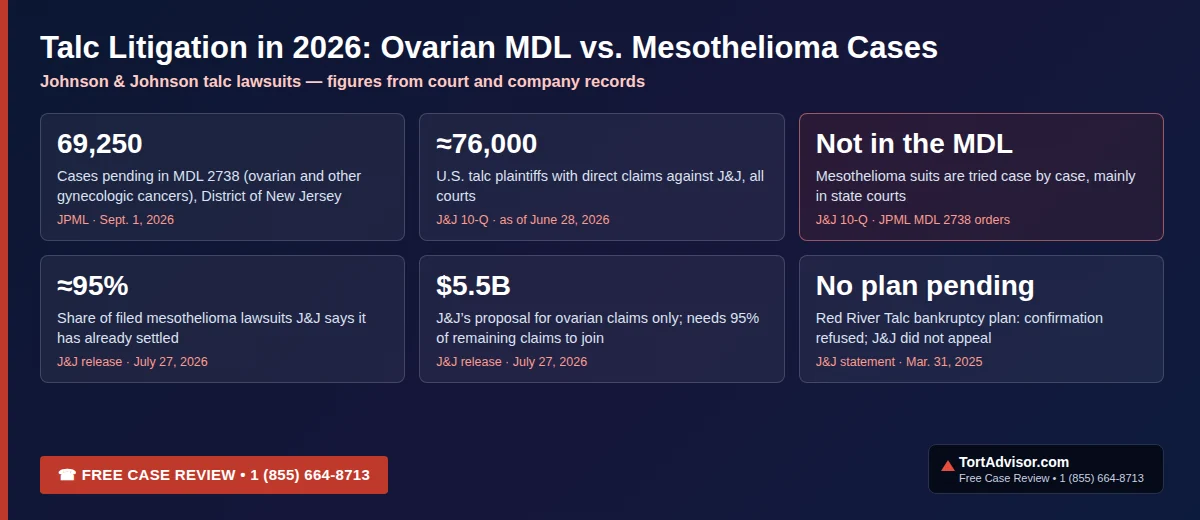
The talcum powder lawsuit is a mass tort litigation against Johnson & Johnson (J&J) and other talc product manufacturers. Plaintiffs allege that cosmetic talc products — primarily Johnson’s Baby Powder and Shower to Shower — contained asbestos, a known human carcinogen, and that regular perineal application of these products caused ovarian cancer and mesothelioma. The litigation began building momentum after investigative reporting by Reuters in 2018 revealed that J&J had known since the 1970s that its talc could contain asbestos. Internal corporate documents — later admitted as evidence in trials — showed that executives knew of potential contamination and failed to notify regulators or consumers. (Reuters, 2018) Today, the talcum powder lawsuit encompasses 69,340 cases pending in federal multidistrict litigation (MDL No. 2738) in the U.S. District Court for the District of New Jersey (October 1, 2026), plus thousands of state court cases. J&J reports approximately 76,000 U.S. talc plaintiffs in all.
SourceJPML MDL report1 Sep 2026J&J 10-Q (Q2 2026)23 Jul 2026
Key Products Named in the Talcum Powder Lawsuit
- Johnson’s Baby Powder (talc-based formula, sold until 2020 in the U.S.)
- Shower to Shower (acquired by Valeant Pharmaceuticals, then Church & Dwight)
- Clubman Pinaud Talc
- Various generic store-brand talcum powders
Johnson & Johnson discontinued talc-based Baby Powder in the United States and Canada in 2020, citing “misinformation” about its safety. The company reformulated the product with cornstarch. However, it continued selling talc-based Baby Powder internationally until 2023.
Health Risks Linked to Talcum Powder
The health risks at the center of the talcum powder lawsuit fall into two categories: ovarian cancer linked to perineal talc use, and mesothelioma linked to asbestos contamination in talc mining operations.

Ovarian Cancer and Talcum Powder
Many epidemiological studies have examined the link between perineal talc use and ovarian cancer. A 2018 systematic review and meta-analysis in Epidemiology (Penninkilampi & Eslick) reported that perineal talc use was associated with a modestly higher risk of ovarian cancer. (Penninkilampi & Eslick, 2018, National Library of Medicine) The International Agency for Research on Cancer (IARC), a division of the World Health Organization, classified perineal use of talc-based body powder as possibly carcinogenic to humans (Group 2B) in its 2006 evaluation — a classification that has been cited repeatedly in talcum powder lawsuit trials. (IARC Monographs, WHO) In 2024, IARC reclassified talc as probably carcinogenic to humans (Group 2A).
SourceEpidemiology 2018Jan 2018IARC Q&A (Vol. 136)Jul 2024
Mesothelioma and Asbestos-Contaminated Talc
Asbestos and talc are naturally occurring minerals that share geological formations. Critics and plaintiffs’ experts argue that J&J’s talc supply chain — sourced primarily from mines in Vermont and Italy — was never fully free of asbestos contamination. Mesothelioma plaintiffs include not only product users but also workers in talc mines and factories who developed occupational exposure. The U.S. Food & Drug Administration (FDA) has conducted multiple rounds of talc testing. In October 2019, FDA testing found chrysotile asbestos in a sample from one lot of Johnson’s Baby Powder, and J&J voluntarily recalled that lot. (FDA Talc Information Page) J&J disputed the findings; in May 2020 it announced it would discontinue talc-based Johnson’s Baby Powder in the U.S. and Canada.
SourceFDA notice18 Oct 2019J&J statement19 May 2020
Talcum Powder Settlement Amounts in 2026
Settlement values in the talcum powder lawsuit vary significantly based on diagnosis, years of product use, age at diagnosis, and the strength of individual case evidence. Here is what the court record and company filings show about verdicts and settlements.
Notable Jury Verdicts
- $4.69 billion — Missouri jury verdict (2018) in a consolidated trial of 22 women who alleged J&J Baby Powder caused their ovarian cancer. It was reduced on appeal in 2020. (Reuters)
- About $2.1 billion — what remained after the Missouri Court of Appeals (June 2020) threw out the claims of non-Missouri plaintiffs for lack of personal jurisdiction and reduced the award; the U.S. Supreme Court declined review on June 1, 2021.
- About $1.56 billion — December 2025 Baltimore verdict for Cherie Craft, who alleged asbestos in J&J talc caused her peritoneal mesothelioma ($59.84 million compensatory, $1 billion punitive against J&J and $500 million against Pecos River Talc); J&J said it would appeal.
- $223.8 million — New Jersey judgments (July 2020) for four mesothelioma plaintiffs after a 2019–20 trial; reversed on appeal on October 3, 2023, with new trials ordered.
- $250,000 — February 2026 Philadelphia jury award ($50,000 compensatory, $200,000 punitive) to the estate of a woman who died of ovarian cancer.
SourceMo. Ct. App. opinion23 Jun 2020U.S. Supreme Court1 Jun 2021Daily Record (news)23 Dec 2025N.J. App. Div. opinion3 Oct 2023Reuters via Claims J.17 Feb 2026
What Talcum Powder Settlements Are Worth
Headline verdicts generate publicity, but most talcum powder lawsuit settlements are negotiated confidentially, and no per-case settlement values have been published. Johnson & Johnson says it has settled about 95% of filed mesothelioma lawsuits, and its July 27, 2026 proposal calls for per-claim payments from a $5.5 billion commitment for ovarian claims; individual amounts under it have not been published. Contingency fees and case costs are set in each client’s written fee agreement.
SourceJ&J press release27 Jul 2026
See our Talcum Powder Settlement Amounts for comparison data across mass tort cases.
Who Qualifies for a Talcum Powder Lawsuit?
Not every person who used talcum powder is eligible to file a lawsuit. Courts and plaintiff attorneys use specific eligibility criteria to evaluate claims. Here are the primary qualification factors:
Basic Eligibility Requirements
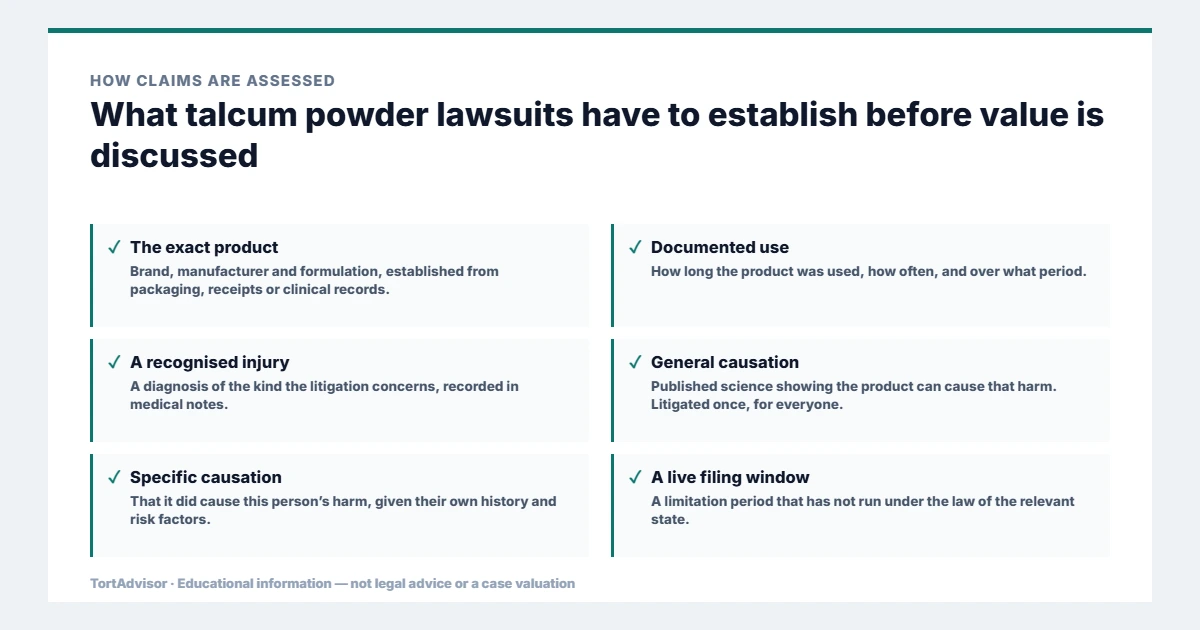
- Product Use: You used Johnson’s Baby Powder, Shower to Shower, or another talc-based cosmetic powder on a regular basis — typically defined as at least one year of perineal application or prolonged body/genital use.
- Qualifying Diagnosis: You have been diagnosed with ovarian cancer (any type), peritoneal cancer, fallopian tube cancer, or mesothelioma. Some attorneys also evaluate uterine and cervical cancer cases.
- Causal Link: Your attorney and medical experts must be able to establish that your talcum powder use preceded your cancer diagnosis and that the duration and frequency of use is consistent with the dose-response relationship identified in epidemiological studies.
- Statute of Limitations Compliance: Your claim must be filed within the applicable statute of limitations period in your state (see below).
Who May Not Qualify
- Individuals who used cornstarch-based baby powder (not talc)
- Individuals without a qualifying cancer diagnosis
- Individuals whose statute of limitations has expired without filing
- Individuals who already settled their claim and signed a release
If you’re unsure whether you qualify, speak with a talcum powder attorney through our Active Lawsuits Hub for a free case review. Most attorneys accept these cases on contingency, meaning no upfront fees.
Johnson & Johnson Bankruptcy Update 2026
One of the most consequential developments in the talcum powder lawsuit history is Johnson & Johnson’s controversial use of the “Texas Two-Step” bankruptcy strategy to limit its liability exposure. In 2021, J&J created a new subsidiary — LTL Management LLC — and transferred all talc liabilities to it. LTL filed for Chapter 11 bankruptcy on October 14, 2021, pausing talcum powder litigation. The strategy was designed to force claimants into a centralized bankruptcy settlement process at significantly reduced payouts. However, federal courts have repeatedly rejected LTL’s bankruptcy filings. In January 2023 the U.S. Court of Appeals for the Third Circuit ordered LTL’s first bankruptcy dismissed, ruling that LTL was not in financial distress. LTL filed a second bankruptcy petition in 2023, which was dismissed in July 2023. J&J’s third attempt, through its subsidiary Red River Talc (filed September 2024), offered about $8 billion in present value over 25 years for ovarian and gynecologic claims. It ended on March 31, 2025, when the U.S. Bankruptcy Court for the Southern District of Texas refused to confirm the plan; J&J did not appeal and returned to fighting the cases in court. On July 27, 2026, J&J proposed a $5.5 billion resolution of ovarian claims outside bankruptcy, which depends on claimants representing at least 95% of the remaining claims taking part.
Source3d Cir. opinion30 Jan 2023J&J press release28 Jul 2023J&J press release20 Sep 2024J&J statement31 Mar 2025J&J press release27 Jul 2026
What This Means for Your Claim
- No bankruptcy plan is pending: the Red River Talc plan was rejected on March 31, 2025.
- J&J’s July 2026 proposal: per-claim payments from a $5.5 billion commitment, with the first payment of no more than $3 billion in 2027 — only if claimants representing at least 95% of the remaining claims take part.
- The federal MDL: according to J&J, on July 22, 2026 the MDL court ordered plaintiffs to show why the remaining claims should not be dismissed for inability to prove specific causation.
- Deadlines still apply: statutes of limitations keep running regardless of settlement talks.
SourceJ&J statement31 Mar 2025J&J press release27 Jul 2026
How to File a Talcum Powder Lawsuit Claim

Filing a talcum powder lawsuit claim involves several key steps. Here is a straightforward guide to what the process looks like from start to finish:
Step 1: Gather Your Evidence
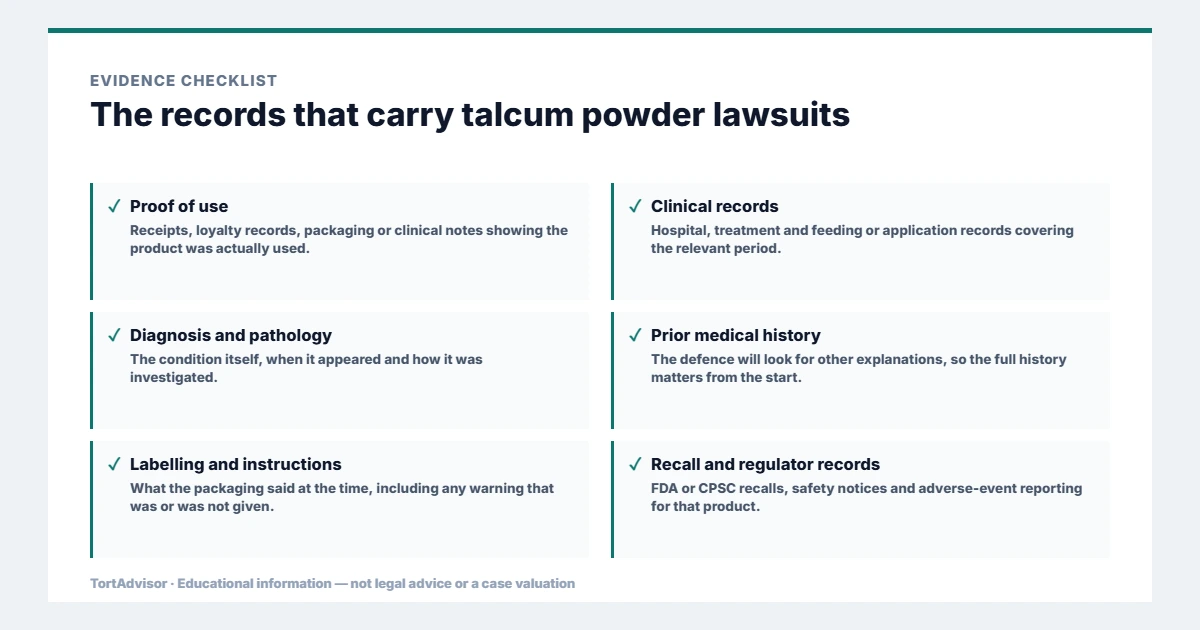
Before contacting an attorney, begin collecting supporting documentation. This includes medical records confirming your cancer diagnosis, purchase records or photos of talcum powder products you used, and any documentation of how long and how often you used the product. Witness statements from family members who remember your product use can also be helpful.
Step 2: Contact a Qualified Mass Tort Attorney
The talcum powder lawsuit is a specialized area of mass tort law. You need an attorney with experience in asbestos litigation, product liability, and the specific procedural history of MDL 2738. Most reputable talcum powder attorneys offer free case evaluations and work on a contingency fee basis — meaning you pay nothing unless you receive compensation.
Step 3: Complete Your Free Case Evaluation
Your attorney will review your medical records, product use history, and diagnosis details. They will determine whether your case meets the threshold requirements for filing. This evaluation is typically completed within one to two weeks.
Step 4: Your Claim Is Filed
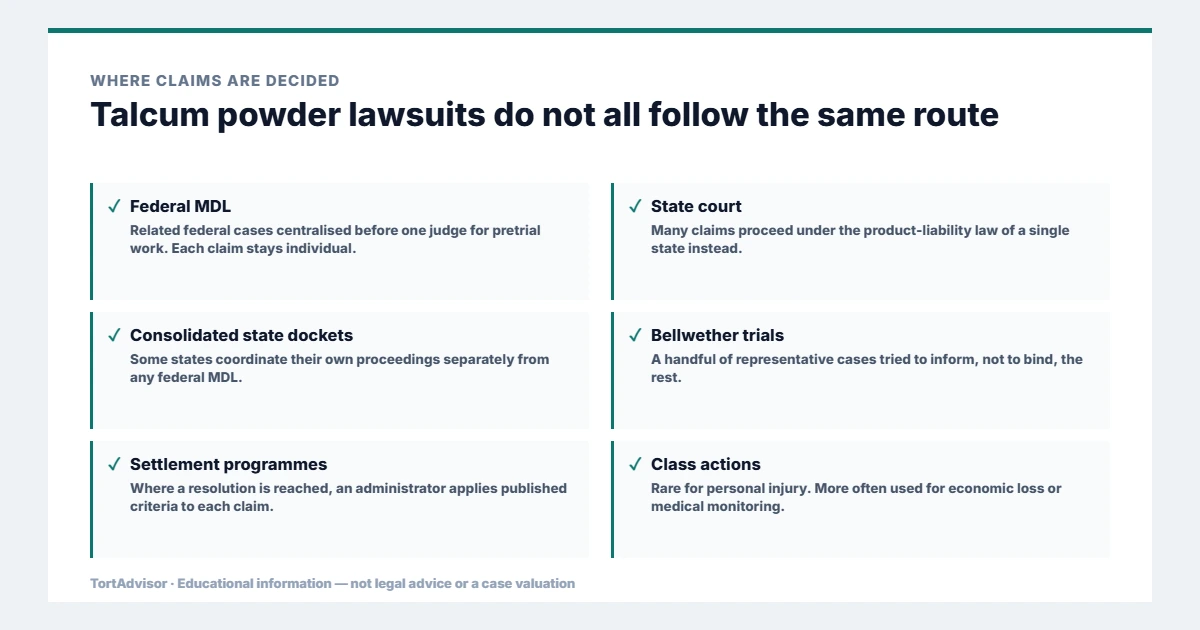
If your case is accepted, your attorney will file a Short Form Complaint in the federal MDL or a direct complaint in your state court. Your case becomes part of the consolidated litigation. Your attorney handles all filings, deadlines, and communications with opposing counsel.
Step 5: Discovery and Case Development
Your case enters the discovery phase, during which both sides exchange evidence. Your attorney will work with medical experts, pathologists, and epidemiologists to build a strong causation argument linking your talcum powder use to your cancer diagnosis.
Step 6: Settlement Negotiation or Trial
The majority of talcum powder cases are resolved through settlement negotiations rather than trial. Your attorney will advise you on any settlement offers and their fairness given the specifics of your case. If a fair settlement is not reached, your case may proceed to trial, where a jury will determine the outcome.
Statute of Limitations: Act Before Time Runs Out
The statute of limitations for a talcum powder lawsuit varies by state and typically runs from the date you were diagnosed with cancer or the date you knew (or reasonably should have known) that your cancer may be linked to talcum powder use. Most states allow two to three years from the discovery date. Here are the statute of limitations periods for some of the most common states where talcum powder cases are filed:
- California: 2 years from discovery of injury
- New York: 3 years from discovery
- New Jersey: 2 years from discovery
- Texas: 2 years from discovery
- Florida: 4 years for product-liability injury claims (§ 95.11(3)(d)); general negligence claims have had a 2-year limit since 2023
- Illinois: 2 years from discovery
- Missouri: 5 years from discovery
SourceFla. Stat. § 95.11Current lawMo. Rev. Stat. 516.120Current law
If you are the surviving family member of someone who died from ovarian cancer or mesothelioma linked to talcum powder, a wrongful death statute of limitations applies — typically two years from the date of death. Do not wait. Contact an attorney immediately to ensure your claim is preserved.
Talcum Powder Lawsuit Timeline: Key Events
Understanding the history of the talcum powder lawsuit helps illustrate why this litigation has continued for more than a decade and why it remains unresolved:
- 1971: Early internal J&J research reportedly identifies asbestos in talc samples. Documents later surface in litigation.
- 2006: IARC classifies perineal talc use as possibly carcinogenic (Group 2B).
- 2013: In the first talc–ovarian cancer trial, a South Dakota federal jury found J&J’s consumer unit negligent but awarded no damages.
- 2016: Missouri jury awards $72 million to the family of a woman who died from ovarian cancer linked to J&J Baby Powder; reversed on appeal in 2017 for lack of personal jurisdiction.
- 2018: Missouri jury awards $4.69 billion to 22 women in a consolidated talcum powder trial (reduced on appeal in 2020).
- 2018: Reuters investigation reveals J&J internal documents showing decades of knowledge about asbestos in its talc supply.
- 2019: FDA finds asbestos in Johnson’s Baby Powder lot; J&J issues voluntary recall of that lot.
- 2020: J&J discontinues talc-based Baby Powder in United States and Canada.
- 2021: J&J creates subsidiary LTL Management, which files for Chapter 11 on October 14, 2021, pausing talc suits.
- January 2023: Third Circuit orders LTL’s first bankruptcy dismissed, ruling that LTL was not in financial distress.
- 2023: J&J discontinues talc-based Baby Powder globally.
- July 2023: LTL’s second bankruptcy is dismissed.
- July 2024: IARC classifies talc as probably carcinogenic to humans (Group 2A).
- September 2024: Third bankruptcy attempt through Red River Talc LLC.
- March 31, 2025: The court refuses to confirm the Red River plan, and J&J returns to the tort system.
- December 2025: Baltimore jury awards about $1.56 billion in a talc mesothelioma case; J&J says it will appeal.
- February 2026: Philadelphia jury awards $250,000 ($50,000 compensatory, $200,000 punitive) to the family of a woman who died of ovarian cancer.
- July 2026: The federal MDL court orders plaintiffs to show why their claims should not be dismissed for lack of specific-causation proof (July 22), and J&J proposes a $5.5 billion ovarian-claims resolution (July 27). No bankruptcy plan is pending; 69,340 MDL cases remained on October 1, 2026.
SourceD.S.D. order (Berg)19 Nov 2013Mo. Ct. App. opinion17 Oct 2017Mo. Ct. App. opinion23 Jun 2020Reuters (news)14 Dec 2018FDA notice18 Oct 2019J&J statement19 May 20203d Cir. opinion30 Jan 2023J&J press release11 Aug 2022IARC Q&A (Vol. 136)Jul 2024J&J statement31 Mar 2025Daily Record (news)23 Dec 2025Reuters via Claims J.17 Feb 2026J&J press release27 Jul 2026JPML MDL report1 Sep 2026
Still unsure where you stand?
Have a trained case advisor review your own facts — free, confidential, and with no obligation.
- Free — no cost, no obligation
- About a minute to complete
- Reviewed by a trained case advisor
- Nothing you submit is published
Your details are sent over a secure connection and reviewed confidentially.
Frequently Asked Questions About the Talcum Powder Lawsuit
How much is a talcum powder lawsuit settlement worth?
There is no published per-person settlement value. On 27 July 2026 Johnson & Johnson proposed a $5.5 billion resolution of about 76,000 remaining ovarian talc claims, with the first payment of no more than $3 billion in 2027; it depends on at least 95% of claimants taking part and is not final. What an individual would receive under it has not been published.
SourceJ&J press release27 Jul 2026
Who qualifies for a talcum powder lawsuit?
You may qualify if you regularly used talc-based powder products (particularly J&J Baby Powder or Shower to Shower) on or near your genital area for at least one year and were subsequently diagnosed with ovarian cancer, peritoneal cancer, fallopian tube cancer, or mesothelioma. Family members of deceased claimants may pursue wrongful death claims.
Is the talcum powder lawsuit still active in 2026?
Yes. The JPML’s report of 1 October 2026 lists 69,340 cases pending in the federal talc MDL in New Jersey. On 22 July 2026 the MDL court ordered plaintiffs to show why the remaining claims should not be dismissed, and J&J’s proposed $5.5 billion resolution of ovarian claims is under consideration. J&J’s Red River Talc bankruptcy plan was rejected in March 2025, so the litigation returned to the courts.
SourceJPML1 Sep 2026J&J press release27 Jul 2026
What cancers are linked to talcum powder?
The International Agency for Research on Cancer classifies talc as probably carcinogenic to humans (Group 2A), based on limited evidence in humans for ovarian cancer. Talc contaminated with asbestos is linked to mesothelioma, because asbestos causes it.
SourceIARC Vol. 1365 Jul 2024
How long does a talcum powder lawsuit take?
Timelines vary. Under J&J’s July 2026 proposal, if it is finalized, the first payments would be made in 2027, with no further payments due before 2028. Cases outside any settlement continue on the court’s schedule.
SourceJ&J press release27 Jul 2026
Do I need to pay upfront to file a talcum powder claim?
No. Talcum powder attorneys typically handle these cases on a contingency fee basis, so you pay no upfront costs and no attorney fees unless you receive compensation. The contingency percentage and case costs are set in your written fee agreement.
Sources & Citations
- Reuters. (2018). Johnson & Johnson knew for decades that asbestos lurked in its Baby Powder. https://www.reuters.com/investigates/special-report/johnsonandjohnson-cancer/
- Penninkilampi, R. & Eslick, G. (2018). Perineal Talc Use and Ovarian Cancer: A Systematic Review and Meta-Analysis. Epidemiology. PubMed/NCBI
- International Agency for Research on Cancer (IARC). Agents Classified by the IARC Monographs. World Health Organization. WHO/IARC
- U.S. Food & Drug Administration. Talc. FDA.gov
- U.S. District Court, District of New Jersey. MDL No. 2738 — In re: Johnson & Johnson Talcum Powder Products Marketing, Sales Practices and Products Liability Litigation.
- Judicial Panel on Multidistrict Litigation. Pending MDL Dockets by Actions Pending (October 1, 2026). JPML
- Johnson & Johnson. Form 10-Q, quarter ended June 28, 2026 (talc litigation note). SEC EDGAR
- Johnson & Johnson. (July 27, 2026). Proposed resolution of ovarian talc litigation. jnj.com
- Missouri Court of Appeals. (2020). Ingham v. Johnson & Johnson, ED107476. Justia
- U.S. Court of Appeals for the Third Circuit. (2023). In re LTL Management LLC. ca3.uscourts.gov
- National Cancer Institute. Ovarian, Fallopian Tube, and Primary Peritoneal Cancer. Cancer.gov
Last reviewed: | Mason Arnao
See Talcum Powder Settlement Amounts 2026 for reported payout ranges, the factors that move claim value, and what the court record actually shows as of August 2026.
Related Posts

How VCF registration works: who should register, the two-year deadline and when it starts, how to register online or by phone, and how it fits with the WTC Health Program.
Paraquat exposure explained from EPA, CDC and court records: how it happens, who is most at risk, drift and vapor, the safety rules since 2016, Parkinson’s research, and the records that help show exposure.

The Supreme Court's June 25, 2026 ruling in Monsanto v. Durnell held that FIFRA can preempt state failure-to-warn claims, unsettling a central theory in paraquat cases. With 6,666 actions pending in MDL 3004 and a global settlement agreed in principle but no terms disclosed, here is what is verified and what is not.