
Foster Care Sexual Abuse Lawsuit: Who Can Be Liable
A foster care sexual abuse lawsuit may involve claims against foster parents or private agencies, but responsibility depends on each party’s own conduct—not simply their connection to the placement, as New York’s rules for private foster-care agency liability illustrate. A county or individual official may also face claims, depending on the duty involved and the facts; courts have recognized county responsibilities toward children placed in foster homes and potential constitutional claims involving individual officials.
The key is identifying who had responsibility for your or your child’s care, what they knew, and how they responded. This article explains the differences among potential defendants, how government immunity can affect a claim, what records may help clarify responsibility, and what to ask before discussing compensation.
It also addresses filing deadlines and notice requirements, using New York’s extended deadline for qualifying childhood sexual abuse claims as a state-specific example—not a nationwide rule.
Who can a foster care sexual abuse lawsuit hold responsible?
A foster care sexual abuse lawsuit may seek to hold the person who committed the abuse responsible, while also examining whether an agency’s own placement or supervision failures contributed to it. Those are different grounds for responsibility. In George v. Windham, a New York appellate court recognized claims alleging a private placement agency’s own negligent foster-parent selection and foster-home supervision. The decision concerned dismissal of claims, not a finding that liability had been proved.
To identify possible defendants without assuming everyone connected to a placement is liable, start with four questions:
- Who committed the abuse?
- Who selected the foster placement?
- Who supervised the placement?
- Who received warnings about abuse or an unsafe placement, and what did they do afterward?
In New York, CPLR 208(b) expressly addresses claims involving intentional or negligent acts or omissions alleged to have resulted in qualifying childhood sexual abuse. That language does not make every person or organization involved automatically responsible; identifying each proposed defendant’s alleged conduct remains essential.
The following sections distinguish possible defendants and the conduct attributed to each. For broader context, TortAdvisor’s sexual abuse lawsuit guide for survivors is another starting point. This is general legal information, not an individual eligibility determination, and TortAdvisor is not a law firm.
Find out if you may have a claim
Answer a few questions and a trained case advisor will review your situation — most people finish in about a minute.
- Free — no cost, no obligation
- About a minute to complete
- Reviewed by a trained case advisor
- Nothing you submit is published
Your details are sent over a secure connection and reviewed confidentially.
Foster parents and private agencies: different reasons for liability
A claim against a foster parent accused of sexual abuse focuses on the alleged abuse itself. A claim against a private placement agency asks a different question: did the agency’s own placement or supervision failures contribute to the abuse? New York’s childhood-abuse provision addresses claims involving intentional or negligent acts or omissions that allegedly resulted in qualifying sexual abuse. That provision does not, by itself, establish that any particular foster parent or agency is liable. New York CPLR 208(b) provides the statutory framework.
For a private agency, the focus should be on what it did—or failed to do—when selecting and supervising the placement. In a New York example, the court distinguished an agency’s own selection and supervision duties from automatic responsibility for a foster parent’s negligent acts. It also discussed the importance of sufficiently specific notice of dangerous conduct when assessing whether abuse was foreseeable. The alleged abuse involved another child in the home, not a foster parent, illustrating why agency supervision can matter regardless of who allegedly committed the abuse. The decision addressed dismissal, not whether liability had been proved, and offers a New York illustration rather than a nationwide rule. See the agency selection and supervision analysis in George v. Windham.
If you are exploring institutional sexual abuse claims, keep these questions separate: who allegedly committed the abuse, and what placement or supervision failures are attributed to the agency?
State agencies, counties, and individual officials are not interchangeable
Identifying who held legal custody—and whose actions or omissions are being challenged—helps clarify who may be responsible. A state agency, a county, and an individual official are not interchangeable defendants, and a state negligence claim raises different questions from a federal constitutional claim.
In New York, a municipality that assumes legal custody of a foster child owes a duty to protect the child from foreseeable harm arising from its chosen placement. Placing the child physically with foster parents does not erase that custodial responsibility. In Weisbrod-Moore v. Cayuga County, the court recognized this continuing custodial duty; its ruling at the dismissal stage did not establish that the county was ultimately liable.
A federal constitutional claim requires a separate analysis. In Henry A. v. Willden, the Ninth Circuit addressed foster children’s constitutional protection rights and deliberate indifference, examining allegations involving individual officials and a county. That analysis requires attention to each proposed defendant’s role; it should not be treated as a uniform nationwide test for foster-care liability.
The distinction between state and local government also matters. In Will v. Michigan Department of State Police, the Supreme Court held that states and state officials sued in their official capacities are not “persons” under the federal civil-rights provision at issue, while distinguishing municipalities. For a survivor evaluating a claim, the practical starting point is therefore more specific than “the foster-care system”: which entity held custody, which people made or carried out the challenged decisions, and what legal claim addresses their conduct?
What government immunity can—and cannot—mean
Government immunity is not a single defense that applies equally to a state, a county, and an individual official. The identity of the defendant, the type of claim, and the relief requested matter.
- States and state officials sued in their official capacity: Sovereign immunity and the limits on federal civil-rights claims are related but distinct issues. In Will, the Supreme Court held that states and state officials sued in their official capacity are not “persons” for federal civil-rights damages claims under Section 1983. The Court distinguished municipalities and preserved the distinction for official-capacity actions seeking prospective relief—orders addressing ongoing or future conduct rather than compensation for past harm. State immunity and official-capacity principles in Will.
- Individual officials: Qualified immunity can protect individual officials against damages claims, but it is not a municipality’s defense. In the foster-care case Henry A., the Ninth Circuit examined whether the alleged violations involved clearly established rights as part of its individual-official analysis. That analysis does not establish one nationwide test for every foster-care claim. Qualified-immunity distinctions in Henry A..
- County governmental-function immunity: Recognizing a duty to a child does not resolve every immunity question. In Weisbrod-Moore, New York’s highest court allowed a foster-care negligence claim to proceed, explaining that resolving the county’s governmental-function immunity defense was inappropriate at that dismissal stage. The decision did not establish that the county was ultimately liable. The limited immunity ruling in Weisbrod-Moore.
Extended childhood-abuse deadlines and notice-of-claim rules
A deadline review should consider both the time allowed to file a lawsuit and any separate requirements for notifying a government defendant. An extended childhood-abuse deadline should not be treated as a nationwide filing rule.
New York example: filing time and notice requirements
For qualifying claims, New York’s CPLR 208(b) allows a lawsuit to be commenced on or before the survivor reaches age 55. It covers claims alleging intentional or negligent acts or omissions that resulted in the abuse. A notice of claim is a pre-suit procedural requirement, distinct from filing the lawsuit. The statute expressly addresses contrary notice-of-claim and notice-of-intention requirements for the qualifying claims it covers. Read New York’s childhood sexual abuse filing provision and its notice-related language. Do not assume that treatment applies in another state or to a different claim.
To prepare for an individual deadline review, gather:
- The state where the foster placement occurred.
- Approximate abuse dates and the survivor’s current age.
- Names of public agencies, private agencies, and others involved in the placement.
- Information about any earlier claim, notice, or lawsuit, including available paperwork.
These are preparation suggestions—not a conclusion that a claim remains timely. TortAdvisor’s explanation of how sexual abuse filing deadlines work can help you prepare questions for that review.
What information can help clarify who was responsible?
Start with what you remember and any records you already have. You do not need a complete personal file before asking for legal advice, and you do not need to contact the alleged abuser to prepare for that conversation.
If available, gather:
- Agency names: Any public or private agencies involved in arranging or overseeing the placement.
- Placement details: Approximate placement dates and foster-home addresses. Mark dates as approximate if you are unsure.
- People involved: Foster-parent and caseworker names, along with any supervisors or other agency contacts you remember.
- Existing communications: Letters, emails, messages, or notes already in your possession, especially those about placement concerns, requests for help, or reports of abuse.
For a proposed agency claim, ask: “How do the placement decisions, supervision, and any earlier warnings relate to this agency’s responsibility?” Selection, supervision, and notice of dangerous conduct were central to the responsibility questions examined in George, a New York case involving alleged abuse by another child in the foster home. That decision addressed dismissal of claims, not whether liability had been proved.
If a proposed claim involves government officials, ask: “What action or failure to act is attributed to each person?” Rather than treating everyone involved as responsible for the same conduct, the individual-defendant analysis in Henry A. examined the allegations against particular officials.
This preparation is a starting point—not an assignment to investigate the abuse yourself. It is okay to identify gaps and ask what additional information may help clarify responsibility.

Questions to ask before discussing compensation
Before discussing a possible settlement, ask how each proposed defendant connects to what happened—and what information is still needed. You do not need to arrive with every answer. These questions can help keep a consultation focused:
- Who would the claim name, and why? Ask which alleged act or omission belongs to each foster parent, agency, county, or official, and which legal theory would apply. Responsibility for an agency’s own selection or supervision decisions is distinct from responsibility for a foster parent’s conduct, as explained in New York’s George v. Windham decision.
- What information is missing? Ask what records or other evidence could help establish who made placement decisions, what concerns were reported, and how those concerns were handled.
- What deadlines and notice requirements apply? Request separate answers about the filing deadline and any government notice requirement. For example, New York’s qualifying childhood sexual abuse provision permits specified claims until age 55 and expressly addresses contrary notice requirements; that is not a nationwide rule.
- What immunity defenses might arise? Ask about each defendant individually. Henry A. v. Willden distinguishes officials’ qualified-immunity defenses from the treatment of municipal defendants.
- What is alleged, and what can be proved? Ask what evidence supports each part of the proposed claim. A ruling allowing allegations to proceed is not itself proof of liability.
TortAdvisor’s sexual abuse settlement guide for survivors and broader settlement amounts and compensation guide can provide background for compensation questions, not a foster-care payout average or an outcome prediction. The sexual abuse settlement calculator is an optional discussion aid—not a determination of eligibility, liability, timeliness, or what a claim would receive.
Frequently asked questions
Can I sue a private foster care agency rather than only the person who abused me?
Potentially, yes. A claim against a private agency may focus on its own failures in selecting or supervising a foster home, rather than automatically holding it responsible for a foster parent’s conduct. In George v. Windham, the New York court distinguished those theories and examined notice and foreseeability. The decision addressed dismissal; it did not establish that the agency was liable.
Can an agency be responsible when another child in the foster home committed the abuse?
Possibly. George v. Windham, linked above, involved alleged abuse by another child in the foster home. The agency’s potential responsibility concerned its own selection and supervision of the placement, including whether it had specific notice of a foreseeable risk. The identity of the alleged abuser therefore does not, by itself, answer whether there may be a claim against the agency.
Does placing a child with foster parents end a county’s responsibility?
Not necessarily. In New York, Weisbrod-Moore v. Cayuga County explains that a county’s custodial responsibility can continue even when a child physically lives in a foster home. Whether the alleged harm was foreseeable remains important. That continuing responsibility does not establish liability by itself, but placement elsewhere does not automatically end the county’s duty.
Does government immunity automatically prevent a foster care abuse claim?
No single immunity rule answers every claim. Weisbrod-Moore, linked above, did not resolve governmental-function immunity in the county’s favor at dismissal. Henry A. v. Willden distinguishes individual officials’ qualified immunity from municipal liability. Will v. Michigan Department of State Police explains that states and state officials sued in their official capacities are not “persons” under the federal civil-rights damages framework at issue. The defendant and legal theory matter.
Can an adult survivor still bring a claim about childhood abuse in foster care?
In New York, potentially yes. CPLR § 208(b) allows qualifying childhood sexual-abuse claims to be brought until the survivor reaches age 55. Its language covers intentional or negligent acts or omissions by potential defendants, not only the conduct of the person who committed the abuse. This is a New York rule, not a nationwide deadline.
Does an extended childhood-abuse deadline also address government notice requirements?
New York’s provision does. The same CPLR § 208(b), linked above, expressly addresses contrary notice-of-claim and notice-of-intention requirements for qualifying claims. That means the extended filing deadline should not be read in isolation from the statute’s notice language. This does not establish that every extended childhood-abuse deadline elsewhere overrides government notice requirements, or that every foster care claim qualifies.
Sources
- George v. Windham, 2019 NY Slip Op 01201 · New York State Law Reporting Bureau — Appellate Division, Second Department · 2019-02-20
- Weisbrod-Moore v. Cayuga County, 2025 NY Slip Op 00903 · New York State Law Reporting Bureau — New York Court of Appeals · 2025-02-18
- Henry A. v. Willden · United States Court of Appeals for the Ninth Circuit · 2012-05-04
- Will v. Michigan Department of State Police, 491 U.S. 58 · Supreme Court of the United States — official United States Reports hosted by the Library of Congress · 1989-06-15
- New York Civil Practice Law and Rules § 208(b) · New York State Senate
This article is general information, not legal advice. Laws and deadlines vary by state and change over time; check the linked sources or speak with a licensed attorney about your situation.
Could a school or religious institution share responsibility for sexual abuse? This California guide explains institutional claims, evidence to discuss with a lawyer, and how to prepare for a case review.

Sexual abuse filing deadlines depend on the state, the survivor's age and whether the case is civil or criminal. How the clock works, with New York, Florida and federal law as examples.
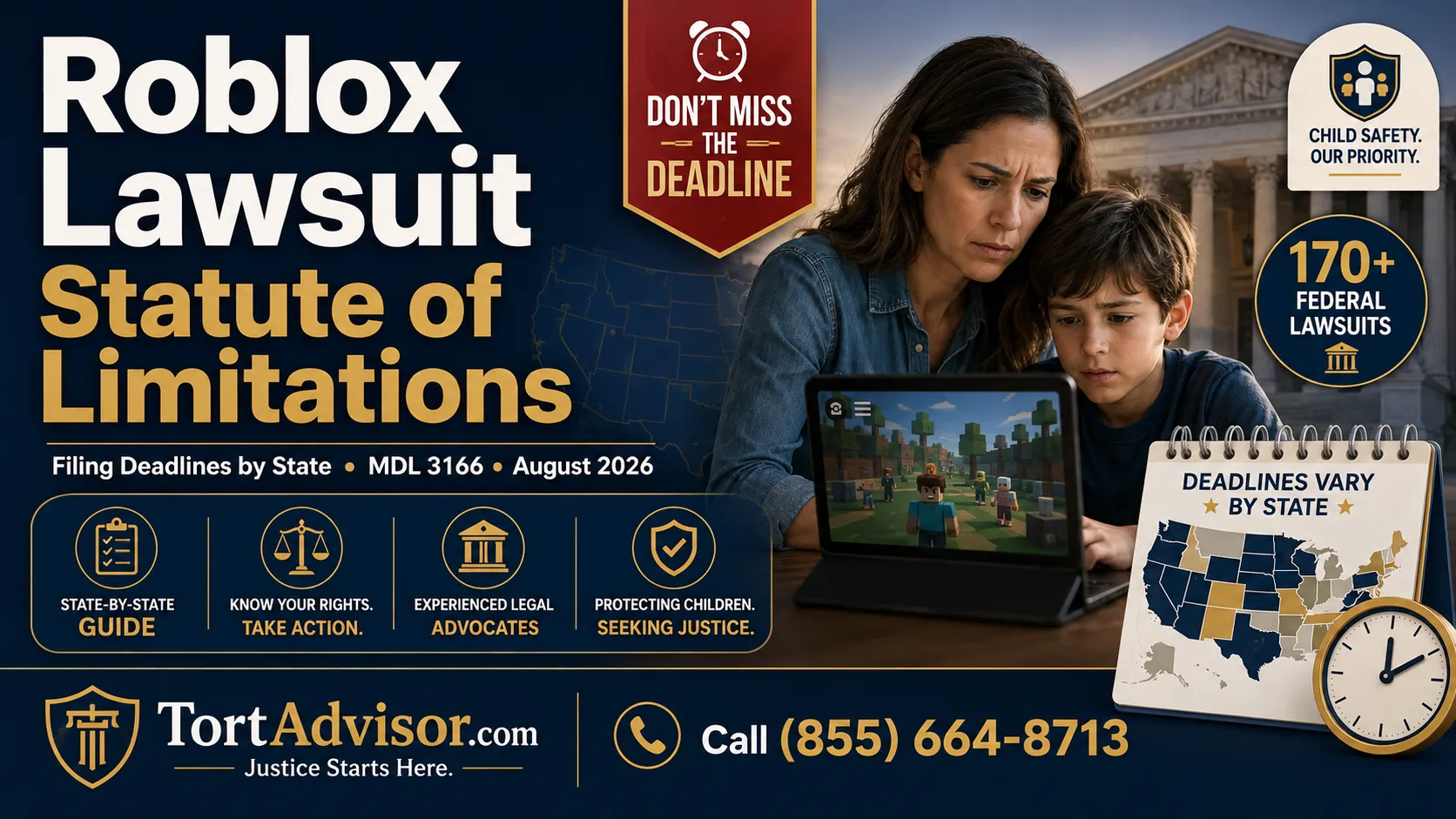
The Roblox lawsuit statute of limitations varies by state. This 2026 guide covers filing deadlines, the minor tolling rule, the discovery rule, and a full state-by-state table so families can determine if they still qualify to file a child exploitation claim.