
Utah Car Accidents Are Rising — Here’s What You Need to Know Right Now
Utah car accident rates have reached alarming levels, and every driver on the state’s roads needs to understand the risks.
Quick facts if you were just in a crash:
- Call 911 — Required if there’s injury, death, or $2,500+ in property damage
- Stay at the scene — Exchange name, address, insurance, and registration info
- Document everything — Photos, witness contacts, police report number
- Notify your insurer — Do this as soon as possible
- Know your rights — Utah’s no-fault system has strict rules about when you can sue
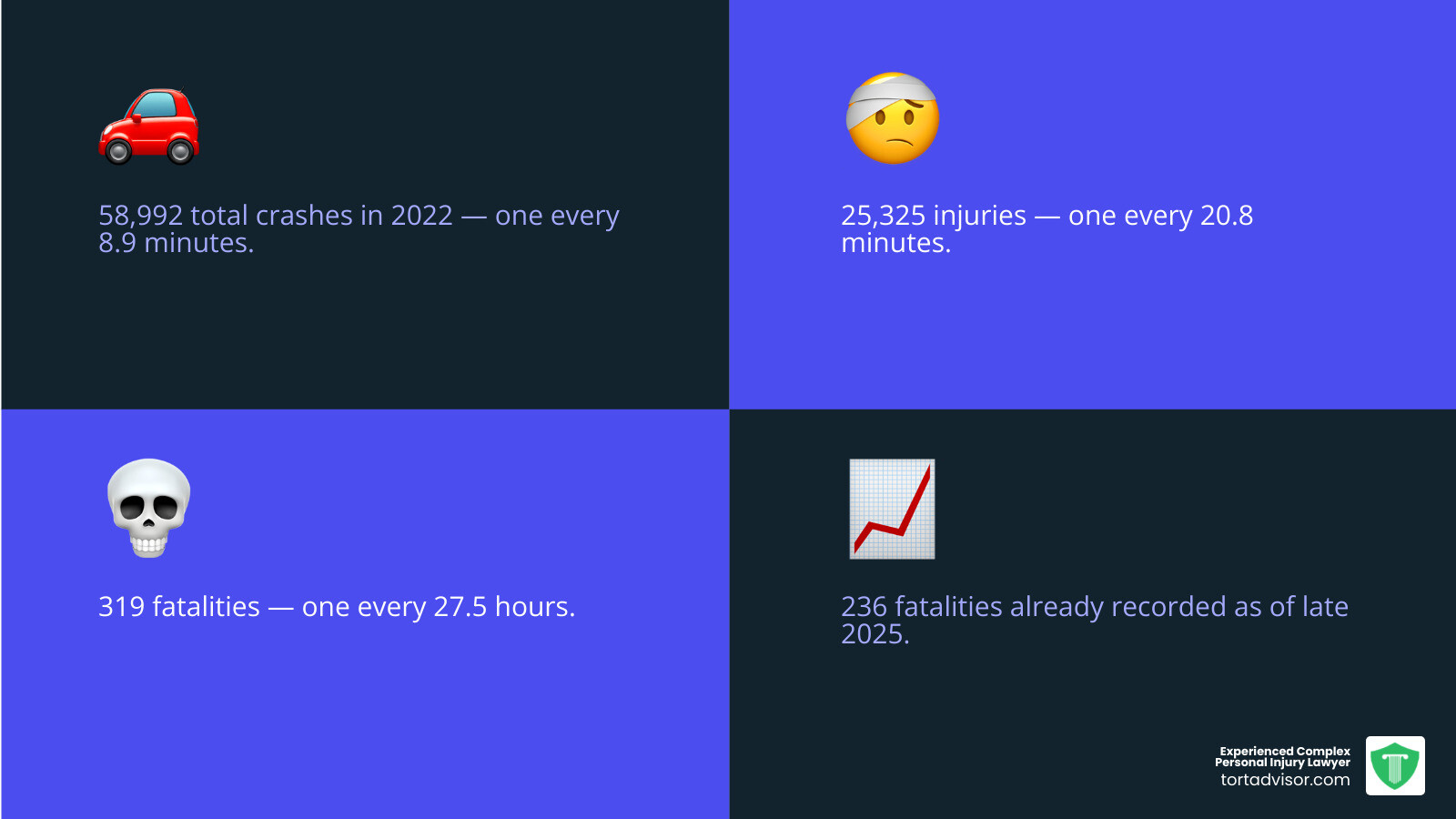
The numbers tell a serious story. In 2022 alone, Utah recorded 58,992 crashes, 25,325 injuries, and 319 fatalities. That breaks down to a crash every 8.9 minutes and a fatality every 27.5 hours. And as of late 2025, the state had already recorded 236 fatalities in a single year.
These aren’t just statistics. In February 2026, a fiery collision in Eagle Mountain — involving an SUV and a passenger car — left one person dead despite a deputy’s heroic rescue attempt. Crashes like this happen across Utah every single day.
I’m Mason Arnao, and while my background is in data systems and internet technology, I’ve spent years analyzing complex data — including traffic and legal data related to Utah car accidents — to help people understand what the numbers really mean. That experience shapes how this guide breaks down the facts so you can take action with confidence.
Utah car accident terms at a glance:
- Catastrophic injury attorney
- common motor vehicle accident injuries
- motor vehicle accident settlement amounts
Current Trends and Statistics for the Utah Car Accident
When we look at the raw data provided by the Utah Highway Safety Office, the picture of road safety in the Beehive State is sobering. We aren’t just seeing a slight uptick; we are seeing consistent patterns of high-velocity collisions and preventable tragedies.

In 2022, Utah saw a staggering 58,992 total crashes. To put that in perspective, that’s nearly 162 crashes every single day. While many of these are “fender benders,” a significant portion results in life-altering consequences. The Utah Crash Summary highlights that 25,325 people were injured in these events.
The severity of these incidents is often underscored by recent headlines. On February 11, 2026, a horrific crash occurred in Eagle Mountain at 6384 North. A passenger car and an SUV collided with such force that the car burst into flames. A sheriff’s deputy heroically pulled the driver from the wreckage, but unfortunately, the victim passed away at the scene. This incident serves as a grim reminder of how quickly a routine drive can turn fatal. For real-time updates on such tragedies, the Statewide Fatality Report provides preliminary data on current year trends.
Fatalities and Demographics in a Utah Car Accident
Who is most at risk on Utah roads? The data reveals specific demographic trends that are vital for safety awareness. According to the Fatalities Data, men are disproportionately represented in fatal crashes, accounting for approximately 75% of all traffic deaths in the state.
Age also plays a massive role. The 20-29 age group consistently records the highest number of fatal crashes. In 2022, this group was involved in 65 fatal incidents. Furthermore, the type of road user matters immensely:
- Drivers: 49% of fatalities
- Motorcyclists: 14% of fatalities (despite making up a tiny fraction of registered vehicles)
- Pedestrians: 14% of fatalities
- Passengers: 14% of fatalities
Motorcyclists and pedestrians are particularly vulnerable. As of late 2025, motorcycle drivers represented 28.2% of all fatalities, a figure that highlights the extreme danger these riders face when sharing the road with larger vehicles.
Urban vs. Rural Crash Dynamics
There is a fascinating, albeit deadly, paradox between Utah’s urban and rural roads. If you look at the Utah Crash Facts 2022, you’ll notice that urban areas like Salt Lake County have a much higher rate of total crashes—213.6 per 100 million Vehicle Miles Traveled (VMT). This makes sense given the congestion and frequency of intersections (where 49% of all crashes occur).
However, rural roads are significantly more dangerous when it comes to fatalities. The fatal crash rate in rural Utah is 0.99 per 100 million VMT, compared to 0.81 in urban areas. Why? Rural accidents often involve higher speeds, longer emergency response times, and a higher likelihood of vehicles leaving the roadway. Interestingly, 82% of all crashes in Utah occur on dry roads, suggesting that driver behavior, rather than poor weather, is the primary culprit.
Top Contributing Factors and Dangerous Roadways
What is actually causing these Utah car accident spikes? It isn’t just “bad luck.” Most crashes are the result of specific, identifiable driver behaviors.
According to official safety reports, the top five driver-related factors in all Utah crashes are:
- Failed to Yield Right-of-Way: 20%
- Followed too Closely: 19%
- Speeding: 14%
- Failed to Keep in Proper Lane: 13%
- Unsafe Lane Change: 8%
When we shift the focus to fatal crashes, the Speed Related Data shows that speeding becomes the undisputed killer, contributing to 35% of all deaths. Following closely behind is the failure to stay in the proper lane (31%). These two factors alone account for the majority of highway tragedies in our state.
Utah’s Most Dangerous Highways
Not all roads are created equal. Certain stretches of pavement in Utah consistently see higher volumes of accidents due to high speed limits, heavy commuter traffic, and environmental hazards.
- I-15: Averaging 22 fatal crashes per year, this is Utah’s deadliest artery.
- US-89: Coming in a close second with 20 fatal crashes per year.
- I-80: Records about 9 fatal crashes annually.
- SR-68 and SR-89: Both average roughly 6 fatal crashes per year.
Utah is famous for its 80 mph speed limits on certain stretches of highway. While efficient, these high speeds reduce reaction time and increase the violence of an impact. Additionally, the Federal Highway Administration weather impacts report reminds us that while most crashes happen on dry roads, Utah’s winter snow and ice significantly complicate mountain driving. Wildlife is another unique factor; thousands of animal-involved crashes occur annually as deer and elk migrate across major transit corridors.
Navigating Utah’s No-Fault Insurance and Liability Laws
Understanding the legal aftermath of a Utah car accident is often more confusing than the crash itself. Utah operates under a “no-fault” insurance system, which essentially means your own insurance company pays for your initial medical bills regardless of who caused the accident.
| Feature | Personal Injury Protection (PIP) | Liability Coverage |
|---|---|---|
| Who it covers | You and your passengers | The other driver/passengers |
| Fault required? | No | Yes (you must be at fault) |
| Utah Minimum | $3,000 | $25k per person / $65k per accident |
| Purpose | Immediate medical costs | Damages you owe others |
Under this system, every driver must carry a minimum of $3,000 in Personal Injury Protection (PIP). This is designed to reduce the burden on the court system by handling smaller claims quickly. However, $3,000 barely covers an ER visit these days. If your injuries are serious, you may need to step outside the no-fault system to pursue a lawsuit against the at-fault driver. To understand the potential value of your claim, you can use an MVA Settlement Calculator or consult a Car Accident Lawsuits Guide.
Modified Comparative Negligence in a Utah Car Accident
If you do decide to sue, Utah’s “modified comparative negligence” rule comes into play. This is a “50% bar” rule. It means you can recover damages as long as your fault is less than 50%.
If a jury finds you were 20% responsible for the crash (perhaps you were speeding slightly), your total Motor Vehicle Accident Settlement Amounts will be reduced by that 20%. However, if you are found 50% or more at fault, you get nothing.
Proving negligence requires meticulous evidence collection. This includes:
- Police reports and citations issued at the scene.
- Photos of skid marks and vehicle resting positions.
- Eyewitness testimony.
- Expert accident reconstruction.
Essential Steps and Traffic Laws to Know
The moments following a Utah car accident are chaotic, but your actions during this time are critical for both your physical safety and your future legal rights.
First, Utah law requires you to stop and remain at the scene. If possible, move your vehicle out of the flow of traffic to avoid secondary collisions. You must exchange information with the other party, including names, addresses, and insurance details.
The $2,500 Rule: In Utah, you are legally required to report an accident to the police if it results in injury, death, or apparent property damage of $2,500 or more. Given the cost of modern vehicle repairs, almost any multi-car collision will meet this threshold. Knowing How to Report a Motor Vehicle Accident properly can protect you from “hit and run” allegations and ensure an official record exists for your insurance claim.
Key Traffic Regulations for Safety
To stay safe and avoid liability, every driver should be intimately familiar with Utah’s specific traffic codes:
- Seat Belts: Utah has a primary seat belt law. This means police can pull you over just for not wearing a belt. Drivers are responsible for all passengers under 16.
- DUI Limits: Utah has the strictest DUI limit in the nation at .05% BAC. Even a single drink can put you over the legal limit.
- Distracted Driving: It is illegal to use a handheld device for texting, emailing, or internet browsing while the vehicle is in motion. Hands-free voice features are allowed, but manual entry is a violation.
- Teen Drivers: Utah’s graduated licensing requires 40 hours of supervised driving (10 at night) and restricts night driving and non-family passengers for the first six months.
- Statute of Limitations: You generally have four years from the date of the accident to file a personal injury lawsuit in Utah. If you miss this window, you lose your right to sue forever. For more on these timelines, see our Car Accident Lawyers Complete Guide.
Frequently Asked Questions about Utah Crashes
What is the injury threshold to sue an at-fault driver in Utah?
Because of the no-fault system, you can only sue the other driver for “pain and suffering” (non-economic damages) if you meet the “tort threshold.” This requires your medical expenses to exceed $3,000, OR that the accident resulted in permanent disability, permanent impairment, permanent disfigurement, or dismemberment.
How long do I have to file a lawsuit after a Utah car accident?
The statute of limitations for a personal injury claim arising from a car accident in Utah is four years. However, if the accident resulted in a fatality, a wrongful death claim must typically be filed within two years. If the accident involved a government vehicle, the deadlines are much shorter (often only one year to file a notice of claim).
What are the minimum insurance requirements in Utah?
Utah law requires the following minimum coverages:
- PIP: $3,000 per person.
- Liability (Bodily Injury): $25,000 per person and $65,000 per accident.
- Liability (Property Damage): $15,000 per accident.
- Uninsured Motorist: Must be offered, though it can be waived in writing (we highly recommend keeping it).
Conclusion
The rising tide of Utah car accident fatalities and injuries is a call to action for every resident. From the high-speed corridors of I-15 to the dangerous intersections of our growing urban centers, the risks are real and the legal landscape is complex.
At Tort Advisor, we understand that a car accident is more than just a legal case—it’s a disruption to your life, your health, and your family’s stability. We connect clients with top-rated specialty attorneys who have a proven track record of navigating Utah’s no-fault system and modified comparative negligence rules. Our goal is to ensure you aren’t just another statistic, but a survivor who receives the full compensation you deserve.
If you or a loved one has been impacted by a crash, don’t navigate the insurance maze alone. Let us help you find the right legal expertise to protect your future.
Free Confidential Case Evaluation
Complete the short form below to get an immediate FREE case review with an expert in your specific claim. Don't wait, your case could be time sensitive to file a claim.
Related Posts

Breaking Depo-Provera lawsuit update: Pfizer files Daubert motion in the meningioma MDL ahead of June 24–26 causation hearings. 3,790 plaintiffs, settlement estimates $100K–$1.5M, who qualifies in 2026. Call 1 (855) 664-8713 for a free case review.

Discover what to do after a Maryland car accident: immediate steps, insurance laws, claims, and legal help for commuters on I-95.

Discover the average payout for cancer misdiagnosis: $450K median settlements. Learn factors, real cases & how to claim compensation today.

Learn about the recall on gummy bear implants, BIA-ALCL risks, affected models, symptoms, lawsuits & compensation. Get expert legal guidance now!

Hire a defective product injury lawyer to fight for compensation after a defect causes harm. Learn strict liability, defects & claims.
Discover PFAS lawsuit settlement amounts per person kidney cancer: $150K-$500K estimates, eligibility, timelines & claim guide. Get started now!