
PFAS Lawsuit 2026: MDL 2873, Cancer Claims & Settlement Update
PFAS lawsuit claims involve alleged exposure to per- and polyfluoroalkyl substances—often called “forever chemicals”—through aqueous film-forming foam (AFFF), contaminated drinking water, military or airport sites, industrial workplaces and other sources. Federal AFFF claims are centralized in MDL 2873 in the District of South Carolina, where personal-injury bellwether proceedings remain active and major public-water settlements are separate from unresolved individual injury claims.
From here you can work through the PFAS settlement calculator, read the PFAS settlement amounts already on the public record, and read the latest PFAS and AFFF litigation update.
Choose the PFAS Lawsuit Information You Need
Start with potential eligibility or the September 2026 MDL status, then review health evidence, exposure proof, settlements or the calculator.
What Is the PFAS Lawsuit About?
PFAS litigation includes different claim types. MDL 2873 primarily coordinates lawsuits involving AFFF and alleged PFAS contamination, including personal injury, medical monitoring, property and public-water claims. Plaintiffs generally allege that PFAS-containing products contaminated water or directly exposed workers and that manufacturers failed to adequately warn about alleged health risks. Defendants dispute liability and case-specific causation.
Cancer & Disease Claims
Claimants may allege that occupational, military, AFFF or contaminated-water exposure contributed to a diagnosed disease.
Public-Water Claims
Separate settlement agreements fund testing, treatment and remediation for qualifying public water systems. These are not individual injury funds.
Property & Monitoring
Some litigation involves property damage, medical monitoring, governmental or environmental claims with different proof and damages rules.
PFAS / AFFF MDL 2873 Status in October 2026
In re: Aqueous Film-Forming Foams Products Liability Litigation, MDL No. 2873, remains centralized in the U.S. District Court for the District of South Carolina before Judge Richard M. Gergel. JPML’s October 1, 2026 report lists 15,264 pending actions and 19,840 historical actions.
December 7, 2018 — MDL 2873 Created
JPML centralized federal AFFF cases in the District of South Carolina for coordinated pretrial proceedings.
March 2024 — Major Public-Water Settlements Approved
Separate public-water agreements involving 3M and DuPont/Chemours/Corteva moved through final approval. Those agreements do not resolve individual personal-injury claims.
August 15, 2025 — CMO 35 Vacates Bellwether Date
The court vacated the October 20, 2025 bellwether trial and identified six “Listed Claims” for case-management purposes: kidney cancer, testicular cancer, ulcerative colitis, thyroid disease, liver cancer and thyroid cancer.
July 30, 2026 — CMO 33E
The court set Rule 702 briefing for thyroid-cancer and liver-cancer general-causation experts: motions August 24, responses October 8 and replies November 2.
July 30, 2026 — CMO 26O
The court moved the Group B deadline for proposed ulcerative-colitis selections and expert-discovery proposals to November 20, 2026.
September 1, 2026 — 15,264 Actions Pending
JPML’s current monthly report confirms that MDL 2873 remains one of the nation’s largest active product-liability MDLs.
Who May Qualify for a PFAS Lawsuit?
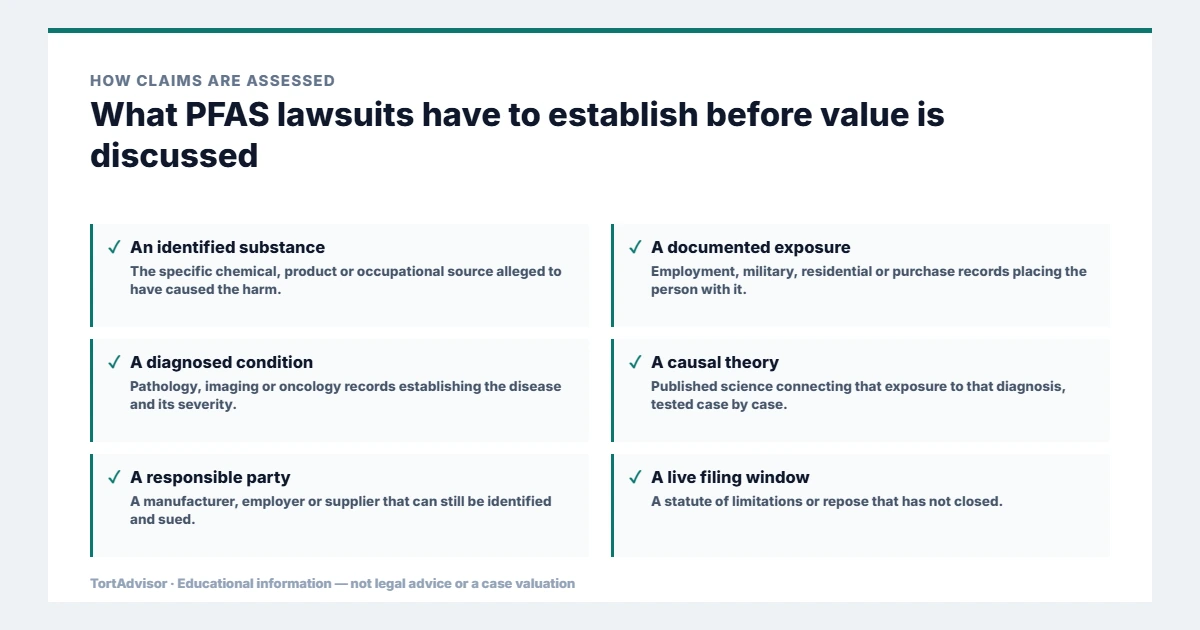
There is no universal PFAS eligibility rule. A personal-injury claim generally requires a documented exposure pathway, a medically established injury, a plausible defendant connection, timely filing and case-specific causation evidence.
Documented Exposure
- Regular AFFF exposure as a military, airport, industrial or municipal firefighter.
- Military service or employment at a facility with documented PFAS contamination.
- Long-term residence served by a contaminated public water system or private well.
- Industrial work involving PFAS manufacturing, processing or use.
Documented Diagnosis
- Pathology, oncology or other medical records identify the disease.
- Diagnosis date follows the alleged exposure period.
- Treatment history, prognosis and competing risk factors can be evaluated.
Source / Defendant Evidence
Water testing, military assignments, fire-department records, AFFF procurement or training records, industrial employment documents and contamination data can help connect exposure to a source and potential defendant.
Deadline & Claim History
State statutes of limitation, statutes of repose, wrongful-death rules, prior settlements and whether a claimant already filed or released claims can materially affect eligibility.
PFAS Cancer and Disease Claims in MDL 2873
Scientific support differs by compound, dose, exposure route and disease. EPA says peer-reviewed studies show that exposure to certain PFAS may be associated with increased risk of some cancers, including kidney, testicular and prostate cancer. ATSDR specifically identifies an association between PFOA exposure and kidney and testicular cancer. IARC classifies PFOA as carcinogenic to humans (Group 1) and PFOS as possibly carcinogenic to humans (Group 2B), while emphasizing that its classifications identify cancer hazard rather than an individual person’s risk at a specific dose.
| Condition | Current Scientific / Litigation Context | Case Review Factors |
|---|---|---|
| Kidney cancer / renal cell carcinoma | ATSDR identifies an association with PFOA; IARC reports limited human evidence for renal cell carcinoma. Listed Claim in CMO 35. | Pathology, exposure duration, water/AFFF source, latency, smoking/medical risks and treatment. |
| Testicular cancer | ATSDR identifies an association with PFOA; IARC reports limited human evidence for testicular cancer. Listed Claim in CMO 35. | Diagnosis subtype, exposure history, age, treatment, fertility consequences and other risk factors. |
| Thyroid cancer | Listed Claim in CMO 35; thyroid-cancer general-causation expert motions are scheduled under CMO 33E. | Pathology, subtype, exposure route, latency, competing thyroid risk factors and expert evidence. |
| Liver cancer | Listed Claim in CMO 35; liver-cancer general-causation expert motions are scheduled under CMO 33E. | Cancer subtype, liver history, viral/alcohol/metabolic risk factors, exposure proof and expert support. |
| Thyroid disease | Listed Claim in CMO 35. ATSDR says human studies do not show consistent evidence of association, while NASEM has characterized evidence differently. | Exact thyroid diagnosis, onset, treatment, exposure period, medication history and alternative causes. |
| Ulcerative colitis | Listed Claim in CMO 35 and part of Group B personal-injury discovery under CMO 26O. ATSDR says findings are not consistent across studies. | GI records, colonoscopy/pathology, exposure timeline, family history and alternative causes. |
Common PFAS Exposure Sources in Lawsuit Claims
AFFF Firefighting Foam
Military and civilian firefighters, airport rescue crews and industrial fire brigades may have direct occupational exposure through training, testing, cleanup and emergency response.
Contaminated Drinking Water
Residence near military bases, airports, industrial sites, landfills or PFAS manufacturing facilities may be relevant when public or private water testing documents contamination.
Industrial Workplaces
PFAS manufacturing, metal plating, textiles, paper treatment and certain chemical-processing environments can require source-specific exposure analysis.
What EPA, ATSDR and IARC Say About PFAS Health Risks
EPA says current peer-reviewed studies show that exposure to certain levels of PFAS may be associated with reproductive, developmental, immune, hormonal, cholesterol and cancer effects. EPA also emphasizes that thousands of PFAS exist, toxicity differs among compounds, exposure can occur by different routes and major research gaps remain.
ATSDR’s clinician guidance identifies evidence of associations between specific PFAS and several health outcomes, including kidney and testicular cancer with PFOA exposure. ATSDR also distinguishes conditions for which human findings are inconsistent. IARC’s PFOA Group 1 and PFOS Group 2B classifications identify carcinogenic hazard; they do not determine the probability that a particular exposure caused an individual cancer.
Association, Not One-Size-Fits-All Risk
EPA lists kidney, testicular and prostate cancers among possible health effects associated with certain PFAS exposures while emphasizing compound-specific uncertainty.
PFOA: Kidney & Testicular Cancer
ATSDR reports epidemiological evidence of associations with kidney and testicular cancer for PFOA and provides separate strength-of-evidence context for other conditions.
PFOA Group 1; PFOS Group 2B
IARC classifies PFOA as carcinogenic to humans and PFOS as possibly carcinogenic to humans, based on its formal hazard-evaluation framework.
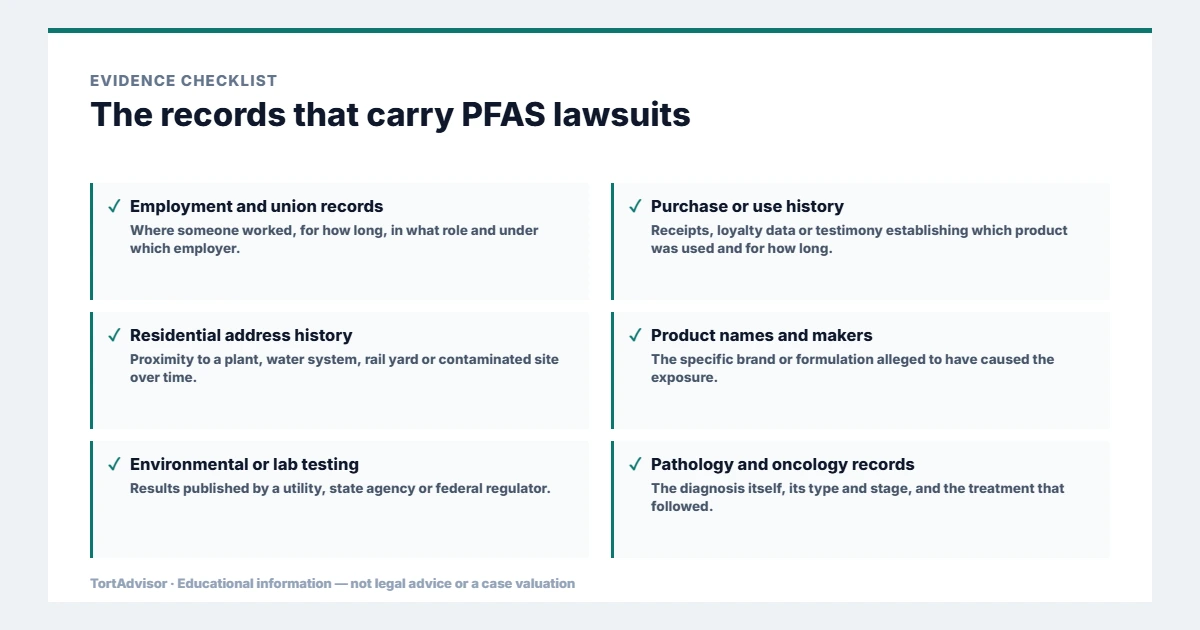
Evidence Commonly Reviewed in a PFAS Cancer Lawsuit
Medical Records
Pathology, diagnostic imaging, oncology, surgery, medication, gastroenterology or endocrinology records can establish the diagnosis and treatment burden.
AFFF / Employment Records
Military records, fire-department rosters, training logs, incident records, procurement documents, job descriptions and tax records can help establish occupational exposure.
Water / Residence Evidence
Water-system identifiers, utility records, private-well results, environmental sampling, deeds, leases and address histories can help establish contaminated-water exposure.
Damages Documentation
Medical bills, wage loss, reduced earning capacity, travel, disability, caregiving, future care and wrongful-death records may support damages.
PFAS Lawsuit Settlement Status and Individual Value Factors
Large PFAS settlements already exist, but the biggest confirmed agreements are primarily for public-water systems—not personal-injury claimants. 3M’s finalized public-water settlement has a nominal cap of $12.5 billion and an expected present-value commitment reported at up to approximately $10.3 billion. DuPont, Chemours and Corteva agreed to contribute $1.185 billion to a separate defined public-water-system settlement fund.
Those agreements do not provide a court-approved nationwide payout chart for a firefighter, service member, industrial worker or resident alleging cancer or another personal injury. As of August 20, 2026, the personal-injury litigation remains in expert and bellwether-development proceedings.
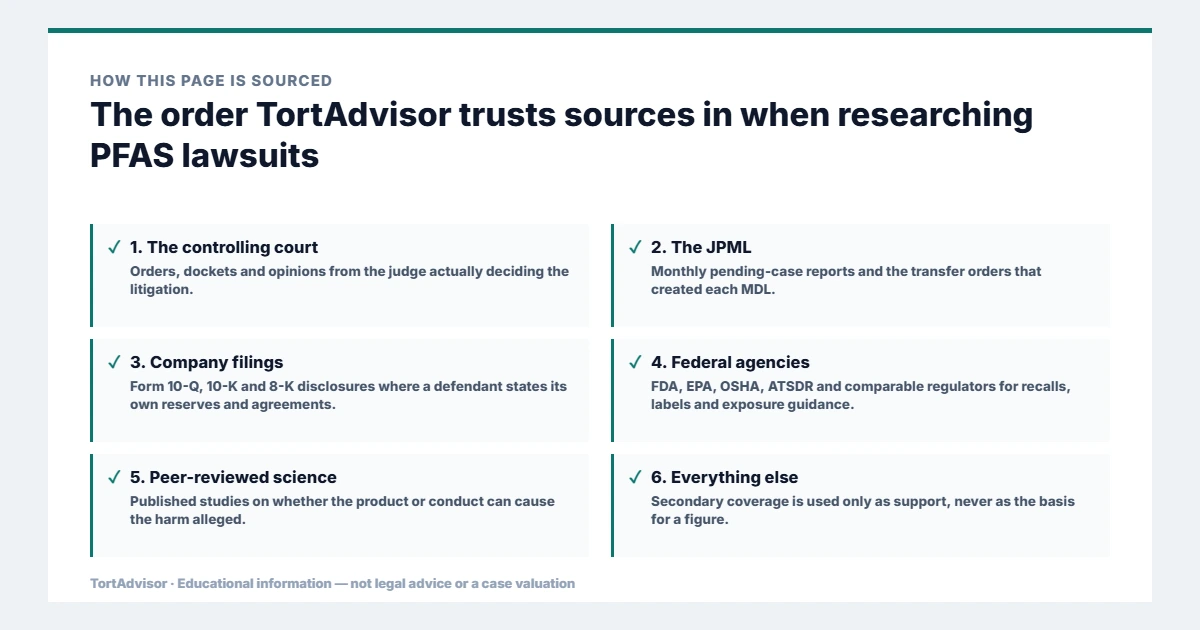
Every status, deadline and figure published on this page about PFAS lawsuits is traced to a primary source before it appears.
Exposure Strength
Duration, frequency, route, concentration, AFFF contact, workplace history and location-specific contamination evidence can affect causation and value.
Diagnosis & Severity
Disease type, stage, recurrence, treatment, surgery, prognosis, disability and future care can materially affect damages.
Scientific Causation
The fit between the specific PFAS compound, exposure route, disease and admissible expert evidence remains central to litigation risk.
Source / Defendant Proof
Identifying AFFF manufacturers, contaminated water sources, base assignments or industrial sources can materially affect claim viability.
Economic & Life Impact
Medical expense, wage loss, reduced earning capacity, disability, caregiving and wrongful-death losses may be recoverable depending on law.
State Law & Deadlines
Discovery rules, limitation periods, statutes of repose, governmental notice rules and prior releases can materially change outcomes.
How a PFAS Lawsuit May Be Evaluated
Identify Exposure
Build the AFFF, work, military, residential or contaminated-water timeline.
Confirm Diagnosis
Collect pathology, diagnostic and treatment records for the claimed disease.
Identify Source
Connect exposure to a water system, military base, airport, employer, industrial site or AFFF product where possible.
Review Causation
Evaluate compound, route, dose, latency, alternative risk factors and current expert evidence.
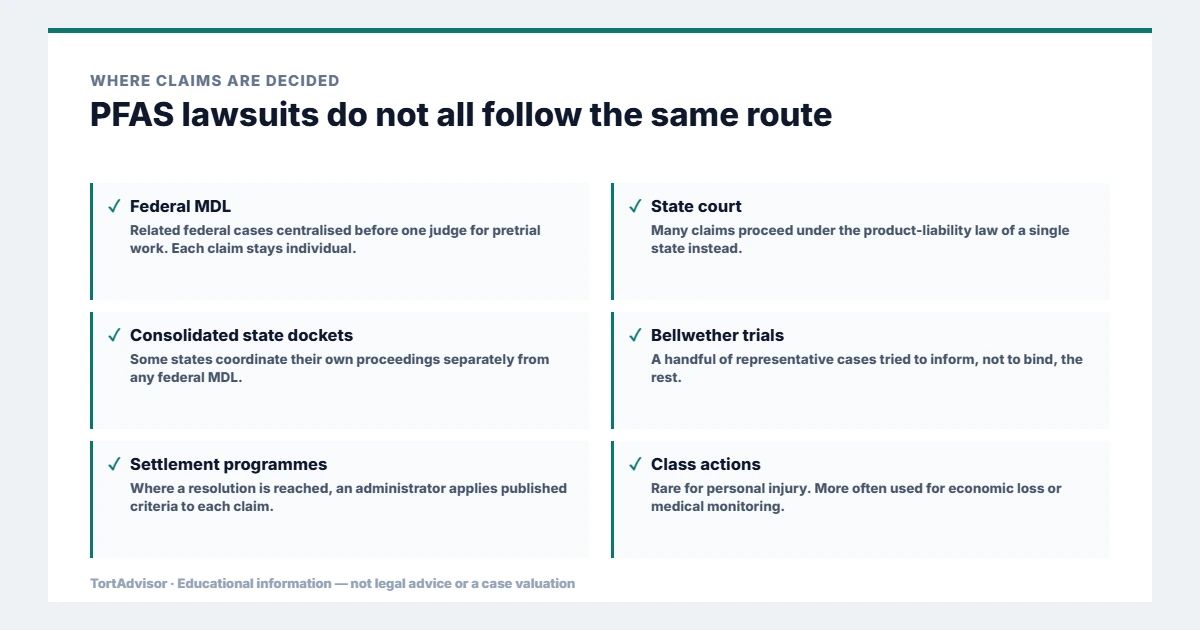
Check Claim Path
Determine whether the case fits MDL 2873, another PFAS claim pathway or a state-specific action.
Document Damages
Preserve bills, wage records, disability, future care, household impact and other legally supported losses.
PFAS Lawsuit Statute of Limitations
There is no single nationwide filing deadline for every PFAS claim. State law can make accrual depend on diagnosis, discovery of a possible PFAS connection, exposure source, residence, wrongful death, governmental defendants, prior litigation and other facts. Some states also impose statutes of repose or special notice requirements.
TortAdvisor publishes research on PFAS lawsuits and does not represent claimants. Nothing on this page is a prediction about the outcome of a particular claim.
PFAS Lawsuit FAQ
How many PFAS / AFFF lawsuits are pending?
The October 1, 2026 JPML report lists 15,264 actions pending and 19,840 historical actions in MDL 2873.
SourceJPML1 Sep 2026
What changed in the PFAS MDL in July 2026?
On July 30, Judge Gergel entered CMO 26O, moving Group B ulcerative-colitis selection/expert proposals to November 20, 2026, and CMO 33E, setting Rule 702 briefing deadlines for thyroid- and liver-cancer general-causation experts.
Which disease claims is the MDL currently managing?
CMO 35 identifies six Listed Claims for case-management purposes: kidney cancer, testicular cancer, ulcerative colitis, thyroid disease, liver cancer and thyroid cancer. Inclusion on that list does not automatically establish eligibility or causation.
SourceD.S.C.CMO 35
Has there been a global PFAS personal-injury settlement?
No court-approved nationwide personal-injury payout matrix has been announced. Major water-system settlements are separate and do not set compensation for individual cancer or disease claims.
SourceBASF21 May 2024
What cancers have the strongest federal health-association evidence?
ATSDR identifies epidemiological associations between PFOA exposure and kidney and testicular cancer. IARC reports limited human evidence for renal cell carcinoma and testicular cancer and classifies PFOA as carcinogenic to humans.
Do I need a PFAS blood test to file a lawsuit?
Not necessarily. Blood testing can measure certain PFAS in the body but generally cannot identify the source or timing of exposure or prove medical causation by itself. Exposure and medical records may be more important.
SourceATSDRClinical guidance
Are the $12.5 billion and $1.185 billion settlements personal-injury funds?
No. Those widely cited agreements address defined public-water-system claims. They should not be divided by the number of personal-injury plaintiffs or described as individual cancer settlement funds.
Can a PFAS wrongful-death claim be filed?
Potentially, but who may file, recoverable damages and the filing deadline are controlled by applicable state law and the specific exposure and medical evidence.
SourceN.Y. EPTLSec. 5-4.1
PFAS Lawsuit Sources and Official References
- U.S. District Court for the District of South Carolina — MDL 2873. Official AFFF multidistrict-litigation page.
- JPML — Pending MDLs by Actions Pending, October 1, 2026. Current MDL statistics used for the 15,264 pending / 19,840 historical count.
- Case Management Order 26O — July 30, 2026. Moves Group B proposed selections and expert-discovery proposal deadline to November 20, 2026.
- Case Management Order 33E — July 30, 2026. Sets Rule 702 briefing for thyroid- and liver-cancer general-causation experts.
- Case Management Order 35 — August 15, 2025. Vacates the October 2025 bellwether date and identifies six Listed Claims for MDL management.
- U.S. EPA — Current Understanding of PFAS Health and Environmental Risks. Federal summary of current health-effect evidence and scientific uncertainties.
- ATSDR — PFAS Health Effects for Clinicians. Reviews disease-specific association evidence.
- IARC Monographs Volume 135. PFOA Group 1 and PFOS Group 2B cancer-hazard evaluations.
- 3M — Public Water Supplier Settlement Final Approval. Describes the finalized settlement and payment structure.
- Chemours / DuPont / Corteva — $1.185 Billion Public-Water Settlement. Company disclosure describing the defined public-water-system settlement fund.
Request a Confidential PFAS Case Review
If you had significant AFFF, occupational, military or contaminated-water exposure and were later diagnosed with a serious condition, submit the exposure, diagnosis, treatment and source information you know now for review.