
Ozempic Gastroparesis Lawsuit: What to Know in 2026
This article supports TortAdvisor’s
Ozempic Lawsuit Research.
For an educational claim-value estimate, use the
Ozempic Settlement Calculator.
You can also browse
Active Lawsuits
and the
Ozempic Lawsuit Research.
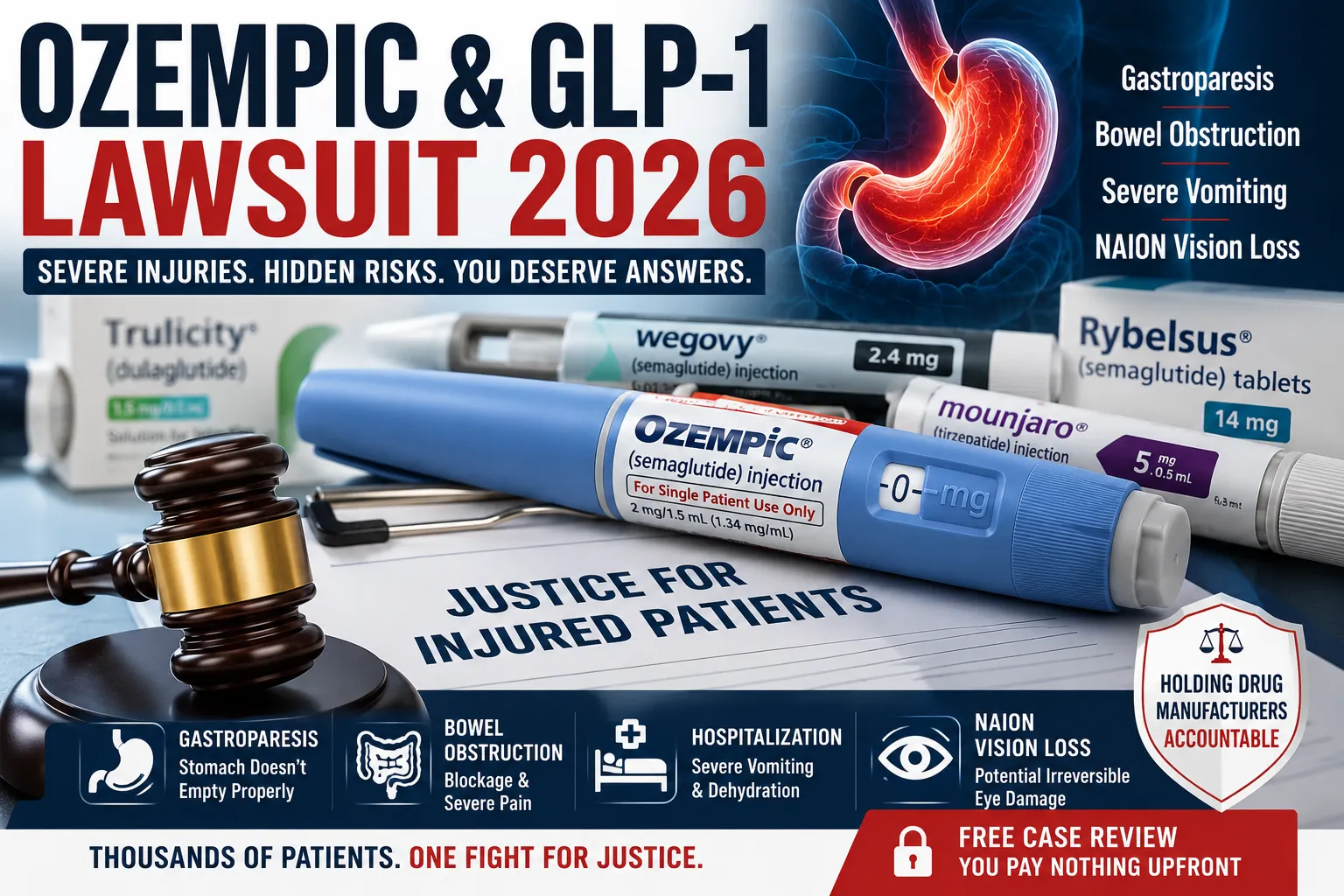
Ozempic lawsuit 2026: Patients who used Ozempic or other GLP-1-related medications and later experienced serious gastrointestinal injuries or certain vision injuries are pursuing product-liability claims alleging inadequate warnings and other defects. Federal litigation is now divided into two major coordinated proceedings: MDL 3094 for alleged gastrointestinal injuries and MDL 3163 for claims involving non-arteritic anterior ischemic optic neuropathy (NAION). The manufacturers contest liability, and every claim requires individual review of medication use, diagnosis, medical history, causation, warnings, and filing deadlines.
What Injuries Are Involved in Ozempic Lawsuits?
Current federal GLP-1 product-liability litigation focuses on alleged injuries that plaintiffs say occurred after use of medications in or related to the GLP-1 receptor agonist class. The two principal coordinated federal proceedings involve gastrointestinal injuries and NAION-related vision loss.
Find out if you may have a claim
Answer a few questions and a trained case advisor will review your situation — most people finish in about a minute.
- Free — no cost, no obligation
- About a minute to complete
- Reviewed by a trained case advisor
- Nothing you submit is published
Your details are sent over a secure connection and reviewed confidentially.
Potential injuries alleged in individual claims can include:
- Gastroparesis or delayed stomach emptying.
- Severe or persistent vomiting.
- Severe nausea and abdominal pain.
- Dehydration requiring medical treatment.
- Ileus or intestinal obstruction allegations.
- Hospitalization for serious gastrointestinal complications.
- Malnutrition or significant nutritional complications.
- NAION and associated partial or permanent vision loss.
- Other serious complications supported by medical records and tied to the specific allegations in an individual case.
Not every side effect creates a product-liability claim. Common temporary gastrointestinal symptoms, standing alone, are different from a documented serious injury requiring emergency care, hospitalization, specialist treatment, diagnostic testing, or long-term medical management.
Gastroparesis and Severe Gastrointestinal Injuries
Gastroparesis is a condition involving delayed stomach emptying in the absence of a mechanical blockage. Symptoms can include nausea, vomiting, abdominal discomfort, early fullness, bloating, difficulty maintaining nutrition, and other digestive problems.
GLP-1-related medications affect gastric emptying as part of their pharmacologic activity. Current prescribing information for products such as Ozempic and Mounjaro includes warnings or precautions addressing severe gastrointestinal adverse reactions, and both products state that they are not recommended in patients with severe gastroparesis.
In the federal litigation, plaintiffs allege that certain GLP-1 products caused serious gastrointestinal injuries and that warnings were inadequate at relevant times. Defendants dispute those allegations and raise product-specific, patient-specific, causation, diagnostic, labeling, and legal defenses.
A strong gastrointestinal injury review generally requires more than a report of nausea or vomiting. Medical documentation may include emergency-room care, hospitalization, gastric-emptying testing, gastroenterology records, endoscopy, imaging, repeated treatment for vomiting or dehydration, nutritional support, medication history, and a timeline showing when symptoms began relative to GLP-1 use.
NAION Vision-Loss Litigation
Non-arteritic anterior ischemic optic neuropathy (NAION) is an optic-nerve condition that can cause sudden vision loss. Federal product-liability cases alleging NAION after use of certain GLP-1 medications are being coordinated separately from the gastrointestinal cases.
The Eastern District of Pennsylvania identifies MDL 3163, In re: Glucagon-like Peptide-1 Receptor Agonists (GLP-1 RAs) Non-Arteritic Anterior Ischemic Optic Neuropathy Products Liability Litigation, as a second GLP-1 MDL. The court specifically distinguishes those NAION cases from the gastrointestinal injury claims in MDL 3094.
NAION claims are medically and legally different from gastroparesis claims. Relevant evidence may include ophthalmology or neuro-ophthalmology records, visual-field testing, optic-nerve imaging, diagnosis date, medication history, vascular and diabetes risk factors, prior eye disease, and expert analysis of causation.
GLP-1 Medications Named in Litigation
Product-liability claims and coordinated proceedings can involve different medications and manufacturers. Drugs commonly discussed in the broader GLP-1 litigation landscape include:
- Ozempic — semaglutide, manufactured by Novo Nordisk.
- Wegovy — semaglutide, manufactured by Novo Nordisk.
- Rybelsus — oral semaglutide, manufactured by Novo Nordisk.
- Mounjaro — tirzepatide, manufactured by Eli Lilly.
- Zepbound — tirzepatide, manufactured by Eli Lilly.
- Trulicity — dulaglutide, manufactured by Eli Lilly.
- Victoza — liraglutide, manufactured by Novo Nordisk.
- Saxenda — liraglutide, manufactured by Novo Nordisk.
These drugs are not identical and are not all approved for the same indications. Tirzepatide, for example, acts at both GIP and GLP-1 receptors. A legal review should identify the exact product, manufacturer, dose, prescribing dates, reason for use, pharmacy records, and whether more than one GLP-1-related medication was used.
Who May Have an Ozempic or GLP-1 Injury Claim?
An Ozempic lawsuit or related GLP-1 injury claim may warrant review when there is documented serious injury following use of a relevant medication. Factors that can strengthen the quality of a case review include:
- Documented use of Ozempic, Wegovy, Rybelsus, Mounjaro, Zepbound, Trulicity, Victoza, Saxenda, or another relevant medication.
- A confirmed diagnosis of gastroparesis or another serious gastrointestinal condition.
- Emergency care or hospitalization for severe vomiting, dehydration, intestinal symptoms, or related complications.
- Objective diagnostic testing supporting the gastrointestinal diagnosis when applicable.
- A documented NAION diagnosis from an ophthalmologist or neuro-ophthalmologist.
- Significant or permanent vision loss.
- Medical records showing symptom onset after medication use.
- No stronger alternative medical explanation, or records allowing competing causes to be evaluated.
- Substantial medical expenses, lost income, disability, or long-term treatment.
These factors do not guarantee eligibility or compensation. Product-liability claims can turn on diagnosis, causation, state law, label history, prescribing decisions, patient risk factors, prior medical conditions, and statutes of limitations.
How the GLP-1 Litigation Is Being Handled in 2026
MDL 3094 — Gastrointestinal Injuries
The federal court identifies MDL 3094, In re: Glucagon-like Peptide-1 Receptor Agonists (GLP-1 RAs) Products Liability Litigation, as the coordinated proceeding involving gastrointestinal injury claims.
The Eastern District of Pennsylvania continues to issue case-management and scheduling orders addressing common pretrial issues, discovery, plaintiff fact sheets, motions, and other coordinated matters.
MDL 3163 — NAION Vision Injuries
NAION claims are coordinated separately in MDL 3163. The court describes this as the second MDL involving personal-injury actions arising from GLP-1-related medications and expressly states that MDL 3094 concerns gastrointestinal injuries while MDL 3163 concerns NAION.
What an MDL Means
Multidistrict litigation is not automatically a class action. Individual lawsuits involving common factual issues are transferred to one federal court for coordinated or consolidated pretrial proceedings. Individual plaintiffs can still have different medications, diagnoses, damages, medical histories, statutes of limitations, and claim-specific defenses.
Do not rely on an old online case count as proof of current litigation size. Federal MDL dockets change as cases are filed, transferred, resolved, dismissed, remanded, or otherwise updated.
Evidence and Medical Records That May Matter
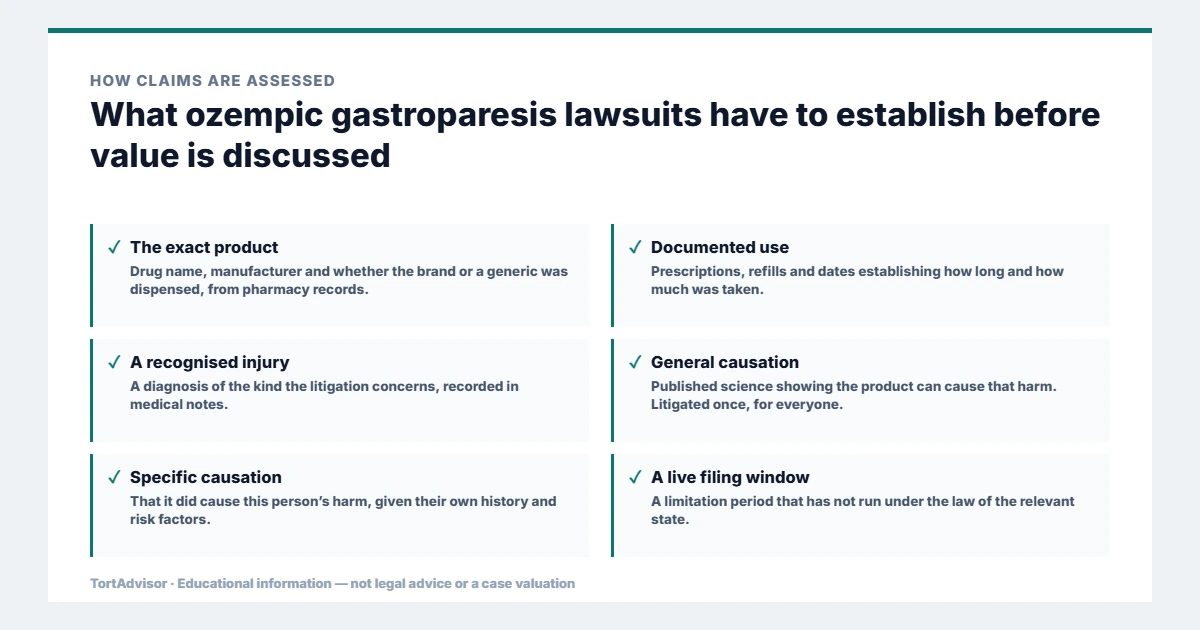
GLP-1 drug-injury litigation is heavily dependent on prescription and medical documentation. Useful evidence can include:
- Pharmacy records showing the medication, dose, refill dates, and prescriber.
- Prescription history from the prescribing physician or clinic.
- Records showing why the medication was prescribed.
- Emergency-room and hospitalization records.
- Gastroenterology records.
- Gastric-emptying studies when performed.
- Endoscopy, imaging, laboratory testing, and specialist evaluations.
- Records documenting vomiting, dehydration, malnutrition, ileus, obstruction, or other gastrointestinal injury allegations.
- Ophthalmology and neuro-ophthalmology records for NAION claims.
- Visual-field testing and optic-nerve imaging.
- Records of diabetes, vascular risk factors, preexisting gastrointestinal disease, or prior eye conditions.
- Medical bills, wage-loss records, disability documentation, and out-of-pocket expenses.
- A timeline of medication use, symptoms, diagnosis, discontinuation, and ongoing treatment.
Do not discard prescription packaging, pharmacy records, medication receipts, or medical records that could help identify the exact drug and treatment timeline.
Ozempic Settlement and Compensation Factors
There is currently no guaranteed Ozempic settlement amount. Potential compensation depends on the facts of each claim and how the litigation ultimately develops.
Potential value factors may include:
- Type and severity of the diagnosed injury.
- Objective medical evidence supporting the diagnosis.
- Hospitalizations and emergency treatment.
- Duration and permanence of gastrointestinal symptoms.
- Extent of NAION-related vision loss.
- Need for specialist care or long-term treatment.
- Medical expenses.
- Lost income or reduced earning capacity.
- Disability or limitations on daily activities.
- Medication-use history and dose.
- Strength of medical causation evidence.
- Alternative medical explanations and preexisting conditions.
- Product-specific warning and prescribing evidence.
- Applicable state law and available damages.
For an educational estimate, use TortAdvisor’s
Ozempic Lawsuit Settlement Calculator.
The calculator can help organize common claim-value factors but does not predict a guaranteed payout or replace legal or medical review.
You can also compare broader pharmaceutical claim research in the
dangerous drugs and product liability pillar.
Ozempic Lawsuit Filing Deadlines
GLP-1 lawsuit filing deadlines vary by state and by the facts of the individual claim. Relevant dates can include when the medication was first and last used, when symptoms began, when a serious injury was diagnosed, when the patient learned of a possible connection to the drug, and whether a prior lawsuit or claim was filed.
Different states can apply different statutes of limitations, discovery rules, statutes of repose, choice-of-law rules, and product-liability requirements.
Important Medical Safety Information
GLP-1 medications are prescription drugs used for important medical purposes, including diabetes treatment and chronic weight management for appropriately selected patients. A pending lawsuit does not mean that a medication is unsafe for every patient or that it caused a particular person’s medical condition.
Current Ozempic prescribing information states that severe gastrointestinal adverse reactions have been reported and that Ozempic is not recommended in patients with severe gastroparesis. Mounjaro prescribing information likewise addresses severe gastrointestinal adverse reactions and states that it is not recommended in patients with severe gastroparesis.
Do not stop, restart, increase, decrease, or otherwise change a prescribed GLP-1 medication solely because of lawsuit information on this page. Discuss medication questions with the prescribing healthcare professional. Seek prompt medical attention for severe or persistent vomiting, serious abdominal symptoms, dehydration, inability to maintain nutrition, or sudden vision changes.
Related TortAdvisor Guides and Tools
Ozempic Lawsuit Research
Gastroparesis, severe gastrointestinal injuries, GLP-1 medication history, evidence, and litigation updates.
Ozempic Settlement Calculator
Educational GLP-1 claim estimate based on diagnosis, treatment, evidence, damages, and vision or gastrointestinal injury.
Settlement Calculators
Browse TortAdvisor’s drug, device, injury, abuse, exposure, and disability claim-value tools.
Ozempic Lawsuit Research
Compare pharmaceutical, medical-device, mass-tort, toxic-exposure, and personal-injury settlement research.
Mass Tort Lawsuits
How coordinated litigation, product-liability claims, evidence, and mass-tort proceedings generally work.
Active Lawsuits
Browse TortAdvisor’s major active lawsuit and mass-tort research pages.
Legal Insights
Recent lawsuit developments, mass-tort updates, drug-safety articles, and settlement research.
Official Court and Drug-Safety Sources
Federal Court — GLP-1 Gastrointestinal Injury MDL:
U.S. District Court for the Eastern District of Pennsylvania — MDL 3094
Federal Court — GLP-1 NAION MDL:
U.S. District Court for the Eastern District of Pennsylvania — MDL 3163
Ozempic Prescribing Information:
DailyMed — Ozempic (semaglutide) FDA Label
Mounjaro Prescribing Information:
DailyMed — Mounjaro (tirzepatide) Label
FDA — Unapproved and Compounded GLP-1 Products:
FDA — Concerns With Unapproved GLP-1 Drugs Used for Weight Loss
Still unsure where you stand?
Have a trained case advisor review your own facts — free, confidential, and with no obligation.
- Free — no cost, no obligation
- About a minute to complete
- Reviewed by a trained case advisor
- Nothing you submit is published
Your details are sent over a secure connection and reviewed confidentially.
Ozempic Lawsuit FAQ
What injuries are being alleged in Ozempic lawsuits?
Federal GLP-1 litigation currently includes coordinated gastrointestinal injury claims and a separate coordinated proceeding for NAION vision injuries. Individual claims can involve different diagnoses, medications, facts, and evidence.
SourceJPML1 Sep 2026
Is gastroparesis part of the Ozempic litigation?
Yes. Gastroparesis is one of the principal gastrointestinal injuries alleged in GLP-1 product-liability cases. Whether a particular patient’s condition was caused by a medication is an individual medical and legal question.
SourceJPML transfer order2 Feb 2024
Is NAION part of the same Ozempic MDL?
No. The Eastern District of Pennsylvania currently maintains separate coordinated proceedings: MDL 3094 for gastrointestinal injuries and MDL 3163 for NAION product-liability claims.
SourceJPML MDL 3163 order15 Dec 2025
What is the difference between Ozempic and Mounjaro?
Ozempic contains semaglutide and acts as a GLP-1 receptor agonist. Mounjaro contains tirzepatide and acts at both GIP and GLP-1 receptors. They are different medications produced by different manufacturers and have different prescribing information.
SourceFDA label: OzempicMay 2026FDA label: MounjaroAug 2026
Do I need a formal gastroparesis diagnosis?
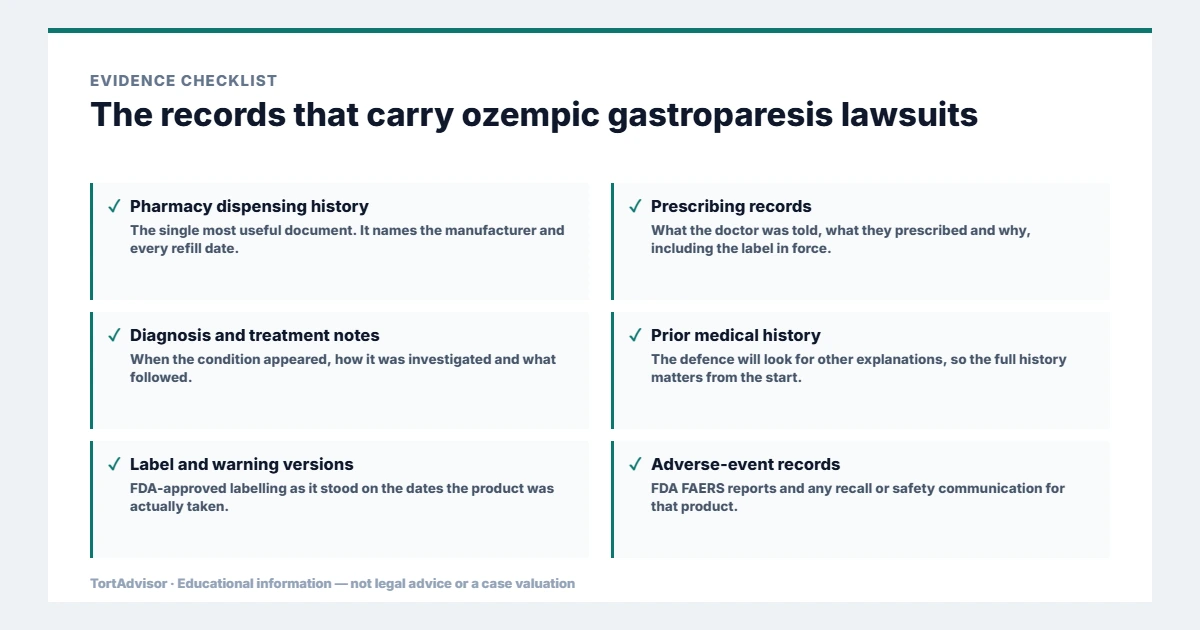
In MDL 3094 the court has ruled on this: in an order of 15 August 2025, it held that a plaintiff claiming gastroparesis must show the diagnosis is based on a properly performed gastric emptying study (scintigraphy, breath test or wireless motility capsule). Other alleged injuries turn on their own medical evidence. Keep all gastroenterology, hospital, imaging, testing and treatment records.
SourceE.D. Pa. order15 Aug 2025
Can I file if I used a GLP-1 medication for weight loss?
The answer depends on the specific medication, injury, prescribing circumstances, product, timing, evidence, and applicable law. The reason the medication was prescribed is one part of the claim review but does not by itself determine eligibility.
How much is an Ozempic lawsuit worth?
There is no guaranteed settlement amount. Potential value can depend on diagnosis, hospitalization, permanent injury, vision loss, treatment, medical expenses, lost income, causation evidence, product-specific warnings, state law, and how the litigation ultimately resolves.
Can I use an Ozempic settlement calculator?
Yes. TortAdvisor’s Ozempic Settlement Calculator provides an educational estimate based on common claim-value factors. It is not a settlement offer, legal valuation, or guarantee of compensation.
Should I stop taking Ozempic or another GLP-1 medication because of the lawsuits?
Do not change a prescribed medication based solely on lawsuit information. Speak with the healthcare professional who prescribed the drug about medical risks, benefits, symptoms, and treatment decisions.
SourceFDA3 Apr 2026
Next Steps for Patients With Serious GLP-1 Injuries
If you experienced a documented serious gastrointestinal injury or NAION after using Ozempic or another relevant medication, begin by organizing your prescription history and medical records. Identify the exact medication, dose, prescribing dates, diagnosis, hospital treatment, specialist care, and the date symptoms first appeared.
Then review TortAdvisor’s
Ozempic Lawsuit Research
for current litigation information or use the
Ozempic Settlement Calculator
to organize common compensation factors.
Research an Ozempic or GLP-1 Injury Claim
For the current litigation status, evidence requirements and settlement research behind this topic, see TortAdvisor’s Ozempic lawsuit research.
Review medication history, diagnosis, treatment, medical evidence, MDL status, filing issues, and potential compensation factors.
About This Guide
This guide was prepared by Mason Arnao using federal court records, FDA-regulated prescribing information, and primary drug-safety sources where available.
This content is for general educational purposes only and does not constitute legal or medical advice. TortAdvisor is not a law firm or healthcare provider. A reported adverse event, medical diagnosis, FDA warning, label change, pending lawsuit, or MDL does not automatically establish that a drug caused an injury or that a manufacturer is legally liable. Eligibility, causation, filing deadlines, potential compensation, and medical treatment decisions require individual professional review.