
Doctor Sexual Abuse Lawsuit: Physician and Hospital Claims
You may be able to bring a doctor sexual abuse lawsuit, and a hospital or clinic could also be responsible if there is a legal basis for a claim against it. For example, California’s civil jury instructions address sexual battery and an employer’s negligent hiring, supervision, or retention as separate claims, each with requirements that must be proved.
This article explains what can count as physician sexual misconduct, who may be sued, and how these claims differ from medical malpractice. It also covers reporting to a medical board, preparing your account, identifying the filing deadline that applies to your circumstances, and what documented settlements can—and cannot—tell you about your own potential claim.
What counts as sexual abuse by a doctor?
An intimate medical examination is not automatically sexual abuse. The concern is whether a physician used the medical relationship for sexual exploitation rather than legitimate care. The Federation of State Medical Boards describes physician sexual misconduct as including physical conduct and inappropriate verbal or electronic communication. Its examples include intimate examinations without clinical justification, explanation, or informed consent. These are professional-policy definitions—not a substitute for the civil law that applies to a particular claim. See the FSMB guidance on physician sexual misconduct and examination boundaries.
You do not need to decide on a legal label before describing what happened. If you are unsure how to explain an encounter, these questions can help you organize your account:
- What examination or procedure did the doctor explain, and what reason did they give for it?
- What touching, comments, messages, or other communication concerned you?
- What did you understand you had agreed to?
- Was anyone else present, and what could that person have seen or heard?
Use your own words, and distinguish what you remember from details you are uncertain about. The goal is to describe the encounter, not to diagnose your own legal claim.
For broader context as you consider next steps, TortAdvisor’s guide to sexual abuse civil claims and survivor rights can help you explore the civil-claim process.
Find out if you may have a claim
Answer a few questions and a trained case advisor will review your situation — most people finish in about a minute.
- Free — no cost, no obligation
- About a minute to complete
- Reviewed by a trained case advisor
- Nothing you submit is published
Your details are sent over a secure connection and reviewed confidentially.
Who can be sued, and how does this differ from malpractice?
A case review should separate two questions: what the doctor did, and whether an institution’s own failures contributed to the harm. A hospital, clinic, or university’s connection to a doctor is a starting point for investigation—not proof of liability.
California example—not a nationwide rule: California’s civil jury instructions distinguish professional negligence, which concerns the professional standard of care, from medical battery, informed-consent claims, and sexual battery. They also provide a separate framework for negligent hiring, supervision, or retention: an employment relationship; an employee’s unfitness or incompetence creating a particular risk that the employer knew or should have known about; harm; and a causal connection between the employer’s negligence and that harm. These distinctions help explain why a claim about the doctor’s conduct differs from a claim about an employer’s failures. See the California civil jury instructions on malpractice, battery, and negligent hiring or supervision.
Useful questions for a case review include:
- Who employed the doctor, and who operated the facility?
- Were earlier concerns reported? If so, to whom, and what response followed?
- Which proposed claim addresses the physician’s conduct?
- Which proposed claim addresses the institution’s hiring, supervision, retention, or response to concerns?
If treatment involved a university clinic, the guide to institutional sexual abuse claims can help you explore that setting. For treatment through an athletics program, continue to sexual abuse claims involving team doctors and sports programs.

Reporting to a medical board and preparing your account
A medical-board complaint and a civil lawsuit serve different purposes. In California, the Medical Board’s role is to investigate complaints and, when warranted, take administrative action against a physician’s license—not pursue a patient’s civil lawsuit. Its FAQ also explains that anonymous complaints can be harder to investigate. Although the Board keeps a complainant’s identity confidential, requesting treatment records may alert the physician that the complaint concerns that patient’s care. Review the Medical Board of California complaint procedures, authority, and confidentiality limits before deciding what to submit.
For your own preparation, consider writing a private account at a pace that feels manageable. You might include:
- The doctor’s name and the facility where you received care.
- Approximate dates, including whether there were multiple visits.
- What the doctor explained about the examination or treatment, and what happened.
- Anyone who may have witnessed the interaction or whom you told afterward.
- Records, appointment details, or messages you already have.
Mark uncertain dates or details as uncertain rather than trying to fill in gaps. This account can help you organize what you remember; it does not need to read like a formal legal statement.
Before submitting a report, consider asking:
- Which board licenses this physician?
- What information and records will the board request?
- What information will be shared with the physician?
- Can investigators use your preferred contact method, and can they leave messages?

Which filing deadline applies to your circumstances?
Ask a lawyer in the relevant state to review the deadline for each claim you may have against a physician or institution. Do not assume that a widely reported filing window applies to your circumstances.
California offers one specific example—not a nationwide extension. The Judicial Council’s summary of AB 250 describes a revival route for qualifying sexual-assault claims whose filing periods have expired, allowing those claims to be commenced between January 1, 2026, and December 31, 2027. Revived institutional claims require specified allegations involving a prior assault or allegation and a cover-up or attempted cover-up. The provisions exclude public entities. These conditions mean the dates are not a deadline for every doctor-abuse claim, nor do they establish deadlines elsewhere in the United States. See the Judicial Council summary of California AB 250 and its revival conditions.
Prepare these questions for your deadline review:
- Which limitations rule governs each proposed claim against the doctor and any institution?
- Does my age when the conduct occurred matter?
- Does a discovery rule or revival provision apply to my circumstances?
- Is any proposed defendant a public institution?
If the conduct occurred during childhood, this overview of how a child sexual abuse claim works explains who can file and discusses time limits in California, Florida, and Maryland.
Ask separately about the civil filing deadline and the medical board’s reporting process. Put both on your list of questions rather than treating a licensing complaint and a lawsuit as the same task.
What documented settlements can—and cannot—tell you
A documented settlement can show how one group of claims was resolved, but it cannot tell you what your own claim might recover. USC’s announcement of the Tyndall state-court global settlement reports an $852 million global agreement involving 710 women who filed civil cases concerning George Tyndall in Los Angeles Superior Court.
That announcement describes a group resolution—not an individual payout for a reader’s claim. Dividing the total by the number of participating women would not establish what any individual received or provide a reliable estimate for your circumstances.
For further research, TortAdvisor’s sexual abuse settlement and compensation guide and source-backed settlement amounts research can help you explore documented resolutions while keeping their context in view. The sexual abuse settlement calculator can help organize questions for a possible claim review; it is not a promised recovery or a substitute for individual legal advice.
A manageable next step is to collect the information you feel comfortable discussing and list your questions about the doctor, the institution, reporting choices, and the filing deadline. You do not need to turn your experience into a dollar estimate to begin organizing those questions. TortAdvisor provides educational research and is not a law firm.
Frequently asked questions
Can sexual misconduct by a doctor involve messages or comments rather than touching?
Yes. The Federation of State Medical Boards’ sexual-misconduct policy recognizes verbal and virtual misconduct, not just physical contact. Sexual comments or messages can therefore raise concerns even without touching. These are professional-policy definitions, however—not a determination that a particular message meets your state’s requirements for a civil lawsuit.
Can a hospital or university face a claim separate from the doctor’s conduct?
Potentially, yes. An institution’s own actions may matter separately from what the doctor did. For example, California’s jury instruction on negligent hiring, supervision, or retention, CACI 426, addresses an employer’s responsibility when it knew or should have known an employee posed a particular risk and its negligence contributed to the harm. Employment alone does not establish that claim.
How is sexual battery different from medical malpractice?
They focus on different conduct. In the California jury instructions referenced above, CACI 501 addresses professional negligence: whether care fell below the applicable professional standard. CACI 1306 addresses sexual battery, involving intentional sexual contact without consent. The instructions also distinguish medical battery and informed-consent claims. An allegation involving a doctor should not automatically be treated as merely a question of poor medical care.
Will the doctor know that I reported my treatment to the medical board?
You should not assume the doctor will be unable to identify you. The Medical Board of California’s complaint guidance explains that, although complainant information is confidential, investigating may require disclosing the treatment involved, which could reveal your identity. Anonymous complaints can also limit an investigation. A board complaint concerns licensing oversight; it is separate from a civil lawsuit seeking compensation.
Does California’s revival window apply to every doctor sexual abuse claim?
No. California’s revival provisions are not a blanket reopening of every claim involving a doctor. The Judicial Council’s summary of AB 250 describes eligibility conditions, including institutional cover-up allegations, and a public-entity exclusion. Whether the window helps you depends on the claim and circumstances. The summary is California-specific and does not establish a deadline for claims elsewhere.
Does a hospital’s global settlement show what my claim is worth?
No. A global total does not establish an individual claim’s value. The joint statement about the Tyndall California state-court settlement reports an agreement covering a group of participating plaintiffs, not an individual settlement estimate. Dividing a total by the participant count would not tell you what any particular person received or what you might recover.
Sources
- Physician Sexual Misconduct: Report and Recommendations of the FSMB Workgroup · Federation of State Medical Boards
- Judicial Council of California Civil Jury Instructions, 2026 Edition · Judicial Council of California
- 2025 Summary of Court-Related Legislation: AB 250 · Judicial Council of California
- Joint Statement about the California State Court Global Settlement · University of Southern California
This article is general information, not legal advice. Laws and deadlines vary by state and change over time; check the linked sources or request a free case review to talk your situation through with a trained case advisor.
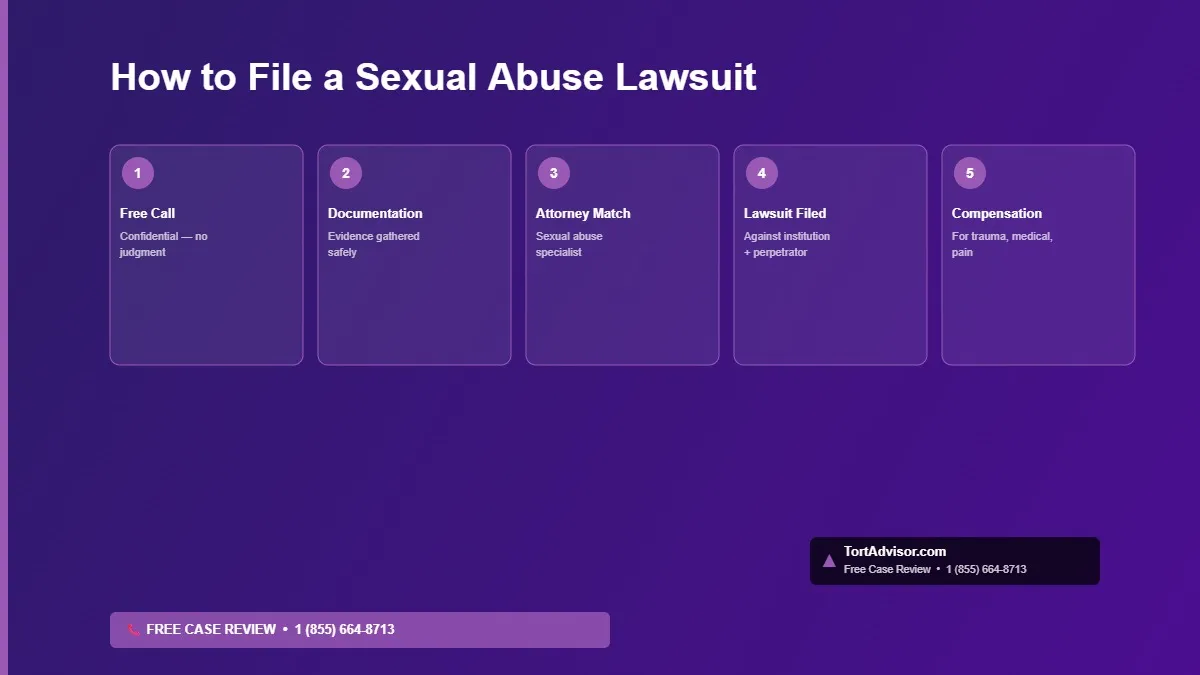
Sexual abuse lawsuit settlement 2026: a compensation guide for survivors — who qualifies, what affects case value, and how to file. Free confidential evaluation available 24/7.