
Bair Hugger Lawsuit 2026: MDL 2666 Update, Case Status and Who Qualifies
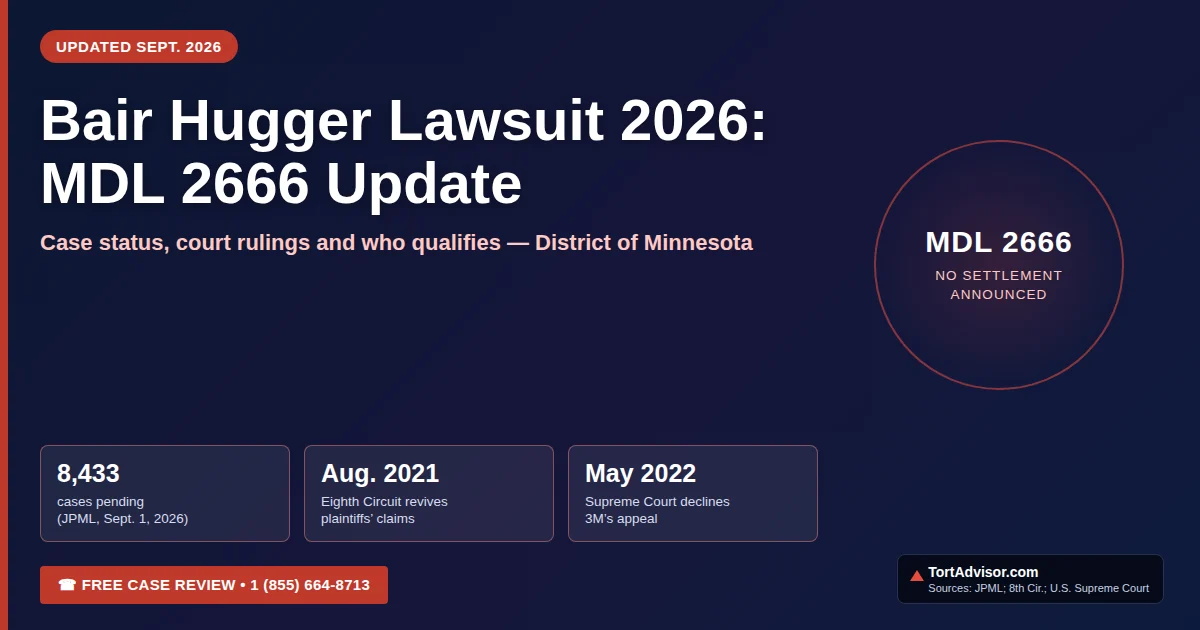
If you developed a serious infection following orthopedic surgery — such as a hip or knee replacement — and a Bair Hugger forced-air warming device was used in the operating room, you may have grounds for a Bair Hugger lawsuit. As of October 1, 2026, 8,424 cases were pending in MDL 2666, no global settlement has been announced in any public court order or company filing, and the court is now deciding whether to require every plaintiff to produce early proof of the claim through a Lone Pine order. Here is what the court record shows — and what to do now to protect your rights.
SourceJPML MDL report1 Oct 2026D. Minn. ECF 369611 Sep 2026
Find out if you may have a claim
Answer a few questions and a trained case advisor will review your situation — most people finish in about a minute.
- Free — no cost, no obligation
- About a minute to complete
- Reviewed by a trained case advisor
- Nothing you submit is published
Your details are sent over a secure connection and reviewed confidentially.
Call our Bair Hugger lawsuit expert advisors now for a free, no-obligation case review.
📞 Call Now: 855-664-8713What Is the Bair Hugger Lawsuit About?
A Bair Hugger lawsuit is a legal claim filed by patients who developed deep periprosthetic joint infections — typically MRSA or other severe bacterial infections — following hip or knee replacement surgeries in which the Bair Hugger forced-air warming device was used. Plaintiffs allege that 3M Company and its subsidiary Arizant Healthcare designed and marketed a product that disrupts carefully engineered laminar airflow in orthopedic operating rooms, pushing contaminated air particles directly into open surgical wounds.
The Bair Hugger is a widely used forced-air patient warming system. It maintains a patient’s core body temperature during surgery — a medically important function. Plaintiffs do not dispute its warming purpose; they argue the design chosen by 3M creates an unacceptable, undisclosed infection risk for the specific patient population undergoing joint replacement, where the consequences of infection can be catastrophic and irreversible.
The FDA has not found a consistent link. In a 2017 letter to health care providers, the FDA said it had been “unable to identify a consistently reported association” between forced-air thermal regulating systems and surgical site infections, and it continued to recommend the devices “when clinically warranted.” Whether the device caused a particular patient’s infection is the most contested question in the litigation.
Source8th Cir. opinion16 Aug 2021
The core injuries alleged include deep periprosthetic joint infections requiring multiple revision surgeries, sepsis, MRSA infections, permanent joint dysfunction, limb loss, and in the most severe cases, wrongful death. For an overview of all defective medical device litigation currently active, see the full Bair Hugger lawsuit guide on our site, or explore TortAdvisor’s mass tort resources for related cases.
Latest Bair Hugger Lawsuit Update (October 2026)
As of October 1, 2026, 8,424 cases were pending in MDL No. 2666 (In re: Bair Hugger Forced Air Warming Devices Products Liability Litigation) before Senior Judge Joan N. Ericksen and Magistrate Judge David T. Schultz in the U.S. District Court for the District of Minnesota.
SourceJPML MDL report1 Oct 2026
No global settlement of MDL 2666 has been announced in any public court order, 3M filing or Solventum filing, and no settlement amount, eligibility criteria or deadlines have been published. What the court record does show is court-ordered mediation: after its March 2023 status conference, the court ordered the parties to participate in mediation.
SourceD. Minn. order10 Jul 2023
A Lone Pine order is now being briefed. On September 11, 2026, Judge Ericksen overruled plaintiffs’ objections and adopted Magistrate Judge Schultz’s recommendation for expedited briefing on whether a Lone Pine (docket control) order should be issued. 3M’s memorandum and proposed order were due October 2, plaintiffs’ response is due October 16, and the reply is due October 23, 2026. Lone Pine orders typically require each plaintiff to produce basic evidence for the claim early in the case, such as records and an expert opinion on causation, or face dismissal. No ruling had been published as of October 13, 2026.
SourceD. Minn. ECF 369611 Sep 2026
Late claims are being dismissed. Between June and August 2026, the magistrate judge recommended dismissing claims as time-barred under the laws of Alabama, Michigan, New York, Nebraska, South Dakota, Kansas, Oklahoma and Texas, and in September 2026 Judge Ericksen granted 3M’s motions and dismissed those claims with prejudice. The court refused to dismiss two North Carolina claims, finding the plaintiffs’ fraudulent-concealment tolling argument was not futile. Cases have also been dismissed for missing Plaintiff Fact Sheets (Pretrial Order No. 14) and late suggestions of death (Pretrial Order No. 23).
SourceD. Minn. ECF 34475 Jun 2026D. Minn. ECF 36391 Sep 2026D. Minn. ECF 36411 Sep 2026D. Minn. ECF 37856 Oct 2026
Solventum now reports the litigation. Solventum, the health care company 3M spun off in 2024, agreed to indemnify 3M for uninsured Bair Hugger liabilities and to manage the litigation. Its report for the quarter ended June 30, 2026 says 3M is a named defendant in approximately 8,400 U.S. lawsuits and one Canadian putative class action, and that there are eight state-court personal injury cases, including a multi-plaintiff case of amputees in Ramsey County, Minnesota. It says “the parties are actively litigating several MDL bellwether and state court cases” and that, based on developments in the Bair Hugger matter, Solventum increased its litigation accrual to management’s best estimate of probable loss. It does not disclose the amount. The previous quarter’s report said trials were “anticipated in 2026”; that wording no longer appears.
SourceSolventum 10-Q5 Aug 2026Solventum 10-Q5 May 2026
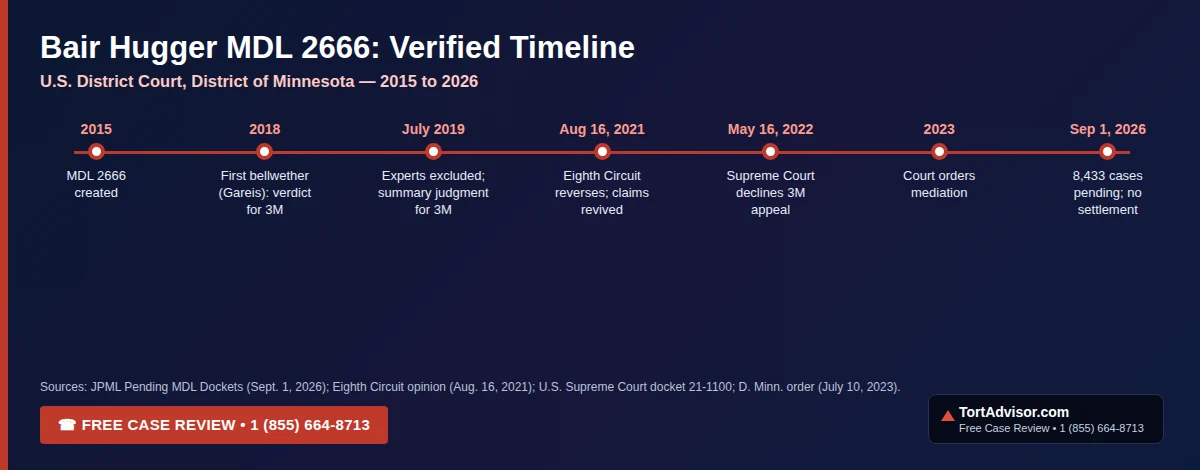
The road here has been long. The MDL was created in 2015. The first bellwether trial (Gareis) in 2018 ended in a defense verdict for 3M, which the Eighth Circuit later affirmed. In July 2019, the court excluded plaintiffs’ general-causation experts and granted summary judgment to 3M. Plaintiffs appealed, and on August 16, 2021 the U.S. Court of Appeals for the Eighth Circuit reversed the exclusion of plaintiffs’ general-causation medical experts and the grant of summary judgment, while partly upholding the exclusion of one engineering model. The Eighth Circuit’s mandate returned the cases to the MDL court in November 2021, and the U.S. Supreme Court declined to hear 3M’s appeal on May 16, 2022.
Source8th Cir. opinion16 Aug 2021D. Minn. order10 Jul 2023U.S. Supreme Court16 May 2022
In February 2025, a ruling in Boncher v. 3M in the Eastern District of Pennsylvania denied 3M’s motion to exclude plaintiffs’ infection-causation expert under Rule 702 and denied summary judgment, keeping the core causation theory in play outside the MDL.
SourceE.D. Pa. (Boncher)14 Feb 2025
Settlement Status and Case Value
No global settlement of MDL 2666 has been announced. Mass tort settlements are often administered through a court-approved Qualified Settlement Fund (a “468B fund”), but we found no court order, 3M filing or Solventum filing announcing a settlement or a settlement fund for the Bair Hugger litigation.
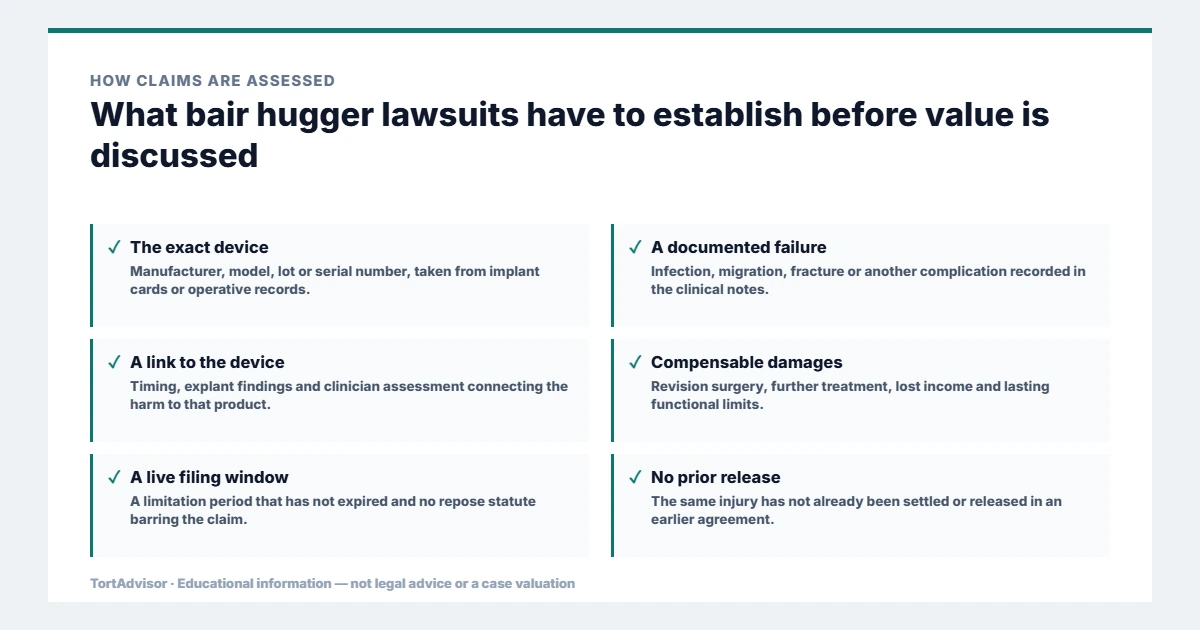
What is confirmed: 8,424 cases were pending on October 1, 2026; the court ordered the parties to mediation after its March 2023 status conference; court orders from July and August 2026 note that individual cases “later settled,” without stating terms; and Solventum says it increased its litigation accrual for the Bair Hugger matter in its report for the quarter ended June 30, 2026.
SourceJPML MDL report1 Oct 2026D. Minn. order10 Jul 2023D. Minn. ECF 353722 Jul 2026Solventum 10-Q5 Aug 2026
What is not public: No global settlement, settlement amount, eligibility criteria or deadlines have been announced by the court, 3M, Solventum or Arizant, and Solventum has not disclosed how much it has reserved for the Bair Hugger cases. Any specific dollar figure you read elsewhere should be treated as an estimate, not a confirmed offer.
For what is and is not known about payouts, see our Bair Hugger settlement amounts guide.
Do You Qualify to File a Bair Hugger Lawsuit?
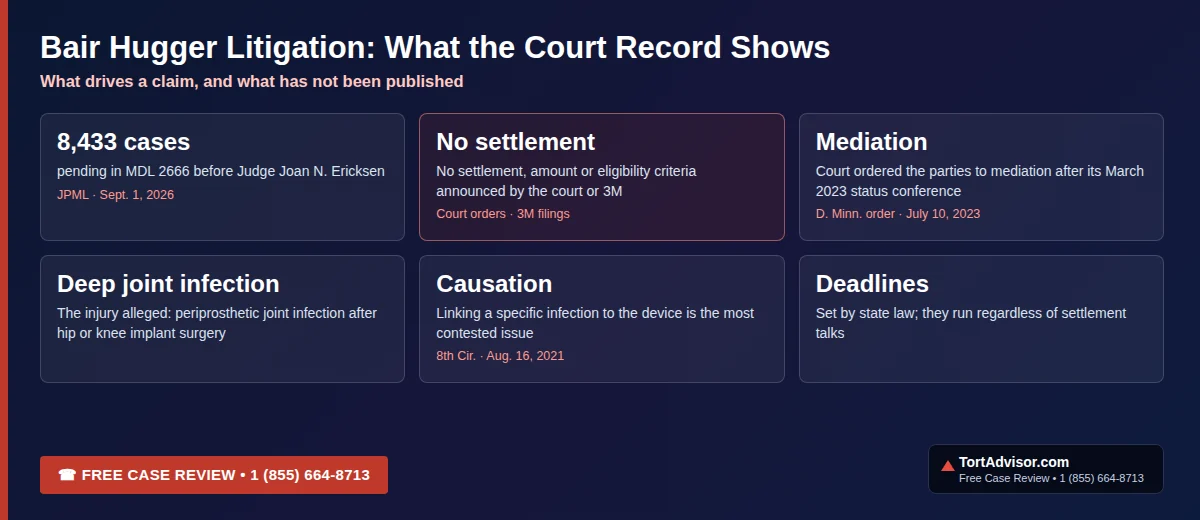
No settlement framework or eligibility criteria have been announced. Attorneys filing claims in MDL 2666 generally evaluate potential clients based on the following criteria:
- Orthopedic implant surgery (hip or knee replacement) — The Bair Hugger device was specifically used in your surgery. This is typically documented in surgical and anesthesiology notes.
- Post-surgical deep infection diagnosis — You developed a deep periprosthetic joint infection, MRSA, sepsis, or a comparable serious infection after the surgery. Superficial wound infections may not qualify; the injury must be a deep joint/bone infection.
- Medical records linking use and infection — Hospital records, surgical notes, and infection diagnosis records are required to support a claim. The closer in time the infection follows surgery, the clearer the potential causal link.
- Filing deadline — Deadlines are set by state law, and the MDL court is enforcing them: in 2026 it dismissed claims as time-barred under the laws of eight states. Which deadline applies depends on where you live and when the infection was diagnosed or discovered, so older surgeries need a prompt review.
- Qualifying injury severity — Revision surgery, prolonged hospitalization, permanent joint damage, amputation, or wrongful death are the most compelling injury profiles. Milder infections that resolved quickly may still qualify, but with different case value projections.
- Wrongful death claims — Family members of patients who died from a Bair Hugger-related infection may be eligible to file on behalf of the estate.
Note that 3M has argued that proving a specific patient’s infection was caused by the Bair Hugger (rather than another intraoperative source) is a significant evidentiary challenge. An experienced mass tort attorney can evaluate whether the facts of your case support a strong causation argument. You can also explore other active mass tort lawsuits you may qualify for.
How Much Could Your Bair Hugger Case Be Worth?
The value of an individual Bair Hugger lawsuit claim depends on several injury-specific factors. Because no settlement terms exist, these factors are used by plaintiff attorneys to evaluate — not guarantee — case value. For a fuller breakdown of what is and is not known about payouts, see our Bair Hugger settlement amounts guide. You can also explore the factors in our Bair Hugger settlement calculator.
Infection severity is the single most influential factor. A deep periprosthetic joint infection progressing to systemic sepsis or MRSA bacteremia — requiring ICU care, IV antibiotics, and joint explantation — is likely to command significantly higher compensation than a contained localized infection treated with a single course of antibiotics. The number of revision surgeries required also directly affects both economic damages (medical costs) and non-economic damages (pain, suffering, and loss of quality of life).
Permanent disability or functional loss is a major value driver. Patients left with a permanently unstable joint, a prosthesis that could not be reimplanted, reduced mobility, or a lower-limb amputation will generally have the strongest damages cases. Lost wages and reduced earning capacity — particularly for working-age plaintiffs whose careers were interrupted or ended by the infection and its treatment — are also weighted heavily in comparable mass tort settlements.
Duration of illness and the overall treatment burden also factor in. Cases involving years of follow-up surgeries, ongoing antibiotic therapy, and continued joint complications typically produce more extensive documented economic damages, which strengthens the case for higher compensation.
How to File a Bair Hugger Lawsuit
Filing a Bair Hugger lawsuit involves a straightforward process, though timing and documentation are critical. Here is what most claimants can expect:

- Free case evaluation — An experienced mass tort attorney reviews your surgical records, hospital records, and infection diagnosis to assess whether your case meets the threshold criteria for MDL 2666. There is no cost for this review.
- Gathering medical records — Your attorney requests your surgical and post-surgical records, including operating room logs confirming Bair Hugger use, anesthesia records, microbiology/culture results confirming infection type, and records of any revision surgeries.
- Filing your claim — Your attorney files a complaint, typically in MDL 2666 in the District of Minnesota for federal cases, or in state court where appropriate.
- Discovery and expert review — Your legal team works with medical and engineering experts to establish that (a) the Bair Hugger was in use during your specific surgery, (b) you developed a qualifying infection, and (c) your infection is causally linked to the device’s use — the most contested element in this litigation.
- Settlement negotiation or trial — Cases may resolve through negotiation or proceed toward trial; no global settlement has been announced. Individual state-court filings may also resolve through direct negotiation with 3M’s legal team.
Filing deadlines are critical, and they are decided under state law. In 2026, Judge Ericksen dismissed claims as time-barred under the laws of Alabama, Michigan, New York, Nebraska, South Dakota, Kansas, Oklahoma and Texas. The court’s orders also describe a tolling agreement between the parties that suspended the limitations period from November 3, 2023 through April 15, 2025, but it did not save claims that had already expired before it took effect. Getting your records reviewed promptly is the most important step you can take.
SourceD. Minn. ECF 36391 Sep 2026D. Minn. ECF 35623 Aug 2026
For peer-reviewed scientific context on the Bair Hugger–infection link, see the published literature on PubMed/NIH, which includes multiple orthopedic and infectious disease studies examining forced-air warming and periprosthetic infection risk. The Eighth Circuit’s August 16, 2021 opinion sets out the legal framework under which this litigation now proceeds.
Did You Develop an Infection After Bair Hugger Use During Surgery?
More than 8,400 Bair Hugger cases are pending in MDL 2666. Our advisors can go over your surgery and infection history with you — free, with no obligation.
📞 Call Now: 855-664-8713 — Free Case ReviewFrequently Asked Questions
What is the Bair Hugger lawsuit about?
Plaintiffs allege that 3M’s Bair Hugger forced-air warming device contributed to deep periprosthetic joint infections after hip and knee replacement surgery. The federal cases are consolidated in MDL 2666 in the District of Minnesota, where the JPML’s report of 1 October 2026 lists 8,424 cases pending.
Source8th Cir.16 Aug 2021JPML1 Oct 2026
Is there a Bair Hugger settlement in 2026?
No global settlement of MDL 2666 has been announced in any public court order, 3M filing or Solventum filing as of October 2026, and no settlement amount or eligibility criteria have been published. Court orders note that individual cases later settled, and Solventum says it increased its litigation accrual for the Bair Hugger matter, but it has not disclosed an amount.
SourceSolventum 10-Q5 Aug 2026D. Minn. ECF 353722 Jul 2026
What is the Lone Pine order in the Bair Hugger MDL?
It is a proposed case-management order. On September 11, 2026 the MDL court ordered expedited briefing on whether to issue a Lone Pine (docket control) order, which would typically require each plaintiff to produce basic evidence for the claim early or face dismissal. Briefing closes on October 23, 2026, and no order has been issued yet.
SourceD. Minn. ECF 369611 Sep 2026
Who qualifies for a Bair Hugger lawsuit?
The MDL cases involve people who developed a deep periprosthetic joint infection after an orthopedic implant surgery in which a Bair Hugger was used. Families of patients who died may bring wrongful death claims. Whether a particular person has a claim depends on the medical records and on the filing deadline in their state.
Source8th Cir.16 Aug 2021
How much is a Bair Hugger lawsuit worth?
There is no public Bair Hugger settlement amount or plaintiff verdict to base a value on. Any per-case figure quoted online is an estimate, not a published record, and the value of an individual claim depends on the infection, the treatment it required and the evidence tying it to the device. Solventum, which indemnifies 3M for the litigation, says it cannot estimate a possible loss beyond what it has recorded, and it has not disclosed that amount.
SourceSolventum 10-Q5 Aug 2026
Was the Bair Hugger lawsuit dismissed and then reinstated?
Yes. In July 2019 the MDL court excluded the plaintiffs’ general-causation experts and granted summary judgment to 3M, ending the cases. On 16 August 2021 the Eighth Circuit reversed the exclusion of those experts and the summary judgment, which reinstated the litigation.
Source8th Cir.16 Aug 2021
How do I file a Bair Hugger lawsuit?
Claims are filed individually, and federal cases are handled in MDL 2666. Filing deadlines are set by state law and vary, so the deadline that applies depends on where you live and when the infection was diagnosed. In 2026 the MDL court dismissed claims as time-barred under the laws of eight states.
SourceD. Minn. ECF 36391 Sep 2026
Your Bair Hugger Lawsuit Claim May Already Be Time-Sensitive
With 8,424 cases pending in MDL 2666 and the court dismissing claims filed too late, getting your records reviewed now matters. Our advisors can explain your options — free, with no obligation.
📞 Claim Your Free Case Review — 855-664-8713Related Articles
Navigating Bair Hugger Claims: How to Choose the Right Injury Lawyer
Updated August 23, 2025
The Bair Hugger: More Than Just a Warming Blanket
Updated September 2, 2025
Understanding Product Liability Injuries and Your Rights
Updated May 28, 2026
Sources
- Judicial Panel on Multidistrict Litigation, Pending MDL Dockets by Actions Pending — report dated October 1, 2026 (MDL 2666: 8,424 pending)
- MDL 2666 order on Lone Pine briefing, ECF 3696 — September 11, 2026
- MDL 2666 report and recommendation on statute of limitations, ECF 3447 — June 5, 2026
- MDL 2666 order granting judgment on the pleadings, ECF 3639 — September 1, 2026
- MDL 2666 order denying judgment on the pleadings (North Carolina plaintiffs), ECF 3641 — September 1, 2026
- MDL 2666 order and report and recommendation (tolling agreement), ECF 3562 — August 3, 2026
- MDL 2666 order and report and recommendation, ECF 3537 — July 22, 2026
- MDL 2666 order on Pretrial Order No. 23 dismissals, ECF 3785 — October 6, 2026
- MDL 2666 order of July 10, 2023 (court-ordered mediation), ECF 2304 — July 10, 2023
- Solventum Corporation Form 10-Q, commitments and contingencies note — quarter ended June 30, 2026, filed August 5, 2026
- Solventum Corporation Form 10-Q, commitments and contingencies note — quarter ended March 31, 2026, filed May 5, 2026
- U.S. Court of Appeals for the Eighth Circuit, In re Bair Hugger, No. 19-2899 — August 16, 2021
- U.S. Supreme Court docket 21-1100 (certiorari denied) — May 16, 2022
- U.S. District Court for the Eastern District of Pennsylvania, Boncher v. 3M — February 14, 2025
Published by Mason Arnao. This article is general information, not legal advice, and nothing on it is a guarantee of any recovery. TortAdvisor is not a law firm. Filing deadlines vary by state — consult a licensed attorney about your situation.
Related Posts

How VCF registration works: who should register, the two-year deadline and when it starts, how to register online or by phone, and how it fits with the WTC Health Program.
Paraquat exposure explained from EPA, CDC and court records: how it happens, who is most at risk, drift and vapor, the safety rules since 2016, Parkinson’s research, and the records that help show exposure.

The Supreme Court's June 25, 2026 ruling in Monsanto v. Durnell held that FIFRA can preempt state failure-to-warn claims, unsettling a central theory in paraquat cases. With 6,602 actions pending in MDL 3004 as of 1 October 2026 and a global settlement agreed in principle but no terms disclosed, here is what is verified and what is not.