
Depo-Provera Rule 702 Hearing: What’s at Stake in the Causation Ruling
Used Depo-Provera and later diagnosed with a meningioma?
A settlement is already moving forward, but a separate court ruling on general causation (hearing set for September 18, 2026) could still affect claims outside it. Find out where you stand now.
Depo-Provera Rule 702 Hearing: What’s at Stake in the Causation Ruling
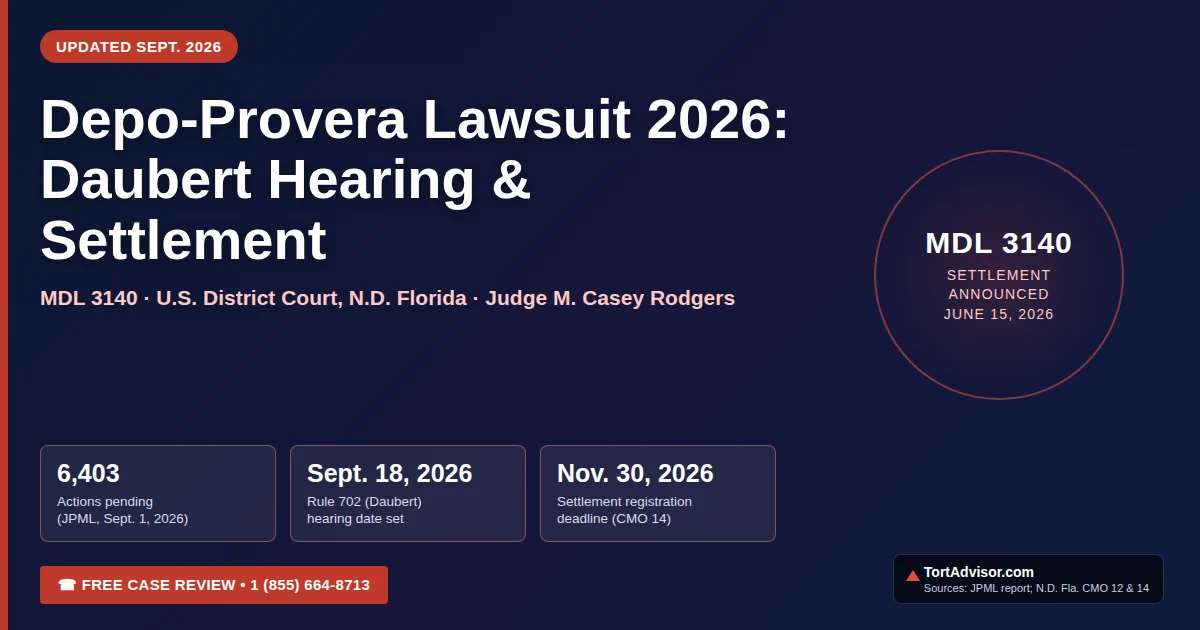
- The Rule 702 (Daubert) hearing on general causation in the Depo-Provera MDL was moved from June 24-25 to July 27, 2026, after Pfizer and plaintiffs’ leadership announced a global settlement framework on June 15, and was later set for September 18, 2026. No ruling had been posted as of September 24, 2026.
- The hearing decides whether plaintiffs’ expert witnesses can tell a jury that Depo-Provera is capable of causing meningioma — a threshold question for any case the settlement doesn’t resolve.
- U.S. District Judge M. Casey Rodgers, who presides over MDL No. 3140 in the Northern District of Florida, vacated trial deadlines in Toney v. Pfizer Inc., removing the immediate need for the first bellwether trial, which had been set for December 7, 2026.
- The June 15 order (Pretrial Order No. 30A) makes clear the settlement will not resolve every case in the MDL, so the causation ruling still matters for plaintiffs who don’t meet the eventual eligibility criteria.
- A 2024 study in The BMJ found women who received injectable medroxyprogesterone acetate (Depo-Provera) had more than five times the odds of developing an intracranial meningioma compared with non-users.
Table of Contents
- What Is the Depo-Provera Rule 702 Hearing, and Why Did It Move to July 27?
- Why the Hearing Still Matters After the Settlement Announcement
- The Science Behind the Lawsuits
- Toney v. Pfizer: The Bellwether Case That Was Vacated
- What Happens After July 27
- Do You Need to Act Before the Ruling?
- FAQ
What Is the Depo-Provera Rule 702 Hearing, and Why Did It Move to July 27?
The Depo-Provera Rule 702 hearing is a “gatekeeping” proceeding where a judge decides whether expert witnesses can testify to a jury at all, before any trial begins. In the Depo-Provera MDL, Judge Rodgers originally scheduled this hearing for June 24-25, 2026, to evaluate whether plaintiffs’ general-causation experts could testify that Depo-Provera is capable of causing intracranial meningioma.
According to the court’s June 15 order, the hearing was pushed back to July 27, 2026, in Pensacola, Florida, to give the parties time to finalize the terms of a global settlement announced that same day. The court still expects to rule on the underlying Rule 702 motions “in the ordinary course,” since the settlement will not cover every pending case.
Find out if you may have a claim
Answer a few questions and a trained case advisor will review your situation — most people finish in about a minute.
- Free — no cost, no obligation
- About a minute to complete
- Reviewed by a trained case advisor
- Nothing you submit is published
Your details are sent over a secure connection and reviewed confidentially.
Why the Hearing Still Matters After the Settlement Announcement
A settlement does not end the litigation. Judge Rodgers noted that the parties’ global agreement “will not resolve all cases in the MDL,” because only plaintiffs who meet its eligibility criteria can participate; the parties estimate that roughly 80% of MDL plaintiffs will be eligible. The Master Settlement Agreement signed on July 21, 2026 covers the MDL and related New York state-court cases (Case Management Order No. 12). For plaintiffs outside it, the Rule 702 causation ruling determines whether their claims can move toward trial.
Plaintiffs who did not separately request permission to submit their own general-causation experts or additional briefing will be bound by whatever ruling comes out of the July 27 hearing, per the court’s June 15 order.
Key Dates in the Depo-Provera Rule 702 Timeline
March 2024
The BMJ publishes a French national case-control study finding a 5.55x increased odds of intracranial meningioma among users of injectable medroxyprogesterone acetate.
February 7, 2025
The Judicial Panel on Multidistrict Litigation centralizes federal Depo-Provera cases as MDL No. 3140 before Judge M. Casey Rodgers in the Northern District of Florida.
December 2025
The FDA approves an updated Depo-Provera label addressing meningioma risk.
May 15, 2026
A joint status report shows 5,549 cases pending in the federal MDL and confirms general-causation expert depositions are complete.
June 15, 2026
Pfizer and plaintiffs’ leadership announce a global settlement in principle; the court vacates trial deadlines in Toney v. Pfizer Inc. and reschedules the Rule 702 hearing.
July 27, 2026
The rescheduled Rule 702/Daubert hearing on general causation is set to proceed in Pensacola, Florida.
Source: Court orders in In re: Depo-Provera Products Liability Litigation, MDL No. 3140 (N.D. Fla.); Roland et al., The BMJ (2024).
The Science Behind the Lawsuits
The litigation traces back to a national case-control study published in The BMJ in March 2024, which examined progestogen use among more than 108,000 French women. Researchers found that women who used injectable medroxyprogesterone acetate — the active ingredient in Depo-Provera — had 5.55 times the odds of developing an intracranial meningioma compared with non-users, an association driven largely by prolonged use of a year or more.
Meningioma Risk by Progestogen (BMJ, 2024 Case-Control Study)
| Progestogen | Odds Ratio |
|---|---|
| Injectable medroxyprogesterone acetate (Depo-Provera) | 5.55 |
| Medrogestone | 3.49 |
| Promegestone | 2.39 |
Source: Roland N, et al. “Use of progestogens and the risk of intracranial meningioma: national case-control study.” The BMJ. 2024;384:e078078.
This is the general-causation science the July 27 hearing addresses: not whether any individual woman’s meningioma was caused by Depo-Provera, but whether the underlying science is sound enough for expert witnesses to say so at trial at all.
Toney v. Pfizer: The Bellwether Case That Was Vacated
Toney v. Pfizer Inc. was one of the early cases moving toward the first scheduled bellwether trial in the MDL, previously set for December 7, 2026. Following the June 15 settlement announcement, Judge Rodgers vacated all trial and pretrial deadlines in that case, effectively removing the immediate need for it to proceed as the litigation’s first test trial.
That does not mean bellwether trials are off the table permanently. A separate order issued the same day, Pretrial Order No. 30A, makes clear the global agreement will not resolve every case, so additional test trials remain possible for claims that fall outside the settlement’s eligibility criteria once those are finalized.
What Happens After July 27
Two tracks are running in parallel in MDL No. 3140. On one track is the settlement program: the parties signed the Master Settlement Agreement on July 21, 2026, BrownGreer PLC was appointed Settlement Administrator on August 5, 2026, and claimants must register by November 30, 2026; payout amounts have not been disclosed. On the other track, the court continues to move the litigation forward for cases the settlement won’t reach; the Rule 702 hearing was later set for September 18, 2026.
Monthly case management conferences are scheduled through the rest of 2026, where the court will address how the settlement structure applies across the MDL and how any remaining, non-settling cases proceed toward trial.
You can review TortAdvisor’s broader active lawsuits and mass tort litigation tracker for updates across other pending cases while these two tracks play out.
Do You Need to Act Before the Ruling?
Attorneys are generally still accepting new Depo-Provera cases. The Master Settlement Agreement signed on July 21, 2026 covers the MDL and related New York state-court cases, but its eligibility criteria are confidential, the parties estimate that roughly 80% of MDL plaintiffs will qualify, and the deadline for claimants to register is November 30, 2026, so waiting can mean losing time against a filing or registration deadline. If you received two or more Depo-Provera (or Depo-SubQ Provera 104) injections and were later diagnosed with an intracranial or spinal meningioma, you can try our settlement calculators or see what the settlement agreement means for your claim.
Not sure if the settlement or the July 27 ruling applies to your case?
Get a free, no-obligation case review so you’re not left waiting on court dates to know where you stand.
Frequently Asked Questions
1. What is the Rule 702 hearing in the Depo-Provera lawsuit?
It is a hearing where Judge M. Casey Rodgers will decide whether plaintiffs’ expert witnesses can testify that Depo-Provera is capable of causing intracranial meningioma. The ruling applies broadly across MDL No. 3140 and determines whether that scientific testimony can be presented at trial in cases the settlement doesn’t resolve.
2. Why was the Depo-Provera Daubert hearing moved to July 27, 2026?
The hearing, originally set for June 24-25, 2026, was rescheduled after Pfizer and plaintiffs’ leadership announced a global settlement agreement in principle on June 15, 2026, giving the parties time to finalize settlement terms.
3. Does the Depo-Provera settlement mean the lawsuits are over?
No. The court’s June 15 order made clear the settlement will not resolve every case in the MDL. Plaintiffs who don’t meet the eventual eligibility criteria, along with most state-court plaintiffs in New York and Delaware, will still depend on rulings like the July 27 Rule 702 decision.
4. What happened to the Depo-Provera bellwether trial?
The first scheduled bellwether trial, Toney v. Pfizer Inc., had its trial and pretrial deadlines vacated by Judge Rodgers on June 15, 2026, following the settlement announcement, removing the immediate need for that trial to proceed as scheduled for December 7, 2026.
5. Can I still file a Depo-Provera lawsuit while the settlement and Rule 702 ruling are pending?
Yes. Attorneys are generally still accepting new cases for women diagnosed with a meningioma after Depo-Provera use. Because eligibility terms for the settlement are not yet final, a case review can help clarify options based on individual diagnosis and use history.
Related Posts
- Depo-Provera Settlement 2026: What the New Global Agreement Means for Your Claim
- Depo-Provera Daubert Hearing 2026: June 24 Date, 6,000 Cases and What It Means
- Depo Provera Brain Tumor Lawsuit 2026: Who Qualifies
External sources: U.S. District Court, Northern District of Florida — MDL No. 3140 docket page; Roland N, et al., The BMJ (2024), via PubMed/NIH.
Related Posts

Quick Answer: The Depo-Provera lawsuit statute of limitations typically runs one to six years from the date of diagnosis, depending [...]
Quick Answer: A Depo-Provera settlement was announced on June 15, 2026, covering a majority of the claims in MDL 3140 [...]
Update — September 24, 2026: A settlement has been reached. On June 15, 2026, plaintiffs’ leadership counsel announced a settlement [...]