

Short answer: This article explains the key facts, eligibility issues, settlement factors, deadlines, and source-backed updates related to this legal topic. Results vary by case facts, evidence, jurisdiction, and representation.
Taking Action with a Cancer Lawsuit
Navigating Your Path with a Cancer Lawsuit
When faced with a cancer diagnosis, the physical and emotional toll is immense. But what if your illness could have been prevented? What if someone else’s negligence caused it? A cancer lawsuit is a legal action taken when someone’s cancer diagnosis is believed to be the result of another party’s negligence or wrongdoing.
Here’s what you need to know about cancer lawsuits:
- What is it? A legal claim seeking justice and financial compensation for cancer caused by another’s fault.
- Who can sue? Individuals or their families if cancer is linked to misdiagnosis, toxic exposure, or faulty products.
- Common causes? This includes medical errors, workplace hazards, dangerous consumer products, or environmental contamination.
- What compensation? You can seek funds for medical bills, lost income, and pain and suffering.
- How to start? Consulting an experienced lawyer is the first crucial step to understand your options.
No one should have to suffer the life-altering consequences of cancer due to another’s carelessness. These lawsuits aim to hold responsible parties accountable. They help victims and their families recover financially from overwhelming medical costs and lost income, providing a path to justice.
My background in technology and internet marketing has given me a unique perspective on managing complex data, which is often crucial in building a strong cancer lawsuit case. As an informational content writer, I aim to simplify these intricate legal topics, helping you understand your rights and options.
Understanding the Main Types of Cancer Litigation

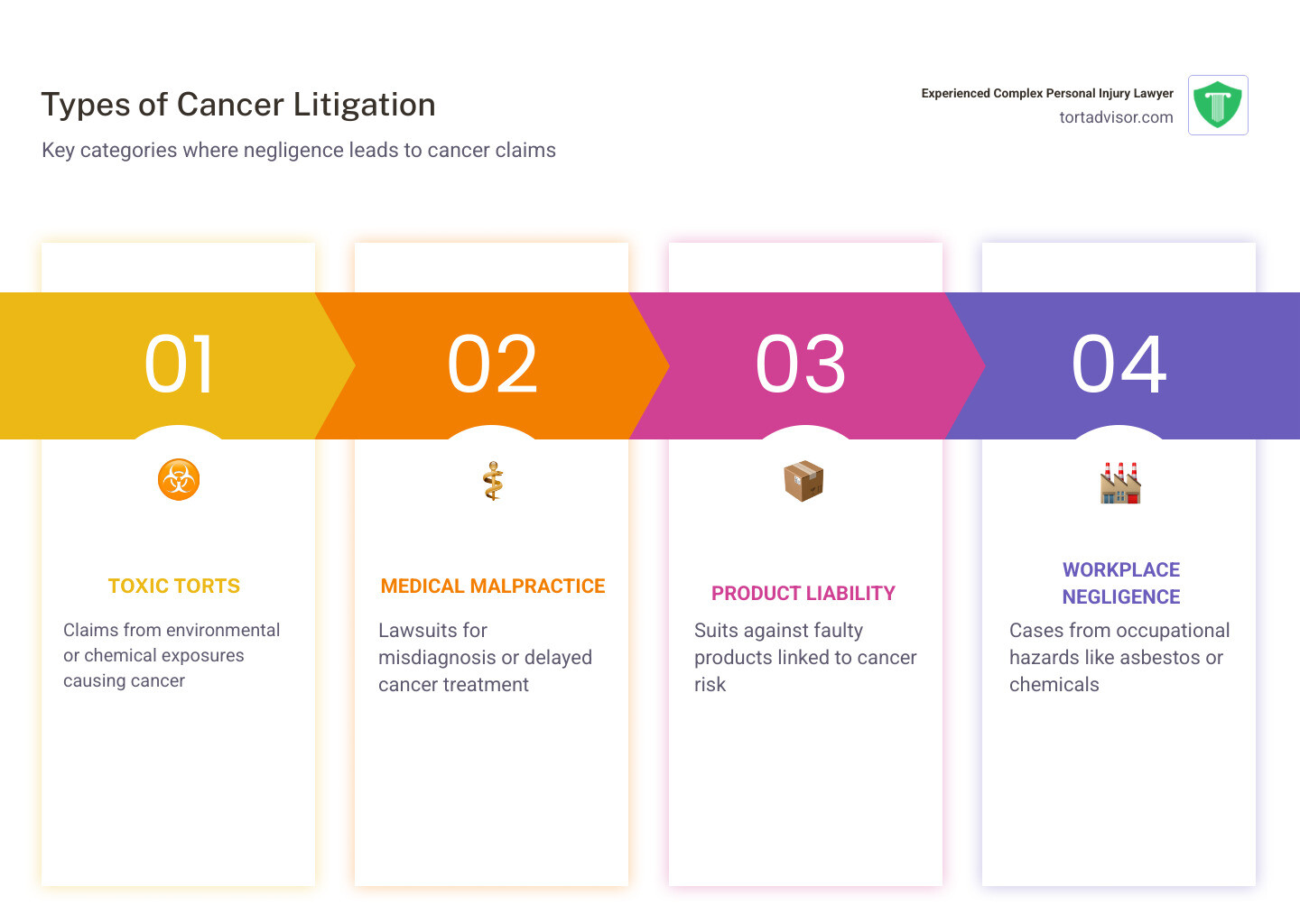
Cancer litigation isn’t a one-size-fits-all area of law. It spans several legal categories depending on how the exposure or negligence occurred. In our experience at Tort Advisor, we see that most cases fall into four primary buckets: toxic torts, medical malpractice, product liability, and workplace negligence.
Toxic Torts and Environmental Contamination
A toxic tort involves a lawsuit against a manufacturer or distributor of a chemical or substance that caused cancer. This often involves large groups of people (mass torts) exposed to the same hazard. For example, many people are currently looking into a Pfas Cancer Lawsuit due to “forever chemicals” found in drinking water across states like Alabama, California, and New Jersey. Similarly, we are seeing a rise in the Hair Relaxer Cancer Lawsuit where chemicals in hair products are linked to uterine and ovarian cancers.
Product Liability
This occurs when a consumer product is inherently dangerous or lacks proper warning labels. A major example is the litigation surrounding certain medical devices. You can find More info on Breast Implant Cancer regarding BIA-ALCL, a rare type of lymphoma linked to textured implants.
Workplace Negligence
Many of our bravest workers face carcinogens daily. Firefighters, for instance, often ask What Cancers Are Linked To Firefighting Foam Exposure after being exposed to AFFF. From construction sites in New York to shipyards in Virginia, employers have a duty to provide a safe environment. When they fail to provide protective gear or warn about asbestos, they can be held liable.
Misdiagnosis and Medical Negligence
Sometimes the cancer wasn’t caused by a third party, but it was allowed to worsen because a doctor missed the signs. Medical negligence occurs when a healthcare professional fails to meet the “standard of care”—meaning they didn’t do what a similarly trained professional would have done in the same situation.
In the case of Scarbrough v. Alabama Cancer Care LLC et al, we see how legal battles unfold when patients feel their treatment or diagnosis didn’t meet professional standards. This can include:
- Failing to order necessary screenings.
- Misinterpreting lab results or pathology reports.
- Delayed referrals to specialists.
Toxic Exposure and Occupational Hazards
Specific substances have become synonymous with a cancer lawsuit. Asbestos is perhaps the most famous, linked to mesothelioma and lung cancer. Then there is glyphosate, the active ingredient in Roundup, which has been linked to Non-Hodgkin’s Lymphoma. Benzene, often found in industrial solvents and even some recalled antifungal sprays, is another known carcinogen that frequently triggers litigation.
Eligibility and Proving Negligence in a Cancer Lawsuit
To win a cancer lawsuit, you can’t just show that you have cancer and that you used a certain product. You have to connect the dots legally. This involves proving four key elements:
- Duty of Care: The defendant (like a doctor or manufacturer) had a legal obligation to keep you safe.
- Breach of Duty: They failed in that obligation (e.g., they knew the product was dangerous but didn’t warn you).
- Causation: The breach directly caused your cancer.
- Damages: You suffered actual losses (medical bills, pain, etc.).
Proving causation is often the hardest part. It requires expert witnesses—usually oncologists or toxicologists—who can testify that “more likely than not,” the exposure was the substantial factor in the diagnosis. Some may wonder, Is There Still A Chance For Compensation Despite The 2024 Federal Court Dismissals? The answer is often yes; state courts frequently have different evidentiary standards than federal courts, allowing many cases to proceed even if an MDL (Multidistrict Litigation) hits a roadblock.
Who Can File a Claim?
Generally, the person diagnosed with cancer (the plaintiff) files the claim. However, if the patient has passed away, the estate representative or surviving family members can file a wrongful death lawsuit. In addition to litigation, many patients also seek financial stability through disability. Our Ssdi For Cancer Complete Guide explains how to navigate Social Security benefits while your legal case is pending.
Proving the Link Between Exposure and Diagnosis
Science is the backbone of these cases. Attorneys look at:
- Latency Periods: Some cancers take 10 to 50 years to develop after exposure (common in asbestos cases).
- Dose-Response: How much of the substance were you exposed to, and for how long?
- Scientific Literature: Studies like the one from the University of Washington which suggested glyphosate increases NHL risk by 41% are vital.
- Exposure History: Detailed work records, product receipts, and even environmental testing of your local water supply. For those worried about water, our Pfas Cancer Risk Complete Guide offers deep insights into these links.
Recoverable Damages and Compensation for Victims
The goal of a cancer lawsuit is to “make the plaintiff whole,” though we know no amount of money can truly replace your health. Compensation is generally split into three categories.
Economic vs. Non-Economic Damages
Economic damages are the tangible, “receipt-based” losses. This includes your Cancer Treatment Costs—which can exceed $140,000 without insurance—and lost wages if you can no longer work. You may also qualify for Cancer Disability Benefits to help cover daily expenses.
Non-economic damages are more subjective. They cover:
- Pain and Suffering: The physical agony and mental anguish of the disease.
- Loss of Consortium: The impact the illness has on your relationship with your spouse.
- Disfigurement: Changes to your body due to surgeries or treatments.
In rare cases of extreme corporate greed, a jury might award punitive damages. These aren’t meant to compensate you, but to punish the defendant and discourage others from doing the same. For example, a Pennsylvania man was initially awarded a massive jury verdict against Bayer for Roundup exposure, which included a heavy punitive component to send a message about corporate safety. If you are struggling now, there are resources for Financial Help During Cancer that can bridge the gap while you wait for a settlement.
The Legal Process: From Diagnosis to Settlement
Filing a cancer lawsuit is a marathon, not a sprint. It starts with a case evaluation where we look at your medical history and exposure. Once a complaint is filed, we enter the “Discovery” phase. This is where both sides swap evidence. You might have to give a deposition (answering questions under oath), and we will certainly depose the company’s scientists and executives.
Key Steps in Filing a Cancer Lawsuit
- Consultation: Meeting with a specialty lawyer to see if you have a case.
- Filing the Complaint: Officially starting the lawsuit in court.
- Discovery: Gathering evidence, including medical records and internal company memos.
- Expert Testimony: Hiring specialists to prove the cancer link.
- Negotiation/Trial: Most cases end in a settlement, but some go to a jury.
For those unable to work during this time, the Ssdi Application Cancer process should be started as soon as possible, as it can be just as rigorous as the lawsuit itself.
Navigating MDLs and Class Actions in a Cancer Lawsuit
You’ve likely heard the terms “Class Action” and “MDL.” They are different:
- Class Action: One lawsuit represents a whole group. If the “class” wins, everyone gets a slice of the same pie.
- MDL (Multidistrict Litigation): Thousands of individual lawsuits (like the Roundup Lawsuit) are consolidated in one court for the discovery phase to save time. However, each person still has their own case and their own settlement amount based on their specific health.
- Trust Funds: In cases like the Asbestos Lawsuit, many companies went bankrupt. They were forced to set up trust funds (now containing over $30 billion) to pay out future victims.
If you are dealing with a specific type of cancer, such as from medical devices, you might join a Breast Cancer Class Action Lawsuit if the circumstances are right.
Real-World Examples of Major Cancer Settlements
The landscape of cancer litigation is constantly shifting with new verdicts and settlements. Here are some of the most significant recent developments:
- Roundup (Glyphosate): Bayer recently announced a $7.25 billion tiered national class settlement to resolve tens of thousands of claims. This follows massive individual verdicts, including a $78 million award in October 2024 for a man with non-Hodgkin lymphoma.
- Asbestos: Over $30 billion is currently available in trust funds. While the average settlement is around $100,000, some families have recovered up to $1.6 million depending on the level of exposure and the number of companies involved.
- Zantac (Ranitidine): GSK (GlaxoSmithKline) reached a deal to settle approximately 80,000 lawsuits for up to $2.2 billion. The litigation focused on the discovery that the drug could degrade into NDMA, a probable carcinogen.
- Talcum Powder: Johnson & Johnson has faced significant heat, including a $966 million verdict in a California mesothelioma case. Testimony from former FDA commissioners has alleged the company hid asbestos risks in their talc for 50 years.
- Insurance Denials: It’s not just manufacturers getting sued. Aetna Gets OK For $3.4M Deal In Cancer Treatment Denial Suit after they wrongly denied coverage for proton beam therapy by calling it “experimental.”
Asbestos and Mesothelioma Payouts
For veterans and blue-collar workers, the Mesothelioma Lawsuit remains a primary path to justice. Military veterans make up about 33% of all asbestos-related diagnoses. Beyond lawsuits, veterans can often claim VA benefits, which can be worth over $4,000 a month for those with a 100% disability rating due to service-connected lung cancer.
Pharmaceutical and Product Liability Wins
We are also seeing movement in the Uterine Cancer Hair Relaxer cases, as more women come forward. In the pharmaceutical world, “innovator liability” is a growing theory—this is where a brand-name maker can be held responsible for injuries caused by a generic version because the brand-name company controlled the warning label.
Frequently Asked Questions about Cancer Litigation
Can I file a lawsuit if I have a history of smoking?
Yes! This is a common misconception. In asbestos cases, for example, doctors recognize a “synergistic effect.” Smoking and asbestos exposure together don’t just add to your risk; they multiply it. Even if you smoked, if you were exposed to asbestos at work, the asbestos companies can still be held liable for their contribution to your illness.
What is the statute of limitations for a cancer claim?
This varies by state, but the “Discovery Rule” is your best friend. It typically says the clock doesn’t start ticking until you discovered (or should have discovered) that your cancer was linked to someone’s negligence. Because cancer has a long latency period, you might be able to sue decades after the actual exposure. However, once you are diagnosed and suspect a link, you must act fast—often within 1 to 3 years depending on where you live, like in California, Florida, or Texas.
How much does it cost to hire a cancer lawyer?
Almost all cancer lawyers work on a contingency fee basis. This means:
- No upfront costs: You don’t pay a dime to start the case.
- We take the risk: If we don’t win or settle your case, you owe us nothing for our time.
- Percentage-based: The lawyer takes a pre-agreed percentage of the final settlement to cover their work and the expensive costs of expert witnesses and filing fees.
Conclusion
A cancer diagnosis changes everything, but you don’t have to navigate the legal aftermath alone. At Tort Advisor, we specialize in connecting you with the right legal experts who have a proven track record of securing the compensation you deserve. Whether it’s holding a multi-billion dollar pharmaceutical company accountable or fighting an insurance denial, our goal is to ensure you have the best possible advocacy.
If you believe your diagnosis was preventable, now is the time to act. Whether you need to explore a Pfas Cancer Lawsuit or take action with a Breast Implant Lawsuit, we are here to help you find the justice you and your family deserve. Don’t let the clock run out on your rights—reach out for a free consultation today.
Related Posts

Explore cancer lawsuit options for negligence, toxic exposure, or malpractice. Learn eligibility, damages, and the legal process to seek justice.

Find the best car accident lawyer phoenix. Expert guide on choosing pros, compensation, steps after crash & Arizona laws.

Tupelo hair relaxer cancer lawsuit victims: Get legal help to claim compensation for uterine/ovarian cancer linked to products. Act now!