Short answer: This article explains the key facts, eligibility issues, settlement factors, deadlines, and source-backed updates related to this legal topic. Results vary by case facts, evidence, jurisdiction, and representation.
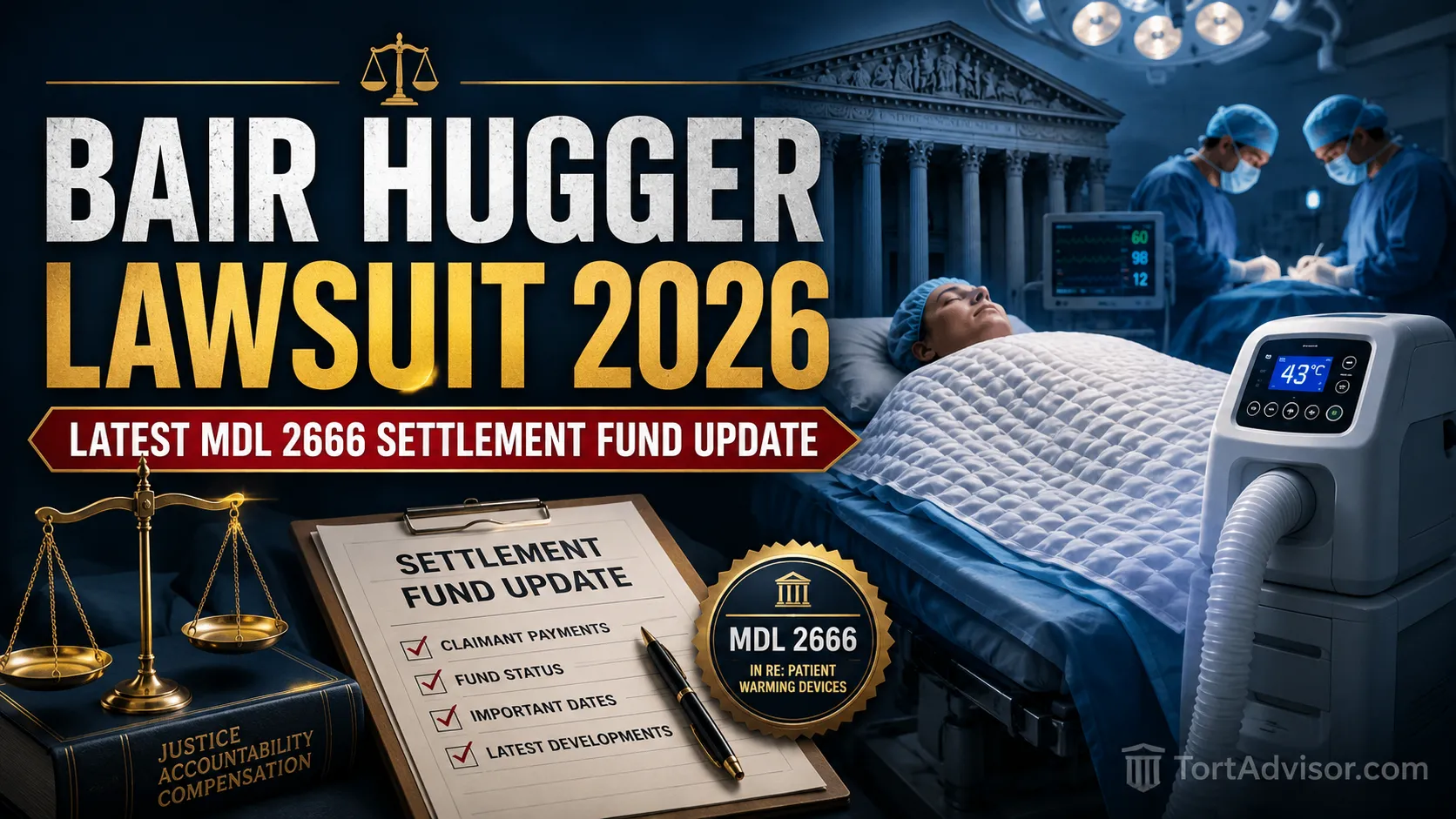
If you developed a serious infection following orthopedic surgery — such as a hip or knee replacement — and a Bair Hugger forced-air warming device was used in the operating room, you may have grounds for a Bair Hugger lawsuit. More than 8,400 claims are currently pending in MDL 2666, and a Qualified Settlement Fund request filed in 2026 may be the most significant development in this litigation to date. Here is everything confirmed so far — and what to do now to protect your rights.
Call our Bair Hugger lawsuit expert advisors now for a free, no-obligation case review.
📞 Call Now: 1 (855) 664-8713What Is the Bair Hugger Lawsuit About?
A Bair Hugger lawsuit is a legal claim filed by patients who developed deep periprosthetic joint infections — typically MRSA or other severe bacterial infections — following hip or knee replacement surgeries in which the Bair Hugger forced-air warming device was used. Plaintiffs allege that 3M Company and its subsidiary Arizant Healthcare designed and marketed a product that disrupts carefully engineered laminar airflow in orthopedic operating rooms, pushing contaminated air particles directly into open surgical wounds.
The Bair Hugger is the dominant patient warming system in U.S. hospitals, estimated to be in use in 80–90% of operating rooms nationwide. It maintains a patient’s core body temperature during surgery — a medically important function. Plaintiffs do not dispute its warming purpose; they argue the design chosen by 3M creates an unacceptable, undisclosed infection risk for the specific patient population undergoing joint replacement, where the consequences of infection can be catastrophic and irreversible.
The core injuries alleged include deep periprosthetic joint infections requiring multiple revision surgeries, sepsis, MRSA infections, permanent joint dysfunction, limb loss, and in the most severe cases, wrongful death. For an overview of all defective medical device litigation currently active, see the full Bair Hugger lawsuit guide on our site, or explore TortAdvisor’s mass tort resources for related cases.
Latest Bair Hugger Lawsuit Update (June 2026)
As of June 2026, approximately 8,422 active Bair Hugger lawsuit claims are pending in MDL No. 15-2666 (In re: Bair Hugger Forced Air Warming Devices Products Liability Litigation) before Judge Joan N. Ericksen and Magistrate Judge David T. Schultz in the U.S. District Court for the District of Minnesota — making it one of the largest active medical device MDLs in the country. The most significant breaking development is a sealed court filing requesting permission to create a Qualified Settlement Fund (QSF), which would establish the formal framework for resolving thousands of pending claims against 3M.
The QSF request represents the first concrete step toward a global resolution in this decade-long litigation. While the specific terms — dollar amounts, eligibility tiers, and claim deadlines — remain sealed and have not been made public, the existence of the filing signals that both parties are engaged in serious settlement negotiations under Special Master James M. Rosenbaum (Ret.). No global resolution has been formally announced as of this writing.

The road here has been long. The MDL was originally filed in 2015. The first bellwether trial in 2018 ended in a defense verdict for 3M. The following year, in 2019, the court excluded plaintiffs’ general causation experts and dismissed the entire MDL — an outcome that appeared to end the litigation entirely. Plaintiffs appealed, and in August 2021 the U.S. Court of Appeals for the Eighth Circuit reversed the dismissal, finding that plaintiffs’ scientific evidence was sufficient to proceed. The U.S. Supreme Court declined to hear 3M’s appeal in June 2022, and the MDL formally reopened in December 2022.
In February 2025, a key ruling in Boncher v. 3M in the Eastern District of Pennsylvania denied 3M’s motion to exclude plaintiffs’ infection-causation expert under Rule 702 and denied summary judgment — preserving the core causation theory that the Bair Hugger can cause periprosthetic joint infections. That ruling, combined with the growing case count (now over 8,400), has likely contributed to the current settlement discussions. The Shirley Hilke v. 3M bellwether trial concluded in 2026 and the appeal is actively briefed before the Eighth Circuit.
Settlement Fund and Case Value
The Qualified Settlement Fund request is the single most important development in the Bair Hugger lawsuit MDL in years. A Qualified Settlement Fund — sometimes called a QSF or “468B fund” — is a court-authorized legal vehicle that allows defendants to deposit money to resolve claims without yet having finalized all individual payments. Creating one signals that a global resolution framework is being actively built.
What is confirmed: The parties have requested court permission to establish a Qualified Settlement Fund. The filing exists and the request has been made.
What is NOT yet confirmed: The amount of money to be deposited in the fund, the eligibility criteria for claimants, payout tiers based on injury severity, and any submission deadlines — all remain sealed. No official settlement amount has been announced by 3M or Arizant. Any specific dollar figure you read elsewhere should be treated as an estimate, not a confirmed offer.
Attorney estimates (speculative, not confirmed): Various plaintiff attorneys commenting publicly on this litigation have estimated individual Bair Hugger lawsuit settlement values could range from approximately $30,000 to $250,000 or more for most cases, with the highest-value cases — involving MRSA, sepsis, multiple revision surgeries, permanent disability, or wrongful death — potentially reaching $1 million or more. These are projections based on comparable medical device MDL outcomes, not guaranteed amounts. For context on how medical device settlements in similar MDLs have been valued, see if you may qualify for a similar recovery in our settlement amounts guide.
Do You Qualify to File a Bair Hugger Lawsuit?
Because official Qualified Settlement Fund eligibility criteria have not been publicly released, the specific requirements for joining the settlement framework are not yet known. However, attorneys actively filing claims in MDL 2666 evaluate potential clients based on the following criteria:
- Orthopedic implant surgery (hip or knee replacement) — The Bair Hugger device was specifically used in your surgery. This is typically documented in surgical and anesthesiology notes.
- Post-surgical deep infection diagnosis — You developed a deep periprosthetic joint infection, MRSA, sepsis, or a comparable serious infection after the surgery. Superficial wound infections may not qualify; the injury must be a deep joint/bone infection.
- Medical records linking use and infection — Hospital records, surgical notes, and infection diagnosis records are required to support a claim. The closer in time the infection follows surgery, the clearer the potential causal link.
- Statute of limitations — Filing deadlines vary by state, typically running 2–4 years from the date of injury or discovery. Some deadlines may have already passed for older surgeries. Acting now is critical.
- Qualifying injury severity — Revision surgery, prolonged hospitalization, permanent joint damage, amputation, or wrongful death are the most compelling injury profiles. Milder infections that resolved quickly may still qualify, but with different case value projections.
- Wrongful death claims — Family members of patients who died from a Bair Hugger-related infection may be eligible to file on behalf of the estate.
Note that 3M has argued — and the Eighth Circuit acknowledged — that proving a specific patient’s infection was caused by the Bair Hugger (rather than another intraoperative source) remains a significant evidentiary challenge. An experienced mass tort attorney can evaluate whether the facts of your case support a strong causation argument. You can also explore other active mass tort lawsuits you may qualify for.
How Much Could Your Bair Hugger Case Be Worth?
The value of an individual Bair Hugger lawsuit claim depends on several injury-specific factors. Because Qualified Settlement Fund terms have not been released, these factors are used by plaintiff attorneys to estimate — not guarantee — case value. To get a personalized estimate based on your situation, estimate what your case could be worth now using our settlement calculator.
Infection severity is the single most influential factor. A deep periprosthetic joint infection progressing to systemic sepsis or MRSA bacteremia — requiring ICU care, IV antibiotics, and joint explantation — is likely to command significantly higher compensation than a contained localized infection treated with a single course of antibiotics. The number of revision surgeries required also directly affects both economic damages (medical costs) and non-economic damages (pain, suffering, and loss of quality of life).
Permanent disability or functional loss is a major value driver. Patients left with a permanently unstable joint, a prosthesis that could not be reimplanted, reduced mobility, or a lower-limb amputation will generally have the strongest damages cases. Lost wages and reduced earning capacity — particularly for working-age plaintiffs whose careers were interrupted or ended by the infection and its treatment — are also weighted heavily in comparable mass tort settlements.

Duration of illness and the overall treatment burden also factor in. Cases involving years of follow-up surgeries, ongoing antibiotic therapy, and continued joint complications typically produce more extensive documented economic damages, which strengthens the case for higher compensation. Attorney estimates of $30,000–$1 million+ reflect this wide variation in injury profiles, not a single standard payout.
How to File a Bair Hugger Lawsuit
Filing a Bair Hugger lawsuit — or registering a claim in advance of a Qualified Settlement Fund — involves a straightforward process, though timing and documentation are critical. Here is what most claimants can expect:
- Free case evaluation — An experienced mass tort attorney reviews your surgical records, hospital records, and infection diagnosis to assess whether your case meets the threshold criteria for MDL 2666. There is no cost for this review.
- Gathering medical records — Your attorney requests your surgical and post-surgical records, including operating room logs confirming Bair Hugger use, anesthesia records, microbiology/culture results confirming infection type, and records of any revision surgeries.
- Filing or registering your claim — Depending on the status of the Qualified Settlement Fund when your claim is ready, your attorney will either file a complaint directly in MDL 2666 in the District of Minnesota, or register your claim with the settlement administrator. Early registration typically places claimants in a better position within any eventual payout framework.
- Discovery and expert review — Your legal team works with medical and engineering experts to establish that (a) the Bair Hugger was in use during your specific surgery, (b) you developed a qualifying infection, and (c) your infection is causally linked to the device’s use — the most contested element in this litigation.
- Settlement negotiation or trial — Cases filed in the MDL may resolve through the Qualified Settlement Fund framework if approved, or proceed to bellwether trials. Individual state-court filings may also resolve through direct negotiation with 3M’s legal team.
Statute of limitations deadlines are critical. Most states provide 2–4 years from the date of injury or discovery to file a Bair Hugger lawsuit, and some plaintiffs with older infections may already be approaching or past their deadline. Speaking with an attorney immediately — especially given the Qualified Settlement Fund is actively being developed — is the most important step you can take.
For peer-reviewed scientific context on the Bair Hugger–infection link, see the published literature on PubMed/NIH, which includes multiple orthopedic and infectious disease studies examining forced-air warming and periprosthetic infection risk. The Eighth Circuit’s August 2021 reversal opinion in MDL 2666 — available through the Eighth Circuit Court of Appeals — provides the definitive legal framework under which this litigation now proceeds.
Did You Develop an Infection After Bair Hugger Use During Surgery?
Thousands have filed Bair Hugger lawsuits in MDL 2666. A Qualified Settlement Fund is being developed. Our attorneys work on contingency — no upfront cost, no obligation, ever.
📞 Call Now: 1 (855) 664-8713 — Free Case ReviewFrequently Asked Questions
Your Bair Hugger Lawsuit Claim May Already Be Time-Sensitive
A Qualified Settlement Fund is being developed in MDL 2666. With over 8,400 active claims and settlement negotiations underway, now is the time to act. Our attorneys take cases on contingency — you pay nothing unless you win.
📞 Claim Your Free Case Review — 1 (855) 664-8713Related Articles
Navigating Bair Hugger Claims: How to Choose the Right Injury Lawyer
Updated August 23, 2025
The Bair Hugger: More Than Just a Warming Blanket
Updated September 2, 2025
Understanding Product Liability Injuries and Your Rights
Updated May 28, 2026
Related Posts

If you developed a serious infection following orthopedic surgery — such as a hip or knee replacement — and a [...]

A global Depo-Provera settlement agreement was announced on June 15, 2026 — the most significant development in this litigation since [...]
If you or a loved one has been diagnosed with mesothelioma after years of using talcum powder products, you may [...]