
Short answer: This article explains the key facts, eligibility issues, settlement factors, deadlines, and source-backed updates related to this legal topic. Results vary by case facts, evidence, jurisdiction, and representation.
What You Need to Know Before Starting Your SSI Application
Completing an SSI application is one of the most important steps you can take if you’re living with a disability, blindness, or are 65 or older with limited income and resources. Supplemental Security Income (SSI) provides monthly federal payments to help cover basic needs — and knowing how to apply correctly can make the difference between approval and denial.
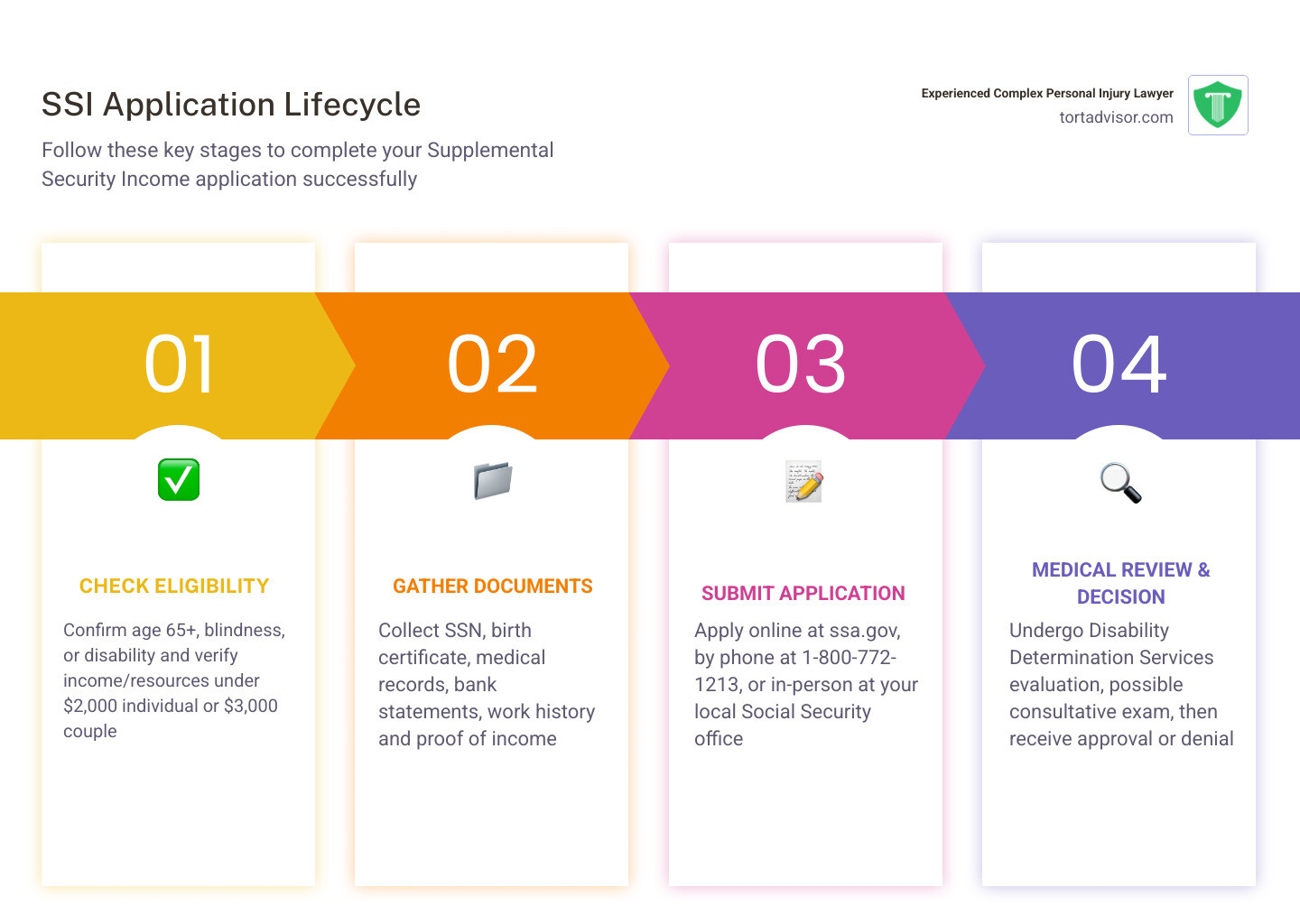
Here’s how to apply for SSI, fast:
- Online — Visit ssa.gov/ssi if you’re between ages 18 and 64 and applying for the first time
- By phone — Call 1-800-772-1213 to schedule an appointment (your call date can count as your filing date)
- In person — Visit your local Social Security office
- With help — You can have a representative, family member, or attorney assist you
Key tip: Apply as soon as possible. SSI benefits cannot be paid for any period before your application date.
Basic eligibility at a glance:
| Requirement | Individual | Couple |
|---|---|---|
| Resources (assets) | Under $2,000 | Under $3,000 |
| Age or condition | 65+, blind, or disabled | Same |
| Work history needed? | No | No |
| Monthly federal benefit (2024) | Up to $967 | Up to $1,450 |
If you’re feeling overwhelmed by the process, you’re not alone. The SSI application can be complex, the paperwork is extensive, and many initial claims are denied — even for people who clearly qualify. This guide walks you through every step so you know exactly what to expect.
My name is Mason Arnao, and while my background is rooted in technology, data systems, and internet marketing, I’ve spent years researching and writing about complex government benefit programs — including the SSI application process — to help everyday people cut through the confusion. I’ll walk you through the full process in plain language, so you can move forward with confidence.
Handy ssi application terms:
Understanding SSI Eligibility and Financial Limits

Before you dive into the paperwork, we need to make sure you meet the basic criteria. Unlike Social Security Disability Insurance (SSDI), which is based on your work history, SSI is a “needs-based” program. This means it is designed for people with very limited income and resources.
To qualify, you generally must be:
- Age 65 or older; OR
- Blind; OR
- Have a medical condition that keeps you from working and is expected to last at least one year or result in death.
Income and Resource Limits
The Social Security Administration (SSA) looks closely at what you earn and what you own. For your ssi application to be successful in 2026, you must fall under these strict thresholds:
- Resources: You cannot have more than $2,000 in countable resources as an individual, or $3,000 for a couple. This includes cash, bank accounts, stocks, and property (though the home you live in and one vehicle usually don’t count).
- Income: The SSA counts wages, pensions, and even “in-kind” support (like free rent). The 2024 federal benefit rate (FBR) is $967 for an individual and $1,450 for a couple, though these numbers are adjusted annually for inflation.
You can find more details on these requirements at Apply for Supplemental Security Income (SSI) | SSA. If you are unsure if you qualify, it is often better to apply anyway, as some income and assets might be excluded from the count.
How to Start Your SSI Application

We recommend starting your ssi application as soon as possible. Why the rush? Because if you are approved, your benefits are usually retroactive to the date you first contacted the SSA to express your intent to file. This is known as your protective filing date.
There are several ways to get the ball rolling:
- Phone: Call 1-800-772-1213 (TTY 1-800-325-0778) to schedule an appointment. If you keep this appointment, the date of your call is preserved as your filing date.
- In-Person: You can visit a local office, though we suggest calling ahead to make an appointment to avoid long wait times.
- Online: For many adults, the easiest route is the Apply for Social Security Benefits | SSA portal.
For a deeper dive into the broader world of disability claims, check out our ssdi claims 2026 complete guide.
Using the Simplified Online SSI Application
In a major win for applicants, the SSA has rolled out a streamlined online process. Previously, the application was a daunting 54-question marathon. Now, for certain eligible adults, it has been slashed to as few as 12 questions.
| Feature | Traditional Paper Application | Simplified Online Application |
|---|---|---|
| Question Count | 54 Questions | As few as 12 Questions |
| Eligibility | All applicants | Adults 18-64, never married, first-time filers |
| Pre-filling | None | Uses existing SSA data to pre-fill answers |
| Form Reference | SSA-8000-BK | Digital Interface |
To use this simplified version, you must be a U.S. citizen between 18 and 64, have never been married, and have never applied for SSI before. If you don’t meet these specific criteria, don’t worry—you can still apply using the standard methods.
Preparing Your SSI Application Documents
The SSA is going to ask for “proof” of almost everything. To make the process smoother, we suggest gathering these items before you start:
- Identification: Your Social Security card and birth certificate.
- Medical Evidence: Names and contact info for all doctors, hospitals, and clinics you’ve visited, along with a list of medications.
- Financial Records: Bank statements, payroll stubs, and information about any other income (like unemployment or pensions).
- Living Arrangements: Lease agreements, mortgage statements, and records of household expenses like food and utilities.
- Work History: Details of where you worked and what kind of work you did over the last 15 years (if applicable).
Don’t let a missing document stop you! If you can’t find something, the SSA is required to help you get it. You can see a list of common disability claim forms to help you prepare.
The SSI Application Timeline and Decision Process
Patience is a virtue, especially here. A typical ssi application takes four months or longer to process. Here is what happens behind the scenes:
- Field Office Review: The SSA checks your non-medical eligibility (income and resources).
- Medical Review: Your file is sent to a state agency called Disability Determination Services (DDS).
- Consultative Exam: If your medical records aren’t complete, the SSA may pay for you to have a medical exam.
- RFC Assessment: Doctors evaluate your residual functional capacity—basically, what you can still do despite your limitations.
Wait times can vary significantly depending on where you live. For a better idea of how long you might wait, you can check the latest ssdi approval time estimates. If you have a terminal illness or a “compassionate allowance” condition, your claim can be expedited.
SSI vs. SSDI: Which Program Is Right for You?
Many people use the terms “SSI” and “disability” interchangeably, but they are very different programs. It is actually possible to apply for both at the same time—this is called a concurrent claim.
| Feature | Supplemental Security Income (SSI) | Social Security Disability Insurance (SSDI) |
|---|---|---|
| Basis | Financial Need | Work History (Credits) |
| Funding | General Tax Revenue | Payroll Taxes (FICA) |
| Health Care | Medicaid (usually immediate) | Medicare (after 24 months) |
| Asset Limits | Strict ($2,000/$3,000) | None |
| Work History | None required | Required (usually 5 of last 10 years) |
If you’ve worked recently and paid into the system, you should look into ssdi eligibility rules. If you have a limited work history, SSI is likely your best path.
What to Do If Your Claim Is Denied
Here is a tough truth: Many initial ssi application submissions are denied. If you receive a denial letter, do not give up. You have 60 days from the date you receive the notice to file an appeal.
The disability appeal process has four main stages:
- Reconsideration: A complete review of your claim by someone who wasn’t involved in the first decision.
- ALJ Hearing: A hearing before an Administrative Law Judge. This is often your best chance at approval. Check out our disability hearing tips for help.
- Appeals Council: They review whether the judge made a legal error.
- Federal Court: The final level of appeal.
If you find yourself in this position, reading our guide on a denied disability claim can provide the next steps you need to take.
Frequently Asked Questions about SSI
Can I apply for SSI if I have never worked?
Yes! This is one of the biggest benefits of the SSI program. Because it is needs-based and funded by general tax revenues (not payroll taxes), your work history—or lack thereof—does not affect your eligibility. As long as you meet the medical and financial requirements, you can qualify.
How long does it take to get a decision on an SSI application?
While the SSA aims for efficiency, the process typically takes about four months. However, it can take much longer if the SSA needs to request additional medical records or if you need to go through the appeals process.
What rights do I have during the application process?
You have several fundamental rights, including:
- The right to apply (no one can tell you “no” before you file).
- The right to help from the SSA in obtaining documents.
- The right to be represented by an attorney or qualified representative.
- The right to receive a written explanation of any decision.
- The right to appeal any decision you disagree with.
For more on these protections, see SSI Application Process and Applicants’ Rights | SSA.
Conclusion
Navigating the ssi application process can feel like a full-time job at a time when you are already dealing with health and financial challenges. Between the strict resource limits and the complex medical requirements, it’s easy to see why so many people feel discouraged.
At Tort Advisor, we connect you with experienced legal professionals who specialize in Social Security law. Our goal is to ensure you have a champion in your corner who knows how to present your case effectively and maximize your chances of approval. Whether you are just starting your application or facing a frustrating denial, you don’t have to do this alone.