

When a Rideshare Ride Becomes a Crime: What Survivors Need to Know
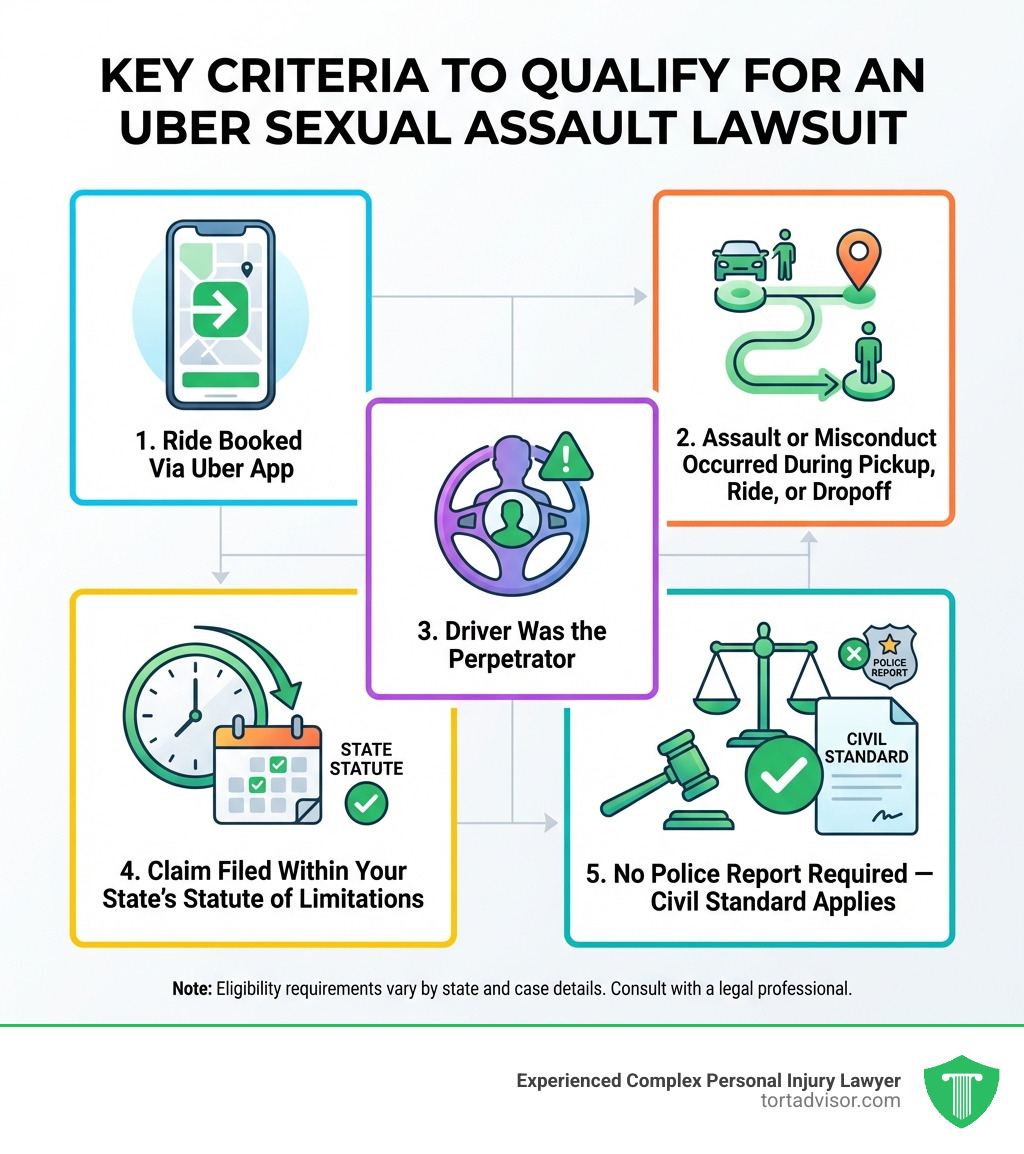
Knowing how to qualify for an uber sexual assault lawsuit is the first and most important step toward getting justice after a traumatic experience.
Here is a quick overview of who qualifies:
You may qualify if:
- The ride was booked through the Uber app (not arranged privately)
- A driver committed sexual assault, harassment, or misconduct during pickup, the ride, or dropoff
- You experienced any form of non-consensual touching, rape, attempted assault, verbal sexual harassment, or forced detour
- The incident occurred within your state’s statute of limitations (varies by state)
- You do not need a police report or criminal conviction to file a civil claim
Uber is currently facing more than 3,700 sexual assault lawsuits consolidated into a federal MDL (Multi-District Litigation No. 3084) in San Francisco. Internal Uber records revealed 400,181 reports of sexual assault or misconduct between 2017 and 2022 — roughly one report every eight minutes. Yet Uber publicly disclosed only 12,522 of those incidents as “serious.”
That gap tells a story. And courts are paying attention.
A first bellwether trial in early 2026 resulted in an $8.5 million compensatory damages verdict. More trials are scheduled. Survivors across the country are stepping forward — and many are winning.
If you were assaulted during an Uber ride, you are not alone. And you may have a strong legal case even if you never filed a police report.
My name is Mason Arnao, and through my work in internet marketing, SEO, and lead generation across legal verticals, I have spent years helping survivors understand how to qualify for an uber sexual assault lawsuit and connect with the right attorneys. In this guide, I will walk you through exactly what it takes to build a qualifying claim — step by step.
Understanding the Uber Sexual Assault MDL and Litigation Landscape
When thousands of people have the same legal complaint against a massive corporation, the court system often uses a tool called Multidistrict Litigation, or MDL. Specifically, Uber Technologies Passenger Sexual Assault Litigation (MDL No. 3084) was created to handle the sheer volume of survivors seeking accountability.
Currently overseen by Judge Charles Breyer in the Northern District of California, this MDL centralizes cases from across the country. This doesn’t mean it’s a “class action” where everyone gets a tiny, equal check. Instead, it allows for coordinated discovery—where lawyers can look into Uber’s internal files—while allowing each survivor to maintain their own individual lawsuit.
The core of these Uber sexual assault lawsuits centers on corporate negligence. Plaintiffs argue that Uber failed in its duty of care by:
- Using “worthless” name-based background checks instead of fingerprint-based FBI checks.
- Ignoring or downplaying hundreds of thousands of internal misconduct reports.
- Failing to implement basic safety features, like “female driver matching,” until it was far too late for many.
Recent developments have shifted the momentum in favor of survivors. In early 2026, a “bellwether trial”—a test case used to gauge how juries react to the evidence—resulted in a staggering $8.5 million verdict for the plaintiff. This sends a loud message: juries understand that Uber’s growth-at-all-costs culture created a systemic safety failure.
Criteria to Qualify for an Uber Sexual Assault Lawsuit
To qualify for an uber sexual assault lawsuit, your case must meet specific legal benchmarks. It isn’t just about what happened; it’s about proving that the relationship between you, the driver, and Uber created a legal liability.
The most critical factor is the app-facilitated ride. If you met a driver through Uber but then agreed to take a ride “off-app” (paying cash or Venmo directly to the driver), Uber will likely successfully argue they aren’t liable. The protection—and the liability—exists because you used their platform to find a “safe” ride.
Qualifying vs. Non-Qualifying Scenarios
| Scenario | Qualification Status | Why? |
|---|---|---|
| Assault occurred during an active Uber ride tracked by GPS | Qualifies | Direct use of the platform and duty of care. |
| Driver assaulted passenger after “ending” the ride but before they exited | Qualifies | The incident is inextricably linked to the Uber transaction. |
| Passenger took a private ride with a driver they met on Uber previously | Unlikely to Qualify | The “contract” with Uber ended when the app was bypassed. |
| Driver made lewd comments and touched passenger inappropriately | Qualifies | Meets the definition of sexual misconduct and harassment. |
Uber often tries to hide behind the “independent contractor” defense, claiming they aren’t responsible for the criminal acts of people who aren’t technically employees. However, courts have increasingly rejected this. Because Uber controls the app, the payment, and the matching algorithm, they have a duty to ensure the people they send to your door are safe.
Internal records revealed by a New York Times investigation showed that Uber logged 400,181 reports of misconduct over a five-year period. This data is a cornerstone for those looking to qualify for an uber sexual assault lawsuit, as it proves Uber had “notice” that their system was being abused by predators.
Types of Misconduct That Help You Qualify for an Uber Sexual Assault Lawsuit
Many survivors mistakenly believe that “only” the most violent crimes count for a lawsuit. This is not true. Uber’s internal tracking actually identifies 21 categories of sexual misconduct.
You may qualify if you experienced:
- Non-consensual sexual touching: Groping, unwanted kissing, or touching of any sexual body part.
- Rape or attempted sexual assault: Any form of non-consensual penetration or forced sexual acts.
- Kidnapping/Forced Detours: If a driver took you to a secondary location or refused to let you out of the vehicle.
- Verbal Harassment: Lewd comments about your body, unwanted sexual propositions, or “creepy” flirting that made you feel unsafe.
If you are unsure where your experience falls, you can use a Rideshare Settlement Calculator to see how different factors impact potential compensation.
Evidence Needed to Qualify for an Uber Sexual Assault Lawsuit
Proving a case against a multi-billion-dollar company requires evidence. While your testimony is powerful, supporting it with digital and physical records makes your claim much harder for Uber to dismiss.
Key evidence includes:
- Trip History & Receipts: This proves you were in the car and that Uber facilitated the ride.
- GPS Data: Uber tracks every ride. If a driver took a 22-minute trip and turned it into a 5-hour ordeal, that data is vital.
- Medical Records: If you sought treatment, therapy, or a forensic exam (rape kit), these documents prove the “damages” or harm you suffered.
- Witness Statements: Did you text a friend during the ride saying you were scared? Did you tell a roommate what happened immediately after? These “contemporaneous” accounts are excellent evidence.
- App Screenshots: Save any messages from the driver or the “ride cancelled” notifications that might seem suspicious.
For more detailed help on building your file, check out these Uber Sexual Assault Claim Tips.
Navigating Statutes of Limitations and Filing Deadlines
Time is, unfortunately, a major factor. Every state has a “statute of limitations”—a deadline by which you must file your lawsuit. If you miss this window, you lose your right to sue, regardless of how strong your evidence is.
Generally, these deadlines range from one to six years depending on the state. However, there are exceptions:
- The Discovery Rule: In some cases, the clock doesn’t start until you “discover” the harm (though this is rare in assault cases).
- Tolling for Minors: If the survivor was a minor at the time, the clock often doesn’t start until they turn 18.
- Revival Windows: Some states, like New York and California, have passed “Child Victims Acts” or similar laws that temporarily reopen the door for survivors of older assaults to file claims even if the original deadline passed.
Because these laws change frequently (often quarterly), it is essential to consult a 50-state civil statute of limitations guide or an Uber Sexual Assault Lawyer Ultimate Guide to ensure you are still within your legal rights.
Seeking Compensation and Legal Accountability
Filing a lawsuit isn’t just about the money; it’s about making it too expensive for Uber to ignore safety. However, the compensation you receive is meant to help you rebuild your life.
Survivors in Rideshare Sexual Assault Lawsuits can seek several types of damages:
- Compensatory Damages: Money for medical bills, therapy costs, and lost wages if you couldn’t work.
- Pain and Suffering: Compensation for the emotional trauma, PTSD, anxiety, and loss of enjoyment of life.
- Punitive Damages: These are designed to punish Uber for particularly egregious behavior, like ignoring a driver’s previous assault reports.
To help manage the thousands of cases, the court has appointed Gail Andler as the Settlement Master. Her role is to facilitate discussions between Uber and the survivors to see if fair settlements can be reached without every single case going to a full trial. Settlements are often categorized into “tiers” based on the severity of the incident and the strength of the evidence.
Most specialized attorneys work on a contingency fee structure. This means we don’t get paid unless you win. There are no upfront costs, which removes the financial barrier to seeking justice.
Frequently Asked Questions about Uber Lawsuits
Do I need a police report to file a civil claim?
No. While a police report is helpful, it is not a requirement to qualify for an uber sexual assault lawsuit. The “burden of proof” in a civil case is much lower than in a criminal case. In criminal court, a prosecutor must prove guilt “beyond a reasonable doubt.” In civil court, we only need to prove that it is “more likely than not” that Uber’s negligence led to your harm.
Can I sue Uber if the driver was an independent contractor?
Yes. Uber has spent millions lobbying to keep drivers classified as independent contractors to avoid liability. However, courts are increasingly looking at the reality of the relationship. Since Uber controls the platform, sets the prices, and performs the (often inadequate) background checks, they can be held liable for “negligent hiring” and “failure to warn.”
Will my identity be made public during the litigation?
In most cases, survivors can file using a pseudonym, such as “Jane Doe.” We understand that privacy is paramount when dealing with sexual trauma. Courts often grant protective orders to keep your name, address, and sensitive medical history out of the public record.
Conclusion
At Tort Advisor, we believe that no one should have to trade their safety for a ride home. We are dedicated to survivor support and corporate accountability. Our specialty attorney network consists of highly skilled legal professionals who provide trauma-informed representation and have a history of proven results.
If you are ready to take the next step, our Uber Sexual Assault Attorney Guide can help you find the right advocate to fight for the justice you deserve. You don’t have to carry this burden alone—we are here to help you navigate the path to recovery and accountability.
Free Confidential Case Evaluation
Complete the short form below to get an immediate FREE case review with an expert in your specific claim. Don't wait, your case could be time sensitive to file a claim.
Related Posts

Learn how to qualify for an Uber sexual assault lawsuit: MDL 3084 criteria, evidence, deadlines & compensation steps.

Consult cosmetic injury lawyers for botched procedures. Learn negligence proof, damages, & claims against surgeons today!
Understand your rights after a California wildfire. Learn how to file a wildfire lawsuit California, claim compensation, and hold utilities accountable.
Find a top Mississippi accident lawyer. Get immediate steps, state laws, compensation tactics & max recovery after your crash.

Discover New Jersey disability benefits: TDI, FLI, SSDI, SSI rates, eligibility, applications & appeals for 2025-2026.
Hire a Depo-Provera lawsuit attorney now. Fight Pfizer for meningioma risks from injections. Free consult, MDL updates & settlements up to $1.5M.