

What Are New Jersey Disability Benefits?
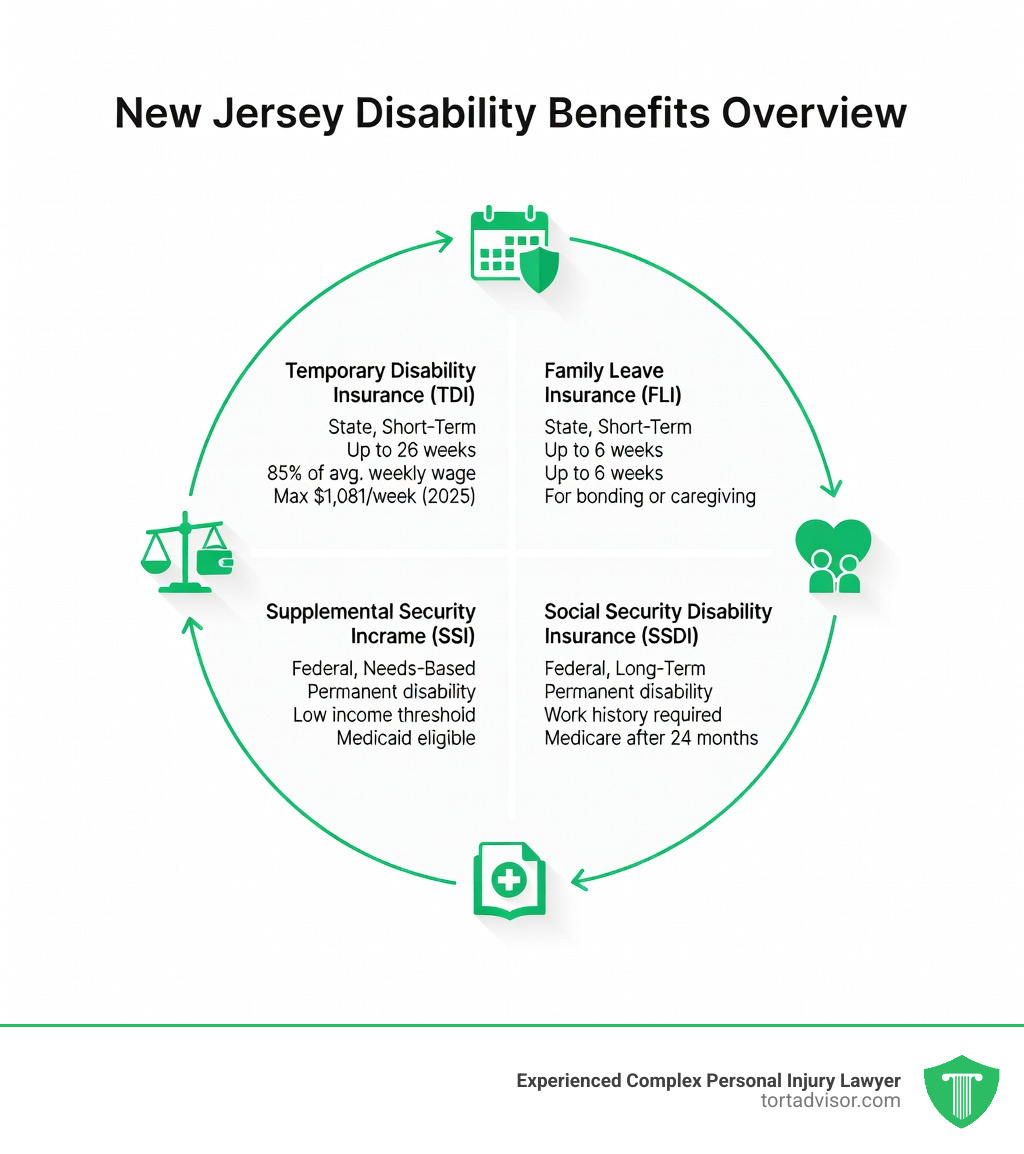
New Jersey disability benefits include several programs that replace income when you can’t work due to illness, injury, pregnancy, or a long-term disability. Here’s a quick overview:
| Program | Type | Duration | Who It’s For |
|---|---|---|---|
| TDI (Temporary Disability Insurance) | State, short-term | Up to 26 weeks | Workers with non-work injuries, illness, or pregnancy |
| FLI (Family Leave Insurance) | State, short-term | Up to 6 weeks | Bonding with a new child or caring for a sick family member |
| SSDI (Social Security Disability Insurance) | Federal, long-term | Ongoing | Workers with a permanent disability and work history |
| SSI (Supplemental Security Income) | Federal, needs-based | Ongoing | Low-income individuals with a permanent disability |
The right program for you depends on how long you’ll be unable to work and whether your disability is permanent.
New Jersey workers facing a short-term setback — like surgery, a broken bone, or childbirth — typically turn to the state’s TDI program. Those with a permanent condition that prevents any meaningful work may qualify for federal SSDI or SSI benefits, which are processed locally by New Jersey’s Division of Disability Determination Services.
Understanding which program fits your situation can mean the difference between getting the financial support you need — or missing out entirely.
I’m Mason Arnao, and through my work in internet marketing, SEO, and lead generation, I’ve helped thousands of people find clear, actionable information about New Jersey disability benefits and connect with the right legal resources. In this guide, I’ll break down every program, eligibility rule, and application step so you know exactly where you stand.
Important New Jersey disability benefits terms:
Understanding New Jersey Disability Benefits

Navigating the web of state and federal programs can feel like trying to solve a puzzle while you’re already feeling under the weather. In New Jersey, we are fortunate to have one of the most robust state-level disability systems in the country. While most states only offer federal programs, New Jersey provides a safety net for short-term needs as well.
The four pillars of support are Temporary Disability Insurance (TDI), Family Leave Insurance (FLI), Social Security Disability Insurance (SSDI), and Supplemental Security Income (SSI). Each serves a distinct purpose. For instance, if you have a scheduled surgery and need eight weeks to recover, TDI is your go-to. If you are caring for a dying parent or bonding with a newborn, FLI steps in. However, if a tragic accident or a chronic illness like advanced cancer leaves you unable to work for a year or more, you’ll need to look toward federal programs.
To help you visualize the differences, we’ve put together this Disability Benefits Complete Guide and the comparison table below:
| Feature | TDI | FLI | SSDI | SSI |
|---|---|---|---|---|
| Governing Body | NJ State | NJ State | Federal (SSA) | Federal (SSA) |
| Duration | Up to 26 Weeks | Up to 6 Weeks | Long-term/Permanent | Long-term/Permanent |
| Work History | Required (NJ) | Required (NJ) | Required (Social Security) | Not Required |
| Financial Need | Not based on assets | Not based on assets | Not based on assets | Strictly needs-based |
Eligibility for New Jersey Disability Benefits
To qualify for Temporary Disability Insurance benefits, your condition must be “non-work-related.” This is a crucial distinction. If you slip and fall at the grocery store or develop a mental health condition that requires intensive treatment, you are likely eligible. However, if you hurt your back lifting a box at your warehouse job, that falls under Workers’ Compensation, not TDI.
Eligibility generally covers:
- Physical Illness or Injury: Broken bones, cancer treatments, or recovery from major surgery.
- Mental Health: Severe depression, anxiety, or PTSD that prevents you from performing your job duties.
- Pregnancy: This includes both the period before birth (if medically necessary) and the recovery period afterward.
Short-Term State Programs vs. Long-Term Federal Support
The biggest “fork in the road” is the duration of your disability. New Jersey’s state-level TDI is strictly a short-term solution, capping out at 26 weeks (about six months). If your medical team expects your condition to last at least 12 consecutive months or result in death, you should begin the application for federal SSDI immediately.
Federal SSDI has a much stricter definition of disability. While TDI just requires you to be unable to perform your specific job, SSDI requires you to be unable to perform any substantial gainful activity. This transition from state to federal support is a common point of confusion, but understanding the 26-week limit is the first step in planning your long-term financial security. For more on the federal side, check out our Social Security Disability Insurance Complete Guide.
New Jersey Temporary Disability (TDI) and Family Leave (FLI)
New Jersey’s Division of Temporary Disability and Family Leave Insurance manages the programs that help families stay afloat during life’s biggest transitions. For many of us, this is most relevant during the birth of a child or when a family member falls seriously ill.
The state’s programs are designed to be generous, offering an 85% wage replacement rate for eligible workers. This is significantly higher than many private insurance plans. To start the process, you’ll need to have your healthcare provider complete a specific portion of the Disability Claim form.
Maternity and Bonding Leave Coverage
One of the most frequent uses of New Jersey disability benefits is maternity leave. Typically, a pregnant worker can receive TDI benefits for four weeks before the expected due date and six to eight weeks after delivery (depending on whether it was a vaginal birth or a C-section).
Once the “disability” portion (the recovery from childbirth) ends, the parent can often transition directly into Family Leave Insurance (FLI) for bonding. FLI provides up to 6 weeks (42 days) of benefits. A major perk in New Jersey is that if you transition immediately from TDI to FLI, the usual one-week waiting period for FLI is waived. You can learn more about the filing process in our Disability Benefits Application guide.
Job Protections and Employee Rights
It is a common fear: “If I take disability leave, will my job be there when I get back?” It’s important to understand that TDI and FLI provide money, but they don’t necessarily provide job protection.
Job protection usually comes from different laws, such as:
- The Federal Family and Medical Leave Act (FMLA)
- The New Jersey Family Leave Act (NJFLA)
These laws ensure you can return to your position (or an equivalent one) and protect you from retaliation. We highly recommend using the state’s Job Protection Coverage Checker to see which specific protections apply to your employment situation.
Federal Disability Programs: SSDI and SSI in New Jersey
When a disability becomes permanent, the focus shifts from Trenton to Washington D.C. (though the medical decisions are still made right here in the Garden State).
SSDI is essentially an insurance policy you’ve paid into through your payroll taxes. To qualify, you must have earned enough “work credits” based on your age and work history. SSI, on the other hand, is a safety net for those who haven’t worked enough to qualify for SSDI or have very limited income and resources. Both programs are governed by strict SSDI Eligibility Rules.
SSDI Qualifications and Work History
The Social Security Administration (SSA) uses a “Blue Book” of medical listings to determine if a condition is severe enough to qualify. For example, we have a SSDI for Cancer Complete Guide that explains the specific criteria for oncological claims.
Beyond the medical diagnosis, you must prove that you cannot engage in “Substantial Gainful Activity” (SGA). In 2025, this generally means you cannot earn more than a specific monthly threshold (around $1,620 for non-blind individuals).
The Role of the Division of Disability Determination Services
While the SSA is a federal agency, they don’t actually make the medical decisions for New Jersey residents. That task falls to the New Jersey Division of Disability Determination Services.
This state agency employs doctors and disability examiners who review your medical records, functional reports, and vocational history. They are the ones who decide if your condition meets the federal definition of “permanent.” This state-federal partnership is why you might see New Jersey state letterhead on a letter regarding your federal benefits.
Calculating Your New Jersey Disability Benefits: 2025-2026 Rates
How much will you actually receive? The math can be a bit tricky, but it’s based on your “base year” earnings. Your base year is generally the first four of the last five completed quarters before you filed your claim.
To get an estimate for federal benefits, you can use our SSDI Benefit Calculator, but for state TDI and FLI, the rates are updated annually by the New Jersey Department of Labor.
2025 and 2026 Benefit Rate Adjustments
New Jersey adjusts its rates every year to keep up with inflation and average wage growth. Here are the critical numbers you need to know for the upcoming years:
| Year | Max Weekly Benefit | Base Week Earnings |
|---|---|---|
| 2025 | $1,081 | $303 |
| 2026 | $1,119 | $310 |
A “base week” is any week where you earned at least the amount listed above. To qualify for benefits, you generally need 20 base weeks in your base year or have earned a total of $15,200 (for 2025) during that period. You can find more technical base week definitions on the official state portal.
Maximizing Your New Jersey Disability Benefits
Don’t leave money on the table! Many claimants don’t realize they may be eligible for a dependency allowance.
- You can receive an additional 7% of your basic weekly benefit for your first dependent.
- You can receive 4% for each of the next two dependents.
- This is capped at a maximum of three dependents.
However, be aware of the “80% cap.” If you are receiving Workers’ Compensation and SSDI at the same time, your combined benefits cannot exceed 80% of your average current earnings before you became disabled. If they do, your SSDI payment will be reduced (offset). For tax implications on these payments, see our Disability Benefits Tax Guide 2025.
Navigating the Application and Appeals Process
Applying for New Jersey disability benefits has moved almost entirely online. The state now uses ID.me for identity verification, which is a secure way to ensure your benefits aren’t stolen by fraudsters.
Once you apply, you can Check your claim status through the New Jersey Department of Labor portal. For federal claims, the process is notoriously slow, so we recommend following our SSDI Application Tips to avoid common mistakes that lead to delays.
Concurrent Benefits and Program Interactions
Can you “double dip”? Sometimes.
- SSDI and SSI: You can receive both (known as concurrent benefits) if your SSDI payment is very low.
- TDI and Unemployment: You cannot receive both for the same week. However, if you become disabled while you are unemployed, you may qualify for “Disability During Unemployment” (DDU).
- Workers’ Comp: As mentioned, this will usually reduce your SSDI but can be received alongside it.
To keep track of your federal history and payments, we always suggest opening a mySocial Security account.
How to Handle a Denied Disability Claim
Getting a denial letter is heartbreaking, but it is not the end of the road. In fact, the majority of initial SSDI claims are denied.
The appeal steps are:
- Reconsideration: A new examiner reviews your file. (See our guide on SSDI Reconsideration Appeal).
- Administrative Law Judge (ALJ) Hearing: This is your best chance for success, as you can present your case in person.
- Appeals Council: A review of the judge’s decision.
- Federal Court: The final level of appeal.
For state private plans (like those through Prudential or Guardian), you typically have a 180-day window to file a written appeal. If you’ve been turned down, don’t give up—visit our Denied Disability Claim resource to learn your next steps.
Frequently Asked Questions about New Jersey Disability Benefits
Can I receive TDI and Workers’ Compensation at the same time?
No. Temporary Disability Insurance is specifically for non-work-related injuries. If your injury happened on the job, you must file for Workers’ Compensation. If you are denied Workers’ Comp, you may then be able to apply for TDI while you appeal that decision.
How long do New Jersey TDI benefits last?
TDI benefits last for a maximum of 26 weeks (six months) for any one period of disability. If you are still unable to work after 26 weeks, you should look into long-term options like SSDI or private long-term disability insurance.
What is the difference between SSDI and SSI in New Jersey?
SSDI is for workers who have a sufficient work history and have paid into the Social Security system. SSI is a needs-based program for people with limited income and resources, regardless of their work history. In New Jersey, SSI recipients are also typically eligible for Medicaid.
Conclusion
At Tort Advisor, we know that a disability doesn’t just affect your health—it threatens your home, your family, and your peace of mind. Whether you are navigating a complex TDI claim or facing a multi-year battle for SSDI, you don’t have to do it alone.
We connect clients with top-rated specialty attorneys who have proven results in handling SSDI Lawsuits and complex disability appeals. Our mission is to ensure you get the maximum benefits you are entitled to under the law. If you’re struggling with a claim in New Jersey, reach out to us—we are here to help you secure the future you deserve.
Free Confidential Case Evaluation
Complete the short form below to get an immediate FREE case review with an expert in your specific claim. Don't wait, your case could be time sensitive to file a claim.
Related Posts

Discover New Jersey disability benefits: TDI, FLI, SSDI, SSI rates, eligibility, applications & appeals for 2025-2026.

Hire a Depo-Provera lawsuit attorney now. Fight Pfizer for meningioma risks from injections. Free consult, MDL updates & settlements up to $1.5M.

Find top Miami florida car accident lawyers after your 305 crash. Get max compensation, navigate no-fault laws & choose the best experts now!
Diagnosed with cancer after Roundup? Learn about the monsanto roundup lawsuits, eligibility criteria, and how to pursue your claim.
Discover how do you qualify for a hair relaxer lawsuit: criteria, diagnoses, evidence & brands in uterine cancer MDL. Claim review now!
Find the best uber sexual assault lawsuit lawyer: expert guides, MDL experience, proven results & nationwide firms for justice.