Short answer: This article explains the key facts, eligibility issues, settlement factors, deadlines, and source-backed updates related to this legal topic. Results vary by case facts, evidence, jurisdiction, and representation.
📋 Table of Contents
- What You Need to Know Before Filing a Chemical Hair Relaxer Lawsuit
- Understanding the Scientific Link Between Relaxers and Cancer
- How Do You Qualify for a Hair Relaxer Lawsuit?
- Brands and Manufacturers Named in the Litigation
- Essential Evidence and the Legal Timeline
- Frequently Asked Questions about Hair Relaxer Eligibility
- Conclusion
What You Need to Know Before Filing a Chemical Hair Relaxer Lawsuit
How do you qualify for a hair relaxer lawsuit? Here is a quick answer:
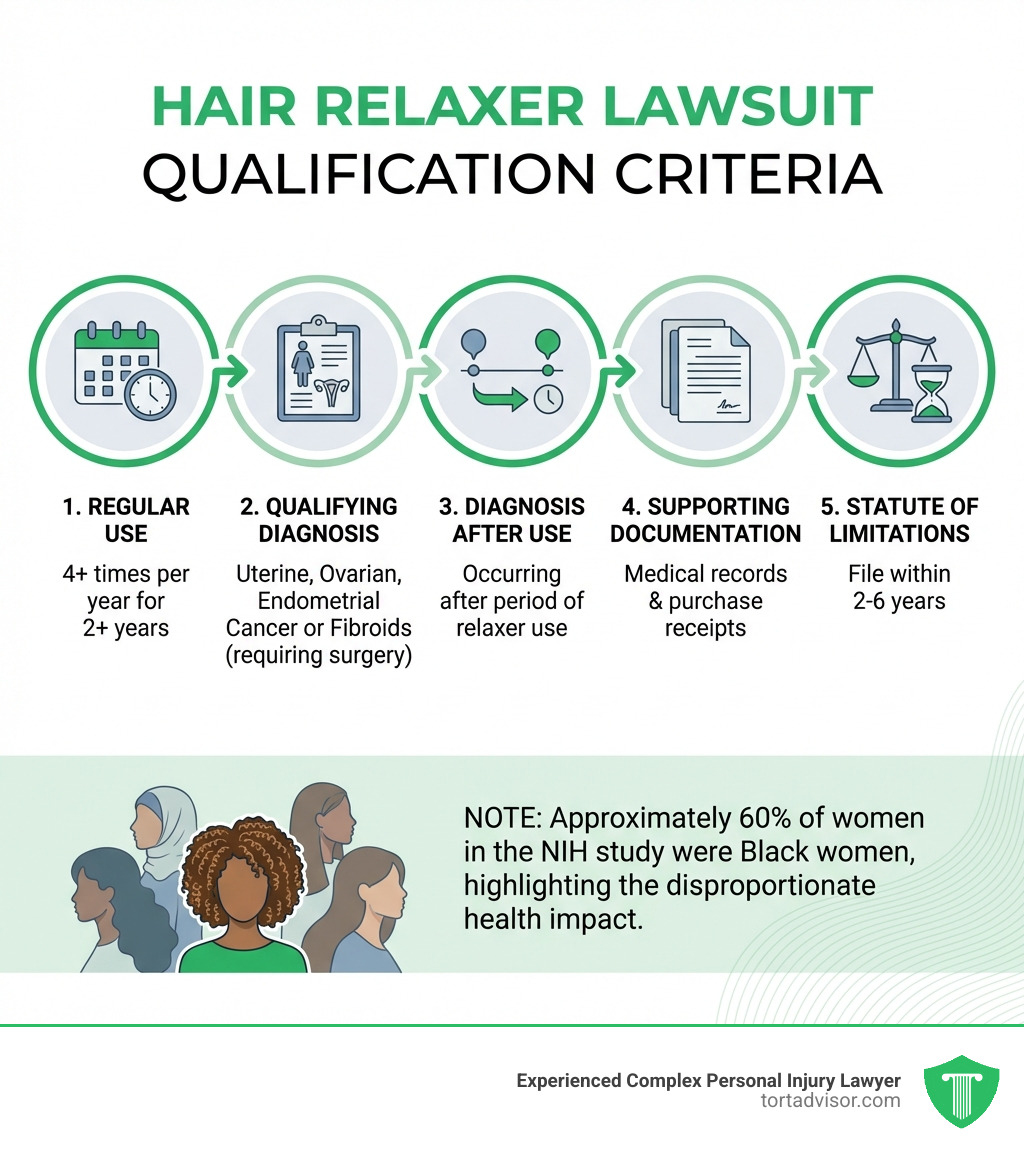
To qualify, you generally need to meet all of the following criteria:
- Used chemical hair relaxers regularly – at least 4 times per year for 2 or more years
- Were diagnosed with a qualifying condition – uterine cancer, ovarian cancer, endometrial cancer, or uterine fibroids requiring surgery
- Your diagnosis came after your relaxer use – the product use must predate the health condition
- Have supporting evidence – medical records, purchase receipts, photos, or stylist testimony
- Are within your state’s statute of limitations – typically 2-6 years from diagnosis or discovery of the link
Hair relaxers have been a staple in many households for decades. But mounting scientific evidence now links the chemicals in these products to serious reproductive cancers – and thousands of women are fighting back in court.
The numbers are striking. According to a major NIH study, women who used chemical hair relaxers four or more times per year had a 2.4 times greater risk of developing uterine cancer compared to non-users. The same research found a 50% increased risk of ovarian cancer in frequent users. As of early 2026, over 11,000 cases are pending in the federal Hair Relaxer Multidistrict Litigation (MDL 3060).
If you or someone you love used these products and later received a cancer diagnosis, you may have a legal claim – but the eligibility rules matter. Not every person who used a relaxer qualifies, and not every diagnosis is covered.
I’m Mason Arnao, a digital marketing and lead generation expert who has worked extensively in the legal industry, including research on complex mass tort cases like how do you qualify for a hair relaxer lawsuit. Let’s walk through exactly what the courts are looking for so you can make an informed decision about your next step.
Understanding the Scientific Link Between Relaxers and Cancer
To understand how do you qualify for a hair relaxer lawsuit, we first have to look at the “why.” Why are these products suddenly under such intense legal scrutiny? The answer lies in the cocktail of chemicals used to break down the natural structure of hair to make it straight.
Many popular relaxers contain substances known as Endocrine Disrupting Chemicals (EDCs). These include phthalates (specifically DEHP), parabens, and formaldehyde-releasing agents. These aren’t just “strong chemicals”; they are biological mimickers. Because they are similar in structure to human hormones like estrogen, they can interfere with the body’s endocrine system.
When these chemicals are applied to the scalp, they don’t just sit on the hair. The scalp is highly vascular, and many users experience “relaxer burns” or small lesions during application. These tiny breaks in the skin provide a direct highway for EDCs to enter the bloodstream. Once inside, they can promote the growth of hormone-sensitive cancer cells in the uterus and ovaries.
The landmark study that changed everything was the Sister Study, published by the National Institute of Environmental Health Sciences (NIEHS). This study followed over 33,000 women for more than a decade. The results were sobering: women who never used straighteners had a 1.64% chance of developing uterine cancer by age 70, but for frequent users, that risk jumped to 4.05%.
Furthermore, research into endocrine-disrupting chemicals in hair products used by Black women has highlighted a significant environmental injustice. Approximately 60% of the women in the NIH study who reported using straighteners were Black. For generations, marketing reinforced Euro-centric beauty standards, leading many Black women to use these toxic products from a very young age, often beginning in childhood.
For more detailed information, you can read our comprehensive guide on hair relaxer health risks.
How Do You Qualify for a Hair Relaxer Lawsuit?
If you are wondering how do you qualify for a hair relaxer lawsuit, it helps to think of the process as a checklist. Legal teams and the courts look for specific “markers” that prove a connection between the product and the injury.
Simply having used a relaxer and later becoming ill isn’t always enough to win a case. We must demonstrate that the exposure was significant enough to cause the harm and that the harm itself is a recognized condition linked to these specific chemicals.

Generally, there are four pillars of eligibility:
- Exposure: You must have used chemical relaxers (either at home or in a salon).
- Duration: You must have used them frequently over a period of years.
- Injury: You must have a diagnosis of a hormone-sensitive reproductive condition.
- Timing: There must be a clear timeline showing the use occurred before the diagnosis.
To help you visualize the requirements, we’ve put together a comparison of qualifying conditions and the evidence typically required:
| Condition | Required Evidence | Key Qualification Factor |
|---|---|---|
| Uterine Cancer | Pathology reports, oncology records | Most common qualifying diagnosis in MDL 3060 |
| Ovarian Cancer | Surgical records, biopsy results | Linked to a 50% increased risk in frequent users |
| Endometrial Cancer | Diagnostic imaging, medical history | Must be primary cancer, not a secondary spread |
| Uterine Fibroids | Surgical records (Hysterectomy/Myomectomy) | Usually requires surgical intervention to qualify |
If you meet these general criteria, you can calculate your potential settlement value using our online tool to see what your claim might be worth.
Frequency and Duration of Use: How Do You Qualify for a Hair Relaxer Lawsuit?
One of the most common questions we hear is: “I only used a relaxer once for a wedding—can I sue?” Unfortunately, the answer is usually no. The current litigation focuses on chronic exposure.
To meet the threshold for most law firms and the federal MDL, you generally need to show:
- Frequent Use: Using the product at least four times per year. This matches the “frequent user” definition used in the NIH study.
- Long-term Duration: Most successful claims involve at least two to five years of regular use. Many plaintiffs in these cases used relaxers for decades, starting as early as age 10.
- Cumulative Load: The legal theory is that the “cumulative chemical load”—the buildup of EDCs in your system over time—is what triggers the cellular changes leading to cancer.
Whether you applied the relaxer yourself using a “box kit” from a drugstore or had a professional stylist apply it in a salon does not change your eligibility. However, if you were a professional hairstylist who applied these products to clients daily for years, your exposure levels might be considered even higher, potentially strengthening your claim.
Qualifying Diagnoses: How Do You Qualify for a Hair Relaxer Lawsuit?
The “injury” part of the equation is specific. Currently, the lawsuits are primarily focused on hormone-sensitive cancers and conditions.
1. Uterine Cancer (including Endometrial Cancer)
This is the strongest link found in scientific literature. There are two main types: endometrial (which is more common and treatable) and uterine sarcoma (which is rarer and more aggressive). Both qualify. If you are unsure of your symptoms, you can review the signs and symptoms of endometrial cancer provided by the American Cancer Society.
2. Ovarian Cancer
Research has shown that frequent relaxer use is associated with a significantly higher risk of ovarian cancer. You can explore the research on hair products and ovarian cancer risk to see how the two are connected.
3. Uterine Fibroids
While fibroids are non-cancerous, they can be incredibly painful and life-altering. However, because fibroids are so common, most lawsuits only accept these cases if the fibroids resulted in a major surgical intervention, such as a hysterectomy (removal of the uterus) or a myomectomy (removal of the fibroids). The loss of fertility is a significant “damage” that the courts recognize.
Brands and Manufacturers Named in the Litigation
When you ask how do you qualify for a hair relaxer lawsuit, you also need to identify the “defendant”—the company responsible for the product. You don’t necessarily need to have used just one brand. Many women switched brands over the years, and that is perfectly fine for your claim.
The major manufacturers currently facing lawsuits include:
- L’Oréal: The world’s largest cosmetic company is a primary target, specifically for its Dark & Lovely and SoftSheen-Carson lines.
- Strength of Nature: This company produces brands like Motions, Just for Me, African Pride, and Soft & Beautiful.
- Namaste Laboratories: Known for the popular ORS Olive Oil (formerly Organic Root Stimulator) hair relaxer.
- Revlon: While Revlon has faced financial restructuring, claims against their products are still being processed through specific legal channels.
If you used Dark & Lovely specifically, it is important to stay informed on how that specific litigation is progressing as the MDL moves forward.
It is important to note that these lawsuits allege these companies knew or should have known about the risks of the chemicals in their products but failed to warn consumers. Instead, they continued to market these products as “safe,” “natural,” or “gentle,” even when targeting them toward young children.
Essential Evidence and the Legal Timeline
Proving your case requires more than just your word. Because these cases are part of a massive federal consolidation (MDL 3060) in the Northern District of Illinois, there are strict rules for what evidence must be submitted.
To support your claim, we recommend gathering as much of the following as possible:
- Medical Records: This is the most critical piece. You need records that show your diagnosis, the date it was made, and the treatment you received (surgery, chemotherapy, etc.).
- Proof of Use: This can be tricky if you used these products years ago. However, you can use purchase receipts, credit card statements, salon invoices, or even photos and videos of you using the product or having it applied.
- Witness Testimony: Statements from family members or your longtime hair stylist can help establish a “pattern of use” over several years.
- Product Containers: If you happen to have an old box or bottle of the relaxer you used, keep it! It can be used to identify specific batches or chemical formulations.
The Statute of Limitations
This is the “expiration date” for your right to sue. It varies significantly by state—ranging from 1 year in Tennessee to 6 years in other areas. However, most states follow the “Discovery Rule.” This means the clock usually doesn’t start ticking until the day you discovered (or should have discovered) that your cancer was linked to the hair relaxer.
Since the major NIH study wasn’t published until October 2022, many women are still well within their window to file. However, you should not wait. The sooner you start, the easier it is to collect evidence. For the very latest on the litigation, see the updates on the hair relaxer class action.
Frequently Asked Questions about Hair Relaxer Eligibility
What is the statute of limitations for filing a claim?
As mentioned, the deadline depends on where you live. For example, in Georgia, there has been a significant legal battle over the “statute of repose,” which is a strict 10-year limit from the date of first use. However, in most of our locations—from Florida to New York to California—the focus is on the date of your diagnosis and when you learned of the toxic link. You can check the statutes of limitations for your specific state to find your deadline.
Can I qualify if I used “no-lye” hair relaxers?
Yes! This is a common misconception. Many women switched to “no-lye” relaxers because they were marketed as “gentler” on the scalp. While they may cause fewer immediate skin burns, they still contain the same endocrine-disrupting chemicals (phthalates and parabens) that are linked to cancer. In fact, some studies suggest that no-lye relaxers may actually have higher concentrations of certain harmful chemicals to compensate for the lack of lye.
Do uterine fibroids qualify for a settlement?
They can, but the criteria are stricter. Because so many women develop fibroids naturally, a lawsuit must prove that the relaxer use made the condition significantly worse. This is usually demonstrated by the need for a hysterectomy or a myomectomy. If your fibroids were managed with medication alone, you might not qualify for the current MDL, but it is always worth having an attorney review your specific medical history.
Conclusion
The journey toward justice for those harmed by chemical hair relaxers is well underway. For too long, major cosmetic corporations ignored the health of women—disproportionately Black women—in favor of profit.
At Tort Advisor, we believe that every woman deserves to know the truth about the products she puts on her body. If you’ve read this guide and believe you meet the criteria, the next step is to speak with a professional who can handle the heavy lifting of a legal claim. We connect clients with top-rated specialty attorneys who have the resources to take on giant corporations like L’Oréal and Revlon.
Our network of attorneys operates on a contingency fee basis, which means there are no upfront costs to you. They only get paid if they win your case. You’ve already been through enough; the legal process shouldn’t add to your stress.
Don’t let the clock run out on your rights. Start your hair relaxer claim review today and take the first step toward the compensation and closure you deserve. We are here to help you turn your “Straight Talk” into real action.
Related Posts

Get expert help from Mesa Arizona car accident lawyers to protect your rights and maximize your settlement after a crash.

Find top accident lawyers in Miami FL for max compensation after crashes. Expert guidance on claims, settlements & Miami laws. Call now!

Quick Answer: The talcum powder lawsuit update for 2026 centers on Johnson & Johnson's proposed $6.48 billion bankruptcy settlement fund [...]