
Short answer: This article explains the key facts, eligibility issues, settlement factors, deadlines, and source-backed updates related to this legal topic. Results vary by case facts, evidence, jurisdiction, and representation.
How Hormone Therapy for Breast Cancer Works — And Why It Matters
Hormone therapy breast cancer treatment is one of the most effective tools doctors have for slowing or stopping the growth of tumors that are fueled by estrogen or progesterone.
Here is a quick overview for anyone who wants the key facts fast:
| Question | Quick Answer |
|---|---|
| What is it? | Treatment that blocks or reduces hormones that feed certain breast cancers |
| Who needs it? | People with hormone receptor-positive (HR+) breast cancer — about 80% of cases |
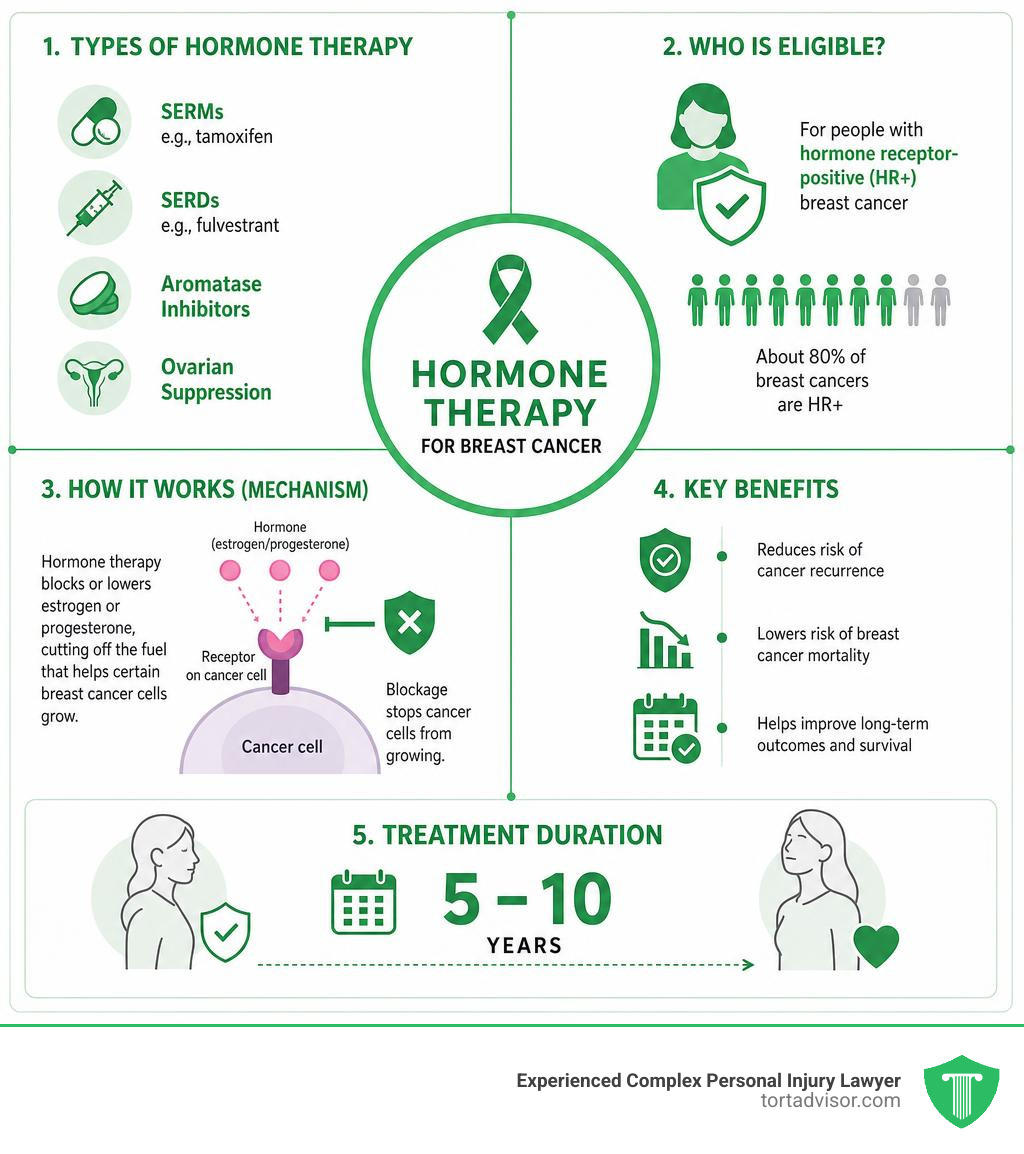
| Main types | SERMs (e.g., tamoxifen), SERDs (e.g., fulvestrant), aromatase inhibitors, ovarian suppression |
| How long? | Typically 5 to 10 years |
| How effective? | Significantly reduces recurrence risk and breast cancer mortality |
About 2 out of 3 breast cancers are hormone receptor-positive. That means estrogen or progesterone is actively helping those cancer cells grow. Hormone therapy — also called endocrine therapy — works by cutting off that fuel supply.
This guide covers everything you need to know: how it works, who qualifies, what the side effects are, and what the latest treatments look like.
I’m Mason Arnao, and while my background is in technology, data systems, and digital marketing, I’ve spent years researching complex medical and legal topics — including hormone therapy breast cancer — to help people navigate overwhelming situations with clarity. This guide is designed to give you straightforward, reliable information so you can ask better questions and make more confident decisions.
Related content about hormone therapy breast cancer:
Understanding Hormone Therapy Breast Cancer Treatment and Eligibility
To understand how hormone therapy breast cancer treatment works, we have to look closely at tumor biology. Unlike systemic chemotherapy, which broadly targets rapidly dividing cells, hormone therapy is a form of targeted treatment. It specifically focuses on the relationship between hormones and cancer cells.
In a healthy body, hormones like estrogen and progesterone regulate normal breast development. However, in about 80% of breast cancer cases, the cancer cells contain special proteins called hormone receptors. These receptors act like tiny antennas, catching circulating estrogen and progesterone and using them as fuel to grow and multiply. By blocking these receptors or lowering the body’s overall hormone production, we can effectively starve the tumor cells.
For a detailed breakdown of how these mechanisms interact with your body, you can read the comprehensive resources provided by the Hormone Therapy | Breast Cancer Treatment – NCI.
Who is Eligible for Hormone Therapy Breast Cancer Treatment?
Not everyone diagnosed with breast cancer is a candidate for endocrine therapy. Eligibility depends entirely on receptor testing performed on a tissue sample from a biopsy or surgery:
- Hormone Receptor-Positive (HR+): If at least 1% of the analyzed cancer cells show receptors for estrogen (ER-positive) or progesterone (PR-positive), the tumor is classified as hormone receptor-positive. These are the patients who will benefit from hormone therapy.
- Hormone Receptor-Negative (HR-): If the cancer cells lack these receptors, hormone therapy will not be effective, and other treatment options like chemotherapy, immunotherapy, or targeted therapies will be prioritized.
Additionally, oncologists look at the tumor’s HER2 status. Whether a tumor is HER2-positive or HER2-negative helps shape whether hormone therapy should be combined with other targeted drugs. To learn more about how pathology results guide your care plan, consult the Hormone Therapy for Breast Cancer | Breast Cancer Treatment | American Cancer Society.
Main Types of Endocrine Therapy and Their Mechanisms
Oncologists have several ways to cut off the estrogen supply to breast cancer cells. The right approach depends on whether you have gone through menopause.
Below is a comparison of the primary drug classes used in hormone therapy breast cancer regimens:
| Drug Class | Common Examples | Primary Mechanism | Best Suited For |
|---|---|---|---|
| SERMs | Tamoxifen, Toremifene | Blocks estrogen from attaching to cancer cells | Premenopausal & Postmenopausal |
| SERDs | Fulvestrant, Elacestrant | Degrades and destroys estrogen receptors | Postmenopausal (or with ovarian suppression) |
| Aromatase Inhibitors | Letrozole, Anastrozole, Exemestane | Stops estrogen production in fat and muscle tissues | Postmenopausal |
| Ovarian Suppression | Goserelin, Leuprolide | Shuts down estrogen production in the ovaries | Premenopausal |
SERMs vs. SERDs in Hormone Therapy Breast Cancer Care
While Selective Estrogen Receptor Modulators (SERMs) and Selective Estrogen Receptor Degraders (SERDs) both target estrogen receptors, they do so in fundamentally different ways.
- SERMs (e.g., Tamoxifen): These drugs sit in the estrogen receptors of breast cancer cells, physically blocking estrogen from binding. Interestingly, SERMs are selective; while they block estrogen in the breast, they act like estrogen in other parts of the body, such as the bones (helping to maintain bone density).
- SERDs (e.g., Fulvestrant): These agents bind to the estrogen receptor much more tightly than SERMs. Instead of just blocking the receptor, they cause the receptor to break down and degrade entirely. This leaves the cancer cell with fewer “antennas” to receive growth signals.
For a deeper dive into the molecular pathways and therapeutic tuning of these options, refer to the academic review on Current Endocrine Therapy in Hormone-Receptor-Positive Breast Cancer: From Tumor Biology to the Rationale for Therapeutic Tunning.
Aromatase Inhibitors and Ovarian Suppression
Before menopause, the ovaries are the body’s primary source of estrogen. After menopause, the ovaries stop making estrogen, but the body still produces small amounts by converting other hormones (androgens) into estrogen. This conversion is performed by an enzyme called aromatase, which lives in fat and muscle tissue.
- Aromatase Inhibitors (AIs): Drugs like letrozole, anastrozole, and exemestane block the aromatase enzyme, dropping postmenopausal estrogen levels to near zero. Because AIs cannot stop the ovaries from making estrogen, they are only used in postmenopausal women.
- Ovarian Suppression: For premenopausal women with a higher risk of recurrence, doctors may combine an AI with a GnRH agonist (like goserelin or leuprolide) to put the ovaries to sleep. This induces a temporary, reversible chemical menopause, allowing premenopausal patients to safely benefit from AIs.
You can learn more about managing ovarian suppression and its clinical expectations from the Hormone therapy for breast cancer – Mayo Clinic.
Clinical Applications: Adjuvant, Neoadjuvant, and Metastatic Settings
Hormone therapy is highly versatile and is used at different stages of the breast cancer journey:

- Neoadjuvant Therapy (Before Surgery): Sometimes given to shrink large hormone-receptor-positive tumors before surgery, making them easier to remove and occasionally allowing for a lumpectomy instead of a mastectomy.
- Adjuvant Therapy (After Surgery): Taken for 5 to 10 years after surgery to destroy any microscopic cancer cells left behind, dramatically reducing the risk of recurrence.
- Metastatic Settings: For advanced breast cancer that has spread to other parts of the body, hormone therapy serves as a primary, long-term treatment to keep the disease stable and manage symptoms.
In advanced settings, oncologists frequently combine hormone therapy with targeted therapies, such as CDK4/6 inhibitors, to overcome hormone resistance. To read the official clinical guidelines on these combinations, see the Endocrine Therapy for Hormone Receptor–Positive Metastatic Breast Cancer: American Society of Clinical Oncology Guideline | Journal of Clinical Oncology.
Managing Side Effects and Drug Interactions
Because hormone therapy lowers estrogen or blocks its effects, it can trigger symptoms similar to menopause. While these side effects can be challenging, they are highly manageable.

- Hot Flashes and Night Sweats: Dressing in layers, avoiding spicy foods, and discussing non-hormonal medications (like certain antidepressants) with your doctor can help.
- Bone Thinning (Osteopenia/Osteoporosis): AIs can reduce bone density. We recommend regular DEXA scans, weight-bearing exercise, and calcium/vitamin D supplements.
- Joint and Muscle Pain: Often associated with AIs, mild exercise, acupuncture, or switching to a different AI can provide relief.
- Blood Clots and Uterine Cancer Risk: Though rare, tamoxifen carries a slight risk of blood clots and uterine lining changes. Report any unusual vaginal bleeding or leg swelling immediately.
Frequently Asked Questions About Endocrine Therapy
How long is hormone therapy typically taken?
For early-stage breast cancer, the standard duration is 5 years. However, for patients with a higher risk of recurrence, extending treatment to 10 years offers superior protection. Doctors sometimes use a genomic test called the Breast Cancer Index (BCI) to help predict whether a patient will benefit from extending therapy past the 5-year mark.
What are the latest advances in hormone therapy?
The approval of oral SERDs, such as elacestrant, represents a major breakthrough for patients with ESR1 mutations—a common genetic mutation that causes tumors to become resistant to standard aromatase inhibitors. Additionally, combining hormone therapy with CDK4/6 inhibitors (like abemaciclib or ribociclib) has significantly improved progression-free survival in metastatic settings.
Can other medications interfere with my treatment?
Yes. Tamoxifen relies on a liver enzyme called CYP2D6 to convert it into its active, cancer-fighting form. Certain antidepressants (specifically strong CYP2D6 inhibitors like fluoxetine and paroxetine) can block this conversion, making tamoxifen less effective. If you need an antidepressant while taking tamoxifen, ask your doctor about alternatives like venlafaxine, citalopram, or sertraline.
Conclusion
Hormone therapy is a cornerstone of personalized medicine, offering highly effective, targeted protection against breast cancer recurrence. However, navigating complex medical treatments, potential side effects, and drug interactions requires strong self-advocacy and a dedicated care team.
At Tort Advisor, we believe in balancing the scales of justice and health. If your medical journey or hormone-sensitive condition was influenced by external factors—such as exposure to harmful chemicals in consumer products like chemical hair relaxers—you may have legal options. Tort Advisor works exclusively with top-rated, highly skilled attorneys across the United States, including in Alabama, California, Colorado, Connecticut, Delaware, Florida, Georgia, and other locations, to secure the best possible outcomes for our clients.
If you believe your health has been compromised, we encourage you to Explore legal options with Tort Advisor to see how we can assist you.
Related Posts

Discover how hormone therapy breast cancer treatment works, who qualifies, and how to manage side effects for better outcomes.
Surprise Arizona car accident lawyers help you navigate claims, maximize settlements, and protect your rights after a crash.

Discover what is SSI: eligibility, benefits, application process, SSI vs SSDI, and FAQs for low-income aged, blind, disabled.